






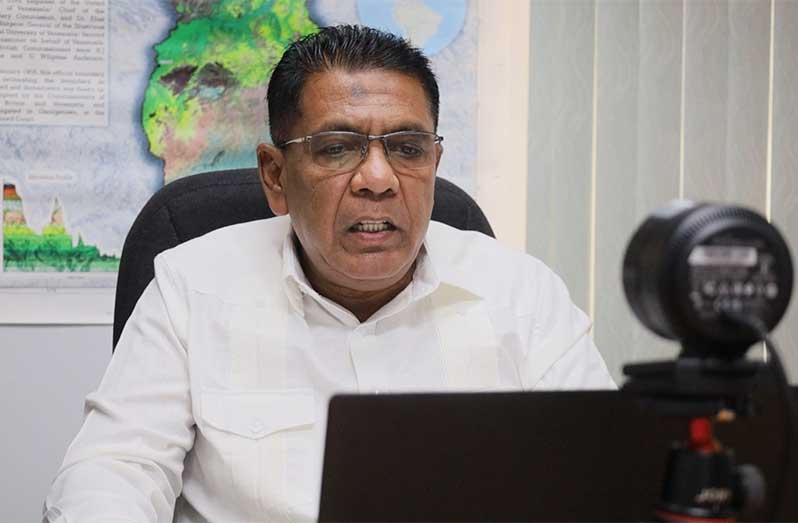
–Minister Mustapha tells FAO forum innovation, climate resilience key to closing food production gaps
GUYANA is harnessing technology and innovation at every stage of its agricultural system to close persistent food production gaps, Agriculture Minister Zulfikar Mustapha has told a high-level Food and Agriculture Organisation (FAO) of the United Nations forum.
Addressing the roundtable on agricultural productivity in the Latin America and Caribbean regions, Mustapha said, on Thursday, that Guyana’s vast natural endowment, rich soils and abundant biodiversity could only be fully realised if backed by science, data and deliberate climate-risk management.
He stressed that Guyana’s agricultural drive is “fully aligned” with the country’s Low Carbon Development Strategy (LCDS), ensuring that growth in food production is sustainable.
“This ensures that growth in the sector is climate resilient, environmentally responsible and socially inclusive. A foundation of our strategy is deliberate risk mitigation and climate resilience,” he said.
At the centre of this approach is a suite of technology-driven interventions like the state-of-the-art tissue culture laboratory at the National Agricultural Research and Extension Institute (NAREI), commissioned last year in partnership with India’s TERI, which is ramping up the production of high-quality, disease-free planting material. Output is expected to rise from around 13,000 to one million plants annually across key crops, providing a scientific base for sustained yield improvements.
Mustapha also highlighted Guyana’s move towards precision agriculture and digital monitoring. These tools, he explained, are already improving input management and efficiency, including through the introduction of nano-urea fertilisers aimed at cutting waste and boosting nutrient uptake.
“Science, technology and innovation underpin our strategy for closing the productivity gap,” he stressed.
Further, to shield farmers from increasing climate volatility, Guyana, in 2025, launched a premium pre-crop insurance scheme providing full coverage for losses caused by floods or drought for rice farmers. More than 4,200 rice farmers have already enrolled, with the programme designed to expand further.
The insurance initiative is being reinforced by heavy investment in physical and digital infrastructure. Upgraded drainage and irrigation systems, new farm-to-market roads and an expanded network of weather stations are being rolled out to protect production and improve logistics. These are complemented by a National Flood Early Warning System, which enhances forecasting capacity and helps safeguard households and agricultural assets from hydrometeorological hazards.
“Our priorities include developing resilience, crop variety, expanding protective agriculture, hydroponics and precision farming, implemented nature-based solution and our low-yield farmer rice project trains small holders in good agronomy practices,” he said, adding: “We have expanded rice risk mitigation and financing mechanisms for climate-related challenges. We have support for research and innovation in sustainable and climate smart agriculture. We have promoted digital transformation and precision agriculture throughout the region. We have strengthened youth and women’s participation in agriculture and agro-processing.”
Mustapha stressed that closing productivity gaps will not be possible without deliberate social inclusion. Guyana has set a minimum target of 35 per cent participation by youth and women in all government-backed agricultural programmes.
The Agriculture Innovation and Entrepreneurship Programme has already engaged more than 300 young people in hydroponics, aquaculture, poultry, apiculture and precision agriculture.
Meanwhile, the country’s Shade House Programme has supported the construction of over 700 new shade houses, enabling farmers many of them women and young entrepreneurs, to produce high-value crops.
He highlighted Guyana’s plans to bring on stream a development bank that will unlock financing for those who traditionally were not able to access loans at commercial banks.
Mustapha said this institution will prioritise small farmers, youth, women and vulnerable groups, offering zero-interest, zero-collateral loans alongside mentorship and technical support.
“This will prioritise small farmers, youth, women and vulnerable groups through zero-interest and zero collateral loans and mentorship support, all of which will help us to close the production productivity gap,” he said.
Looking beyond Guyana’s borders, Minister Mustapha noted that the country is committed to sharing its experience and technical expertise with its neighbours across Latin America and the Caribbean.
“Regional collaboration, knowledge sharing and technical support are essential to ensure that all countries can close the productivity gap when meeting the [Sustainable Development Goals] SDGs distinguished colleagues. Closing productivity gap requires holistic approach, innovation, risk management, climate, resilience and inclusion to go hand in hand,” he said.
This year, the 39th Session of the FAO’s Regional Conference for Latin America and the Caribbean (LARC 39) is being held in Brazil.




