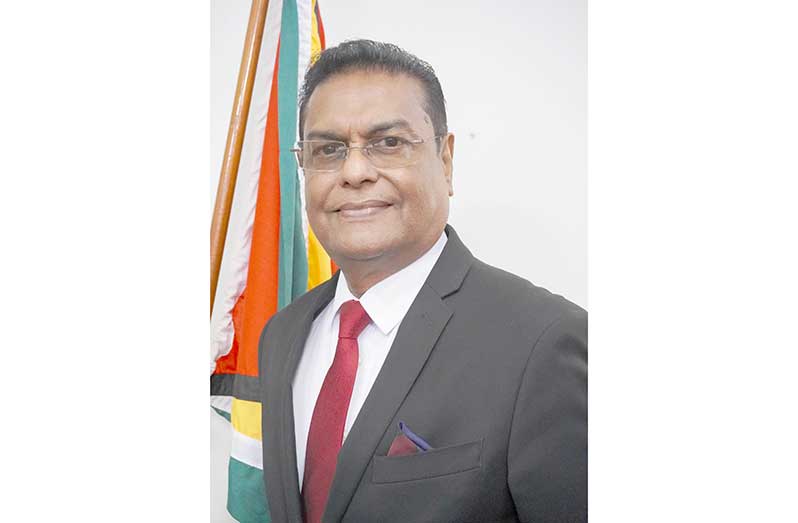
— Speaker says, outlines constitutional process amid Opposition Leader’s extradition fight
SPEAKER of the National Assembly, Manzoor Nadir, has clarified the constitutional and procedural steps that would apply should Guyana’s Opposition Leader, Azruddin Mohamed, be convicted of a criminal offence. The clarification comes as Azruddin, 39, and his 72-year-old father, Nazar Mohamed, continue to fight extradition to the United States, where they are facing serious charges, including money laundering.
In the September 2, 2025, General and Regional Elections, the We Invest in Nationhood (WIN) party, led by Azruddin Mohamed, secured the second-highest number of votes, resulting in Mohamed being elected Leader of the Opposition.
Speaking during a recent interview on The Guyana Dialogue, Nadir explained that the Constitution of Guyana leaves no room for discretion once a conviction is secured.
“If you’re convicted of a criminal offence, you can’t be in Parliament. That’s quite clear. So, we don’t have any discretion there again,” the Speaker said.
Nadir noted that the Standing Orders also provide a mechanism for the Opposition to initiate a change in leadership if necessary. “So, we don’t have any discretion there again. If for some reason the Opposition Leader is not able to attend Parliament, perform his duties, then one-third of the members of the opposition can write to the Speaker and ask that there be a new election for a Leader of the Opposition,” Nadir stated.
“So, once I get a request, then I have to proceed with holding another election.” He further explained that the process is entirely within the control of non-government members of Parliament and does not involve the executive branch.
Nadir also pointed out that even if an election for a new Opposition Leader is triggered, the rules do not automatically bar the same individual from being re-elected, unless a conviction has been recorded.
The Speaker’s comments come at a time when the Mohameds’ extradition case has drawn national attention. Nadir emphasised that the law, not political preference, must guide any action taken by the House.
The Mohameds—owners of Mohamed’s Enterprise—remain on $150,000 bail each as their extradition matter progresses. The next hearing is scheduled for March 12, 2026, before Principal Magistrate Judy Latchman at the Georgetown Magistrates’ Court.
Conditions of their bail required them to surrender their passports and report weekly to the Ruimveldt Police Station, measures intended to ensure their availability for ongoing legal proceedings.
The father and son have been hit with an 11-count indictment in the United States District Court for the Southern District of Florida. The pair face 10 counts jointly, while Azruddin is charged with an additional count related to the importation of a 2020 Lamborghini Roadster SVJ into Guyana.
Court documents alleged that Azruddin and his father conspired to commit wire fraud, mail fraud, money laundering, conspiracy, aiding and abetting and customs-related violations connected to an alleged US$50 million gold export and tax evasion scheme.
The indictment was issued by a grand jury in October 2025.
According to the filings, Nazar owns 90 per cent of Mohamed’s Enterprise, with Azruddin holding the remaining 10 per cent. The two face a maximum sentence of 20 years in prison for the most serious charge.
In June 2024, Nazar and Azruddin Mohamed, along with their business entities, were placed under sanctions by the United States Treasury’s Office of Foreign Assets Control (OFAC) over allegations of gold smuggling and large-scale corruption, including claims that more than US$50 million in taxes owed to the Guyanese state were evaded.
U.S. authorities are believed to have launched their investigation into the Mohameds in the mid-2010s, supported by intelligence sharing and law enforcement co-operation between Guyana and the United States that dates back to around 2016–2017.
The probe involved several U.S. agencies, including the Drug Enforcement Administration (DEA), the Federal Bureau of Investigation (FBI), and the Department of Homeland Security (DHS).