






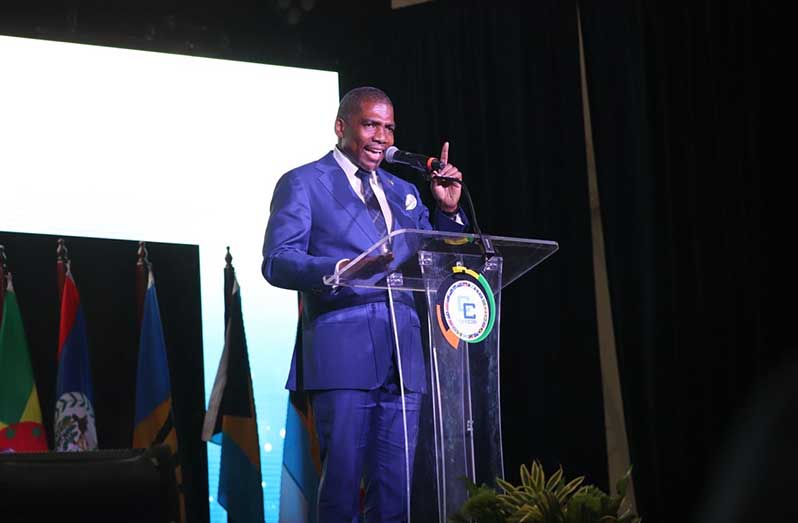
–Chairman warns fragmentation deepens vulnerability
–Secretary-General notes global shocks testing resilience
CHAIRMAN of the Caribbean Community (CARICOM) and Prime Minister of St. Kitts and Nevis Dr. Terrence Drew, has noted that the community stands at a decisive hour as mounting global shocks threaten the stability and development of small states within the region.
The Chairman made this known while delivering the feature address at the opening ceremony of the 50th Regular Meeting of the Conference of Heads of Government, held in St. Kitts.
During his address, the Prime Minister cautioned that in a rapidly shifting global order, disunity would only deepen the Caribbean’s vulnerability.
“CARICOM stands at a decisive hour,” he said, at which point he noted the many challenges plaguing the region, such as unstable supply chains, fluctuating energy markets, and intensifying climate shocks.
“In such a world, fragmentation breeds vulnerability. By contrast, togetherness generates resilience,” he said.
To this end, he indicated that despite criticism that has been levelled against the regional movement, the full attendance of CARICOM heads of government at this 50th meeting signals a renewed commitment to regionalism and further described it as an opportunity for the community to reaffirm its purpose at a time of global uncertainty.
“This Caribbean of ours might be going through challenges and difficulties,” Drew said, “but in adversity, there is opportunity.”
With this, he told leaders to ensure the meeting is remembered for action that strengthens the region’s collective capacity to withstand external shocks.
The CARICOM Chairman stressed that no single member state, regardless of size or resources, can effectively confront today’s global pressures alone. “No one is coming to save us; we must save ourselves,” he said.
As such, Dr. Drew called for disciplined coordination and measurable outcomes that advance the interests of Caribbean people.
Against this backdrop, he noted that the conference must focus on the shared challenges confronting the region, including climate change, economic volatility, security threats, and geopolitical instability.
To this end, he indicated that unity was no longer a political aspiration but a strategic necessity for survival in an increasingly unpredictable international environment.
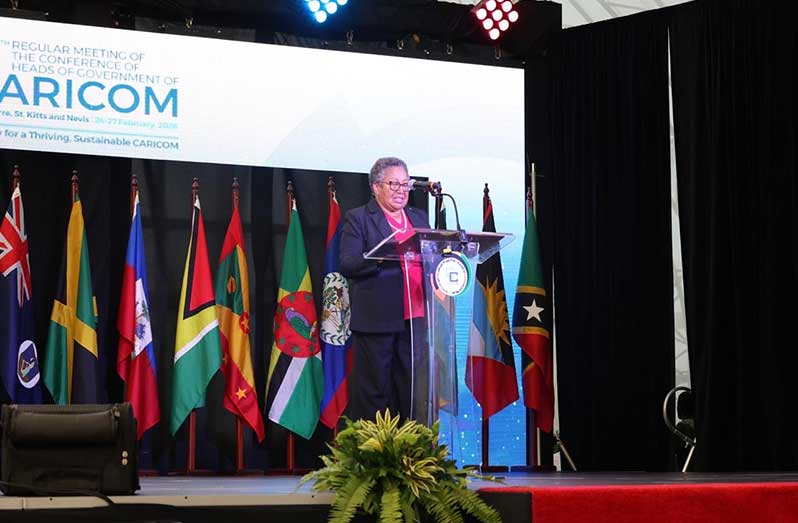
Meanwhile, CARICOM Secretary-General Dr. Carla Barnett shared similar sentiments, stating that recent years have been among the most testing in the history of the regional integration movement.
“Without question, 2025 was one of the most challenging years in the history of our regional integration movement,” Dr. Barnett said as she cited extreme weather events, geopolitical tensions, economic pressures and growing challenges to multilateralism.
She disclosed that these forces tested the region and threatened hard-won development gains in various areas.
Dr. Barnett pointed to the devastation caused by Hurricane Melissa across several Caribbean territories as a stark reminder of the region’s exposure to climate-related disasters.
However, she noted that the response demonstrated both the risks facing small states and the value of collective action, as regional institutions mobilised quickly to provide humanitarian and technical support.
“CARICOM demonstrated our characteristic resilience, the strength of our collective resolve and the value of mutual support,” she said.
Against this backdrop, Dr. Barnett said this 50th meeting of the Conference of Heads of Government carries particular significance.
“We have gathered as a family with considerable time carved out for frank and thorough discussions of priority issues,” she said, adding that the presence of all member states at the level of head of government was testament to their commitment to the region and to working together in the common interest.
The Secretary-General also stressed that unity is the region’s greatest strength, even as individual national priorities remain important. “Our collective strength is what amplifies our voice, secures opportunities for growth and mitigates risk,” she said.
Against this backdrop, she said the Secretariat remains committed to ensuring the defining outcome of the meeting is progress “beyond words to action.




