






–IDB Country Representative says, underscores importance of balancing sustainable development and conservation of forests
–highlights more than 30 women trained to operate solar farms
GUYANA is “one of the most compelling nature capitals in the world,” Country Representative of IDB in Guyana, Lorena Salazar, recently stated as she underscored the economic potential of its vast ecosystem.
During a panel discussion at the Guyana Energy Conference and Supply Chain Expo, she said the ecosystem services across the Amazon region, which includes Guyana that has more than 80 per cent of its territory covered by forests, are estimated to be worth more than USD $1 trillion per year.
Those services translate into flood regulations, carbon sequestration, water purification, coastal protections, but also the culture and economic foundation of communities and indigenous people, to name a few.
“Guyana is part of the Amazon, the relevance of the economic value of this ecosystem is immense,” she said.
Salazar had noted that preserving forests must go hand in hand with building sustainable economic infrastructure and a central example of this is Guyana’s Low Carbon Development Strategy (LCDS) 2030 and its partnership with the Government of Norway, which targets the expansion of Guyana’s renewable energy capacity through the construction of eight large-scale solar farms.
For context, in 2022, Guyana and the Inter-American Development Bank (IDB) signed a US$83.3 million agreement to advance transformative solar power projects under the Guyana Utility Scale Solar Photovoltaic Programme (GUYSOL).
Just last month, GUYSOL held a community meeting at the Watooka Lodge to engage residents, local leaders, and community representatives on the plans for the upcoming implementation of solar farms at Retrieve, Block 37, and Dakoura.
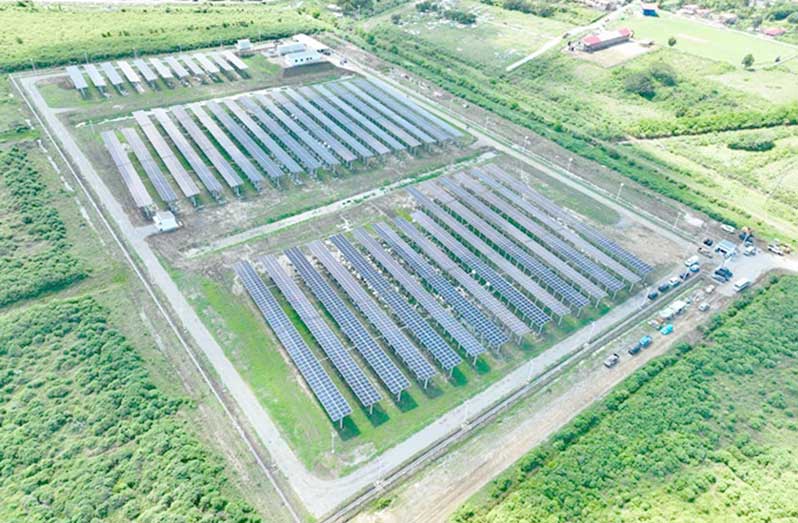
Recently, the US$8.14 million, 3 MWp Charity Solar Farm was commissioned and is set to benefit over 3,000 residents of Region Two (Pomeroon-Supenaam).
Last November, a US$10.4M solar farm was commissioned at Onderneeming. This, together with the one at Charity, is expected to offset more than 9,300 tonnes of carbon dioxide emissions annually. Investments in remote-controlled substations and real-time monitoring systems are also expected to improve grid reliability and responsiveness. The two facilities contribute 8MWp of solar capacity and 12MWh of battery storage to the regional grid.
Under the GUYSOL programme, Berbice has also benefitted from the addition of 10MWp of solar capacity through the commissioning of solar farms at Hampshire, Prospect, and Trafalgar, strengthening energy security in Regions Five and Six.
Salazar stated: “20 per cent or 25 per cent of the population when we finish this project is going to be serviced by renewable energy, but it’s not just that. That means more schools, more hospitals.”
Interestingly, as highlighted by the IDB country representative, under these projects, more than 30 women have been trained.
“Today they are part of the labour force in these solar farms. People with disabilities are already a part,” she said, adding, “So it’s all these aggregates as a result of this agreement, and the nature- how it translates into the economic infrastructure, that is, the solar and renewable energies on the other side, the IDB is also working in other countries. How does it translate? because it’s not just keeping the forest, but also the biodiversity in the nature capital itself.”




