






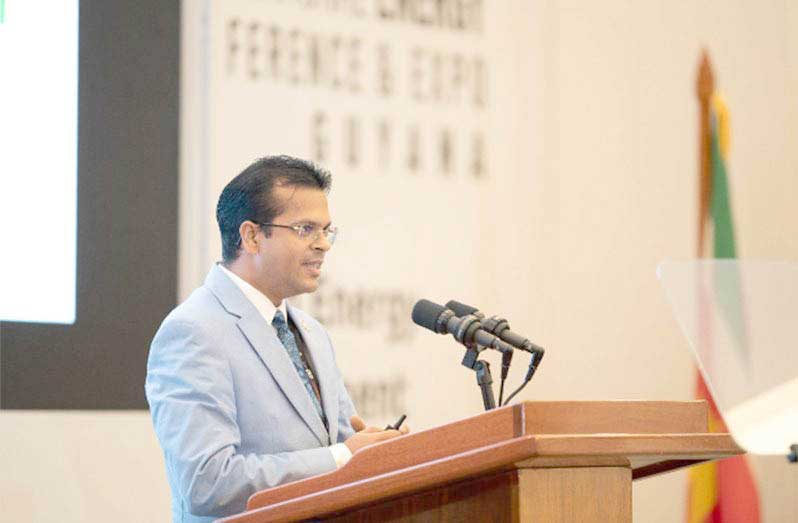
—GEA Head reports; highlights Guyana to continue expanding renewable energy push
MORE than a year after commissioning two hydropower plants in Region Nine (Upper Takutu-Upper Essequibo), the head of the Guyana Energy Agency (GEA), Dr. Mahender Sharma, is reporting significant fuel savings, noting that more than 17,000 drums of diesel were saved since they came into operation.
He made this disclosure during a panel discussion last week at the Guyana Energy Conference and Supply Chain Expo.
“Hydropower is extremely important to your energy matrix, simply because you have greater levels of hydrology, there’s a bit more predictability, the availability factors, and the plan factors are much higher than solar,” he said.
Pointing to the two hydropower plants, one 8.7 megawatts (MW) and 1.5 MW in region nine, Dr. Sharma said those have already saved more than 17,000 drums of diesel.
“They have already avoided 17,000-plus drums of diesel based on the capex, the capital investment that we made for those two hydros; the value of that fuel is 27 per cent of the capex. So hydro power is going to be an important part of our energy matrix, and we have to scale these up,” he added.
The Kumu plant was part of a dual hydropower project executed under a US$12.85m Engineering, Procurement and Construction (EPC) contract awarded in November 2022 to Vidullanka PLC of Sri Lanka. The contract included construction of the 1.5 MW Kumu station (US$9.0625m) and rehabilitation of the 0.7 MW Moco Moco station (US$3.7875m).
Upgrades to the national grid are under way, alongside the rollout of solar farms at Onderneeming, Charity, Leguan, Wakenaam, Trafalgar, Prospect, Hampshire, Bartica, Mahdia, and Lethem. Another mini-hydropower plant was completed at Kato, 46 solar mini-grids installed, and more than 37,000 solar home systems distributed, resulting in over 37 megawatts of renewable energy now powering communities.
Hydropower will play a central role in Guyana’s long-term energy strategy because it is an attractive baseload energy source.
In pursuing a diverse energy mix, the Amaila Falls Hydropower Project (AFHP) remains high on the agenda.
Just last year, the government, through the Office of the Prime Minister (OPM), issued a revised Requests for Proposals (RFPs) for development of the Amaila Falls hydro project under a Build-Own-Operate-Transfer (BOOT) model.
The project, which is expected to deliver a minimum installed capacity of 165 MW, forms a key part of Guyana’s clean-energy transition.
The hydro facility will include a dam, powerhouse, substation, and a 23-square-kilometre storage reservoir, consistent with environmental studies and permits.
Under the revised RFPs, developers were required to assume all geotechnical risks associated with the project and must demonstrate proven capability and financial capacity to deliver large-scale hydro projects.
Only firms or consortia that have successfully built at least three hydro projects of 100 MW or more in the last ten years will be considered.
The government stated that while the transmission network will be developed separately, the size of the hydro may be re-engineered to take advantage of advancements in turbine technology, potentially allowing for greater power generation.
This project will be executed through a new Special Purpose Company (SPC), which will receive all relevant licenses and permits previously issued up to April 2015. Independent supervision of the project’s design and construction will also be engaged under agreed Terms of Reference (ToR).
The deadline for submissions was February 15, 2026.
In response to the country’s energy needs, the PPP/C government had conceptualised the Amaila Falls hydropower project, which was set to produce 165 MW of power. The initiative was launched in 2009, but in 2013, it was voted down by the APNU and AFC in the National Assembly, forcing its major investor, Sithe Global Incorporated to withdraw from the initiative.
The company’s president had reportedly said that the project was too large to continue without a national consensus or without the support of all three major parties in Parliament at the time.
In fact, a Reuters article, which was published in August 2013 as well, stated that Sithe Global pulled out of the $858 million hydroelectric generation project in Guyana, “citing political wrangling that prevented it from obtaining financing.”
While the programme was shelved following the APNU+AFC taking office in 2015, the PPP/C administration, since entering office in 2020, has sought to breathe new life into the project as the party strives to achieve energy security through an energy mix.




