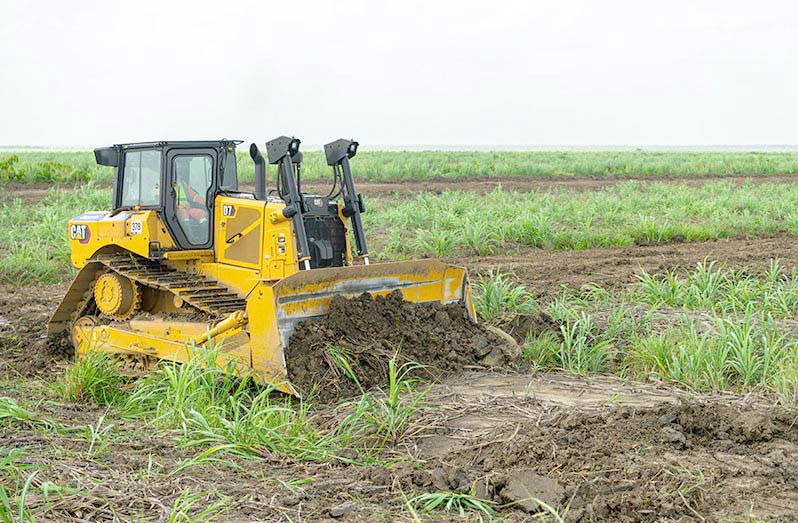
–says no jobs will be lost as corporation advances mechanisation process
AGRICULTURE Minister Zulfikar Mustapha has defended the government’s five year strategic plan for the Guyana Sugar Corporation (GuySuCo), insisting that the sugar industry can return to profitability by 2030 through aggressive mechanisation and factory recapitalisation.
Responding to questions during the Committee of Supply’s consideration of estimates and expenditure, Mustapha on Tuesday said the plan previously presented before Parliament is designed to “change the modus operandi” of the corporation and put it back on a sustainable footing.
He said: “The five year plan is a strategic plan that will work to ensure that GuySuCo goes back to profitability… and we are working towards that, and hopefully we can make a change from this year.”
The minister reported that over 41 per cent of GuySuCo’s cane cultivation is already mechanised, and that the plan envisages a significant step up in the coming months.
He said the corporation will acquire new machinery, including billet cutters and planters, with the ultimate objective of moving to fully mechanised planting and harvesting.
“In that plan, you will see new machinery being bought for the next five years… GuySuCo will go full mode. That’s the objective of planting and harvesting mechanically,” the Agriculture Minister said.
Mustapha added that the government remains committed to reopening closed sugar estates and retaining employment in key sugar growing communities.
He acknowledged that maintaining workforces at partially operating estates, such as Enmore and Skeldon, is currently driving up the cost of production, but argued that these are necessary transitional costs while the modernisation programme takes effect.
On the topic of labour, Mustapha affirmed that no worker will lose his/her job, as the government presses ahead with a broader strategy to modernise the sugar industry and boost production and revenues.
Minister Mustapha moved to quell concerns that the introduction of more machinery in the sector would displace sugar workers.
He affirmed: “With mechanisation, no one will lose their job… this government don’t dismiss people and send home people.”
LABOUR GAPS
Responding to questions from A Partnership for National Unity’s (APNU’s) Juretha Fernandes about how many workers would be affected, the minister explained that GuySuCo is already grappling with a serious labour shortage and that mechanisation is intended to fill existing gaps, not to send workers home.
Over the next five years, he said, the transition to more mechanised operations will be managed through attrition and other natural factors, ensuring that workers are not made redundant.
According to Mustapha, the measures will help guarantee adequate and regular labour for sugar production, stabilising output while supporting the industry’s turnaround efforts.
ROBUST TRAINING AND RESKILLING PROGRAMMES
Pressed further on what would happen to current workers in a more mechanised environment, and whether they would be retrained, the minister pointed to what he described as a “robust training programme” already in place.
He highlighted the role of the GuySuCo Training School, which offers instruction in several disciplines, including: machining, agricultural mechanics, electrical engineering and other technical fields linked to modern agricultural and industrial operations.
In addition, Mustapha referenced initiatives under the Ministry of Labour, noting that the Minister of Labour’s Board of Industrial Training (BIT) programme has trained hundreds of GuySuCo workers to operate heavy-duty machinery.
The APNU+AFC government had placed over 7,000 persons on the bread line after shuttering several estates between 2015 and 2018.
During his contribution to the budget debate last week, Mustapha had told the House the industry is on a path back to profitability, driven by renewed government investment, mechanisation efforts.
The minister said the blueprint will guide the corporation back to profitability by 2030, supported by sustained government funding.
The 2026 budget allocates $13.4 billion to the sugar industry, alongside broader investments in other crops, livestock, and fisheries, as part of a wider “people-centred” approach to agricultural development.
He noted, too, that sugar production had increased to more than 59,000 tonnes in 2025, compared to just over 47,100 tonnes in 2024.