–local power demand growing five times faster than regional average, report finds
PRESIDENT Dr. Irfaan Ali on Monday called the scale and frequency of Guyana’s recent ‘blackouts’ unacceptable, citing a new Inter Energy assessment that found electricity demand is growing nearly five times faster than the regional average, even as billions of dollars are being poured into overhauling the power sector.
Speaking at a news conference, Dr. Ali said peak demand on the Demerara–Berbice Interconnected System (DBIS) climbed from roughly 205 megawatts in 2024 to 242.6 megawatts in August 2026, an 18 per cent growth rate compared with the three–four per cent average for power systems elsewhere in Latin America and the Caribbean.
That pace has outstripped upgrades to the Guyana Power and Light (GPL) network, leaving the system with no flexibility to take generating units offline for maintenance without risking a total collapse, the Head of State said.
“If anything goes wrong there, the entire system shuts down,” Dr. Ali said, noting the level of vulnerability unacceptable for a country undergoing the region’s fastest economic expansion.
He also pointed to a steep rise in fuel costs for power generation, refined gasoline imports up 51 per cent and diesel up 86.8 per cent since January, none of which has been passed on to consumers. Instead, he said, the government has injected tens of billions of dollars in extra subsidies into GPL to shield household budgets.
Dr. Ali acknowledged the strain of rapid growth but insisted the current pattern of outages “cannot continue.”
“Those are the challenges. I acknowledge that it is unpleasant. Some of it unacceptable, but that is why the smart grid has to be predictable,” he said.
He argued the utility can no longer rely on manual fixes, noting: “We can’t have any more two pickups driving up and down looking at the line, or having a shutdown when you’re waiting for one crew to leave with a hook to go to Parika with the pole to pull down the switch.”
The President added saying that while the efforts to enhance the system is costly, it cannot be avoided.
“All over the world, check, go and check the cost. It’s expensive,” Dr. Ali said.
Looking ahead, the Inter Energy report projects electricity demand will rise about 138 per cent by 2029, meaning Guyana will need more than double its current supply within five years.
The GPL is also expected to add over 62,000 new customers in that time, driven by new housing schemes, expanding industries and a wave of hotel and other large developments.
The report calls for a “massive holistic investment” in generation, transmission and distribution, rather than piecemeal fixes.
Dr. Ali presented the findings as both a warning and a roadmap, describing the current push as “the largest transformation of the power system” in Guyana’s history.
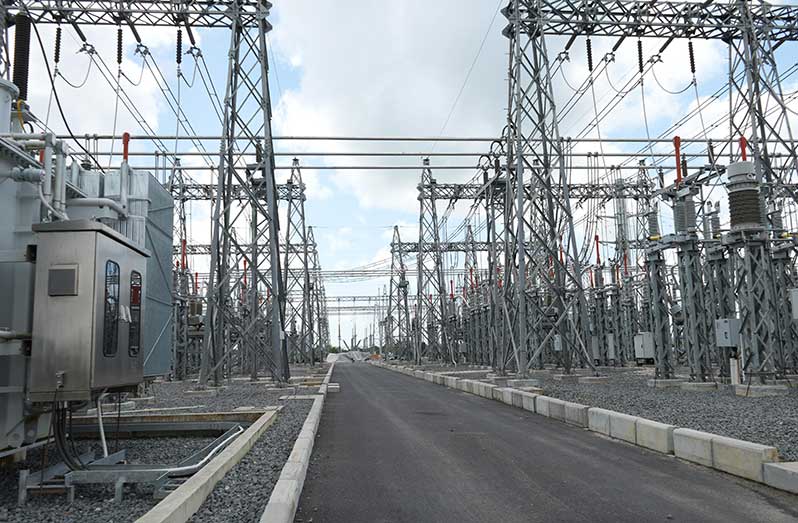
That includes the gas-to-energy project’s planned expansion of generation capacity, a more diversified fuel mix to cut exposure to volatile prices, and more than 360 kilometres of new high-voltage transmission lines. New and expanded sub-stations, smart metering, advanced control systems and battery energy storage are also part of the modernisation drive, he said.
Even so, Dr. Ali said those efforts need to be accelerated and better coordinated to deliver the stable, predictable power supply he said a fast-growing Guyana demands.