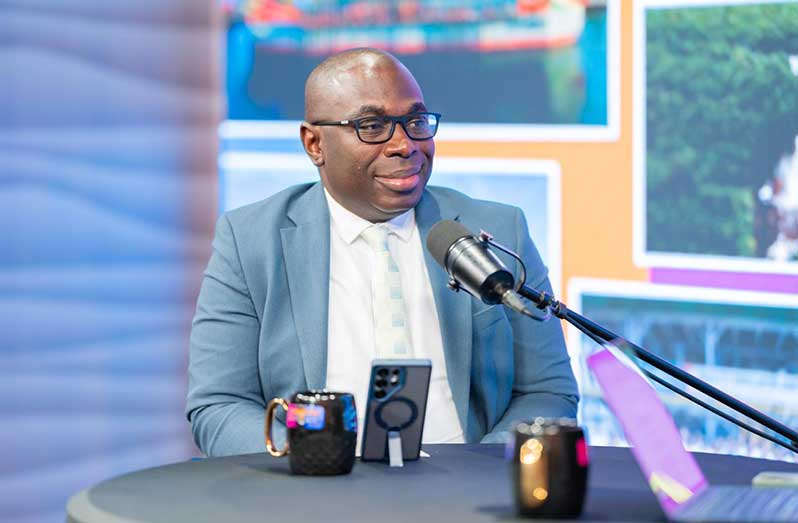
— challenges opposition to offer ‘sensible arguments’
AS the National Assembly prepares to open debates on Budget 2026 on Monday, Minister within the Office of the Prime Minister Kwame McCoy has urged Guyanese to look beyond political distractions and misinformation and focus squarely on the substance of the policies before Parliament.
Speaking ahead of the debates during a preview of the Starting Point podcast, Minister McCoy said the budget discussions are intended to examine how the proposed allocations will tangibly impact the lives of citizens, rather than descend into partisan rhetoric.
He cautioned that organised efforts are already underway to discredit government initiatives through misinformation, warning citizens to remain discerning as the debates unfold.
“We are in the midst of a situation where people are out with their machinery that provides rapid disinformation and misinformation to our people. You have to be able to decipher what is truth, what are facts, and what is intended to be mischief. There will be a lot of noise,” McCoy warned.
The minister said while criticism from the opposition is expected, the key question is whether meaningful, solutions-oriented arguments will be brought to the table.
“Perhaps people say that’s what opposition does,” he said. “But can they get down to real, nitty-gritty, sensible arguments that enhance what exists, rather than distract from what the government is trying to do for the people of this country?”
McCoy said the government is fully prepared to defend Budget 2026 and the programmes and initiatives contained within it, making clear how People’s Progressive Party/Civic (PPP/C) policies have already improved lives and will continue to do so.
“We have the job as a government to defend what we have put forward and to defend it in a way that people understand that this is a job that we are all up to for your benefit, for your own development, for the enhancement of your lives, for ensuring that your children will continue to have not only an education, but free education, a good education, to ensure that you have the means, you and your family, have the means of accessing jobs and better paying jobs, to make sure that you have the opportunity to establish your small businesses, and that you have the support for that small business development, and to make sure that you are the end of the day can have more disposable income to spend on your family, and you’re able to generate wealth, as we want you to do; wealth creation for families, so that you can really be part of a society in which you are truly a beneficiary of all that it has to offer,” McCoy said.
Guyana’s $1.558 trillion Budget 2026 was presented in the National Assembly last Monday, marking a 307 per cent increase over the $383.1 billion budget in 2021, as the government advances its people-centred development agenda under the theme “Putting People First.”
The country’s largest budget comes amid strong economic performance, with overall economic growth recorded at 19.3 per cent in 2025, while the non-oil economy expanded by 14.3 per cent, reflecting broad-based growth across multiple sectors.
Earlier this week, Minister McCoy said that the Opposition’s attacks and response to Budget 2026 continue to expose a troubling lack of seriousness, policy depth and economic literacy.
“The Opposition’s commentary makes it clear that they have not grasped what this budget is designed to do: consolidate growth, protect the vulnerable, expand productive capacity, and responsibly manage a fast-growing economy,” McCoy said in a post on his official Facebook page.
According to the minister, instead of engaging the substance of the fiscal framework – including macroeconomic stability, sectoral investments, social spending, and long-term development planning, Opposition MPs from APNU and the We Invest in Nationhood (WIN) party, which is less than a year old, have resorted to political noise and shallow sound bites.
“Instead of engaging the substance—macroeconomic stability, sectoral investments, social spending, and long-term development planning—they resort to noise, slogans, and shallow sound bites,” McCoy said.
APNU and WIN have been publicly criticising the $1.558 trillion budget by comparing it to their own manifesto-style promises. However, these same parties were previously called out during the 2025 elections after failing to present any concrete, costed plans when challenged to explain how such commitments would be financed or sustained.
As such, many of the Opposition’s proposed measures would, in fact, require a significantly larger national budget, deeper borrowing and an even wider fiscal deficit, the very outcomes they now accuse the government of pursuing.