






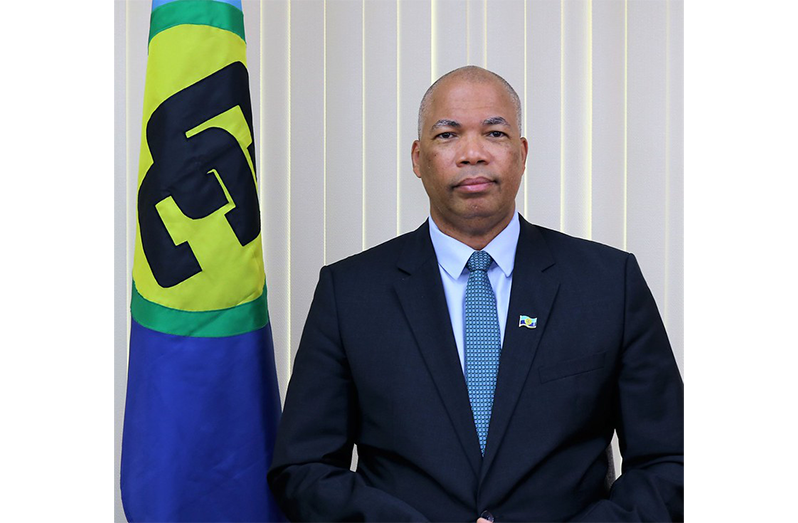
- CSME Assistant-Secretary General tells trade forum
THE Caribbean region should focus on strengthening its existing trade relationships while carefully expanding engagement with new markets such as Africa, India and Brazil, according to Assistant Secretary-General CARICOM Single Market and Economy, Wayne McCook.
McCook was at the time speaking at the World Trade Centre Georgetown during the forum Perspectives on Global Trade 2026: Challenges and Opportunities.
During his presentation, he outlined what he described as a practical and balanced approach to trade policy as the region prepares for continued global uncertainty.
“All of these, I think, need to be practical and purposeful,” McCook said, noting that as the Caribbean looks outward, it must not neglect partners with which it already has established links.
“Part of the strategy must be to strengthen our existing relationships, while we seek to deepen and explore contacts with India, with Africa, with Brazil.”
He stressed that this approach should not be seen as either-or, but rather as a comprehensive strategy that also involves nurturing existing trade agreements. “We also need to nurture the agreements we have,” he said
Against this backdrop, he pointed specifically to agreements with the Dominican Republic and Costa Rica. “So, it’s an all-of-the-above strategy, each being prioritised in its own way,” he added.
McCook linked this broader trade outlook to developments within the region, highlighting the role Guyana has played in shaping regional policy discussions, particularly in agriculture. He noted that work on the regional agricultural policy has been driven at the highest level, with President Dr Irfaan Ali serving as the lead Head for agriculture within CARICOM.
“The 25 by 25 plus five programme is already yielding results,” he disclosed while adding that trade policy must be viewed through both an agricultural and industrial lens.
To this end, he explained that, alongside the regional agricultural policy, CARICOM is moving to advance a regional industrial policy, which he said is critical to addressing long-standing weaknesses. One of the major challenges, he noted, has been the lack of competitiveness.
Meanwhile, McCook said that while policies are important, their success will ultimately depend on implementation. “The practical measures done by businesses in giving effect to these policies and more importantly, driving them, will be critical,” he noted.
Looking ahead for this year, McCook cautioned that global trade conditions are unlikely to stabilise quickly; however, he expressed confidence in the region’s ability to navigate the challenges ahead through solid partnerships and strong private sector engagement.




