






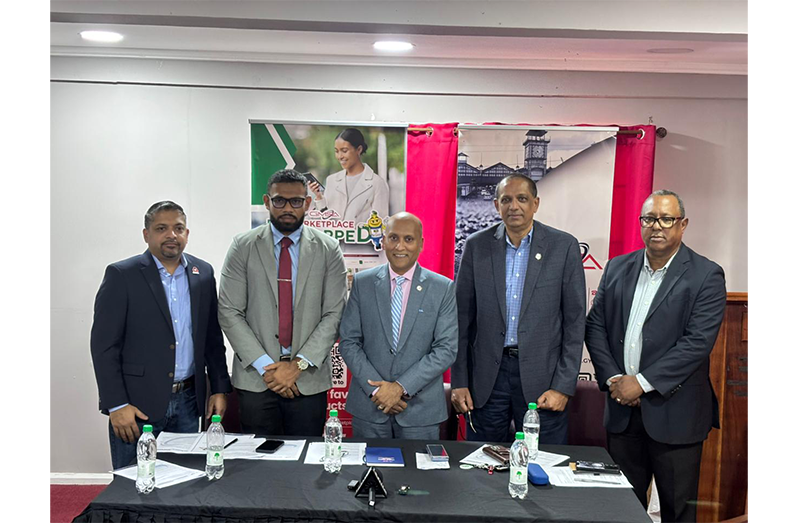
THE Guyana Manufacturing and Services Association (GMSA) has welcomed what it described as a strong response from the government to its recommendations for the 2026 national budget, revealing that about 80 per cent of its proposals were accepted.
This was according to President of the GMSA, Rafeek Khan, during a press conference on Wednesday where he stated that, “Of all the years we have made submissions, perhaps this year, our most recent submission for 2026 budget, at least 80 per cent of them were achieved.
It was then that he added that the government had answered the call to solutions to address competitiveness in manufacturing.
Khan said manufacturers across the association’s wide range of sub-sectors, including agriculture, agro-processing, forestry, construction, engineering and ICT, continue to face common challenges, particularly in relation to human resources and access to raw materials.
“These are two biggest challenges… for every single one of our sectors of our economy,” he noted, while expressing satisfaction that the 2026 budget addressed several of these issues.
One of the most significant initiatives highlighted was the proposed establishment of special development zones, which Khan said would help ease the high domestic cost of logistics.
“The cost of moving the raw material from the hinterlands of Guyana to our manufacturing hubs is a major cost,” he said, describing logistics expenses as very burdensome for local manufacturers.
According to Khan, the development zones would allow for the consolidation of like-minded manufacturers in shared spaces, reducing operational costs while improving efficiency. He added that shared electricity arrangements within these zones would help manufacturers become “more competitive in terms of energy cost” and allow for better monitoring of quality and production standards.
The GMSA president also welcomed the introduction of export incentives, which he said were proposed by the association to help manufacturers manage rising costs, particularly those linked to tariffs in key export markets.
“Without export we cannot grow our GDP in a certain manner. We cannot get the foreign currency that we need to get,” Khan said.
Support for small and micro manufacturers also featured prominently, as he pointed to the role of development finance in expanding access to capital. He said this would be “a great help to our small manufacturers”, many of whom supply larger companies within the manufacturing value chain.
Khan further described the removal of value-added tax on locally manufactured furniture and jewellery as a “tremendous” boost for the sector, noting that these items are “basic essentials that everyone needs in a house” and that the measure would help local products compete more effectively with imports.
To this end, Khan said the association remains optimistic, projecting that “every single sector in the GMSA is expected to see double-digit growth in 2026 and beyond”.




