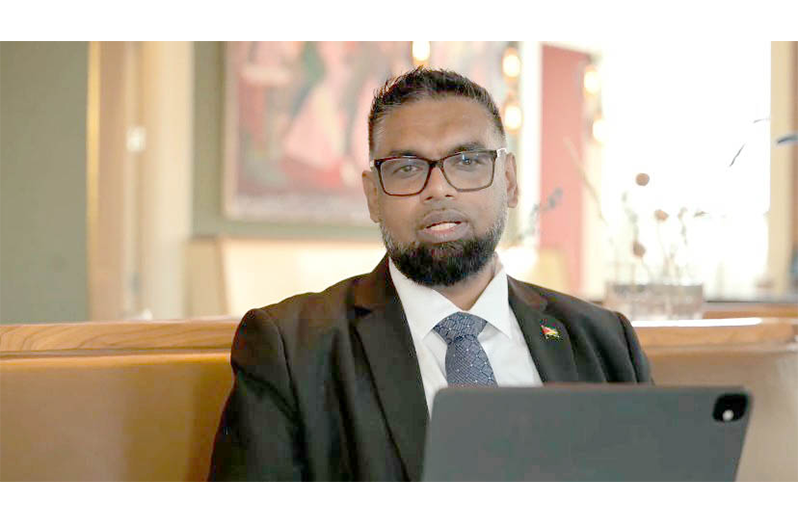
WHILE many nations globally are shifting their fiscal investments away from budgetary measures, Guyana is maintaining its deliberate effort to shield ordinary Guyanese from global economic shocks while deepening opportunities for wealth creation across households and businesses, President Dr Irfaan Ali has said.
The country’s 2026 national budget outlines a series of measures that, he says, collectively absorb hundreds of billions of dollars in potential inflationary pressure that would otherwise fall on families, farmers, and enterprises.
Examining some of these key fiscal policies and measures, Dr Ali, on Wednesday, stressed that the objective is to ease the cost of living and expand economic opportunities.
“I’m happy once again, that I can give some additional insights into budget 2026, a journey of continuation for the people…budget 2026 will continue in this tradition … to ensure price stability for food, expand local production, reduce the cost of local production, and improve our competitiveness for small and medium enterprise,” the President said.
Among the core planks of the budget is the continuation of zero-rated value added tax (VAT) on key food items and basic household necessities, a policy first introduced in the country’s Budget 2021.
This is coupled with the removal of VAT on electricity, water, and medical supplies, a measure the President said is costing the Government around $4 billion annually but directly lowering expenses for ordinary families.
The administration is also maintaining subsidies on electricity and water, with targeted support for old-age pensioners, and sustaining programmes such as the Because We Care grant, old-age pension increases, and one-off bonuses for specific categories of workers and pensioners.
“Since we came into office, we restored zero rated VAT status on key food items and basic household necessities. You will recall budget 2021, did exactly this. We removed VAT on fertilisers, agrochemicals, pesticides that benefit directly every single farmers, whether you are small, medium or large scale; we removed VAT on machinery and equipment used by farmers [and] used in mining. [We] reversed the 220 per cent increase in D&I charges and a 600 per cent increase in land rental that was imposed upon farmers by the then APNU+ AFC [A Partnership for National Unity+Alliance for Change] government,” President Ali said.
BACKING FARMERS AND BOOSTING LOCAL PRODUCTION
A major component of Budget 2026 is to bring down food prices by investing heavily in domestic production; to this end President Ali highlighted substantial allocations for drainage and irrigation, aimed at opening up tens of thousands of acres of new farmland for cultivation.
These investments, he said, will particularly benefit small- and medium-scale farmers, including those on five-acre plots, and support expansion into livestock and non-traditional crops.
And to further reduce production costs and stimulate investment, he reminded that the government has removed VAT on fertilisers, agrochemicals, pesticides, and machinery and equipment used in farming and mining; removed corporate tax on interest earned by banks and relief for the poultry sector, with the aim of lowering borrowing costs and production expenses; and eliminated all taxes on agriculture and agro-processing under Budget 2026, intended to boost lending, confidence, and capital access in the sector.
President Ali asserted that higher output, supported by these measures, will increase supply and translate into lower prices for consumers, while helping farmers access greater markets locally and internationally.
“One of the ways in which you can address rising costs and costs of food is by boosting local production to reduce price pressure. That is why we invest billions of dollars in drainage and irrigation so that we can have more lands available for farming. The investment we’re making in budget 2026 will open up tens of thousands of acreage of new farmlands,” Dr Ali said.
CONTAINING IMPORTED INFLATION
The President also underscored the importance of measures designed to cushion the brunt of the impact of global fuel and shipping costs.
The government has set the excise tax on gasoline and diesel to zero, a policy he said is saving the Guyanese public hundreds of billions of dollars annually and directly limiting fuel-related inflation.
Alongside this, the administration is continuing freight-cost reduction measures, which, according to the president, have already saved consumers close to $20 billion by preventing sharp increases in imported food and essential commodities.
HOME OWNERSHIP AND FAMILY WEALTH
Budget 2026 also places substantial emphasis on housing and infrastructure, which the President linked to long-term wealth building for families.
The government, he said, is investing hundreds of billions of dollars in housing infrastructure to make home ownership easier nationwide, continuing the housing mortgage relief programme, which is putting “tens of billions of dollars” back into households’ pockets.
Supporting lower interest rates on loans up to $30 million, leading to what the President described as “billions of dollars in savings” annually for families and providing targeted housing subsidies.