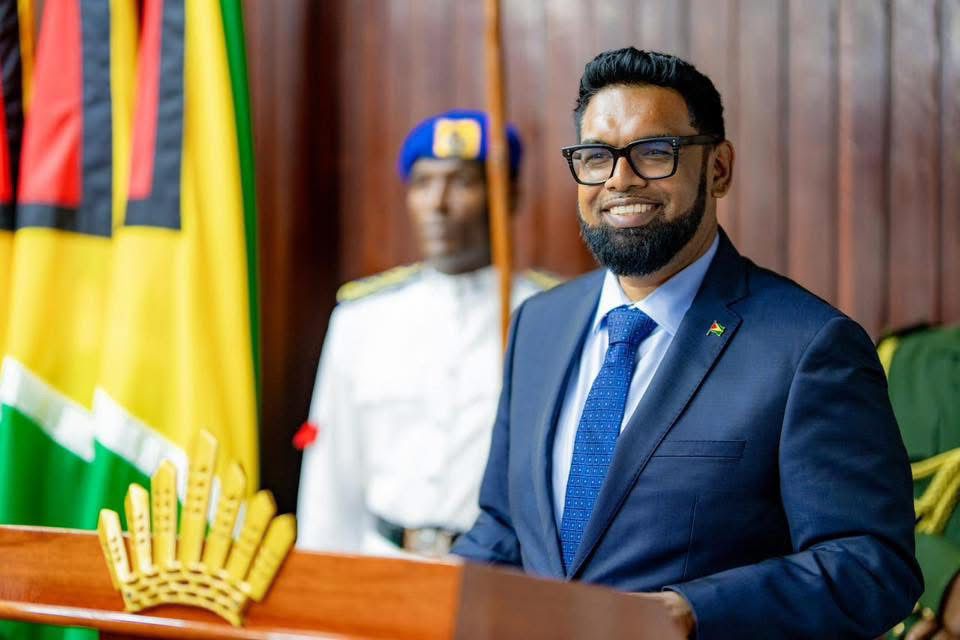
— says Budget 2026 puts people first through growth-focused fiscal measures, investments
FROM direct cash transfers to investments in targeted fiscal measures, the 2026 National Budget, themed ‘Putting People First’, charts the way forward in realising the People’s Progressive Party/Civic (PPP/C) administration’s vision for growth and development.
This is according to President Dr. Irfaan Ali, who said this year’s fiscal package brings to life the government’s five-year development plan.
“What is interesting is if you look at budget 2026 it is actually telling a story that we may very well surpass every single one of the commitment we made, because in this first instalment of real benefits, more benefits for the people, you will see a clear direction as to how the investments are being made to improve lives, expand income, create more disposable income, create jobs, give you Safer Community, better Health Care and Education, ‘the President said during an early morning discussion.
He noted that measures in this year’s fiscal package go just beyond cash transfers, with the government implementing policies and creating investment engines to support small business, co-invesment oppurtunties and create better facilities for the delivery of enhanced health and education.
“We have direct cash in people’s hands and many times, people only look at this measure, direct cash transfer, which is only one of the methods through which we are transferring wealth, creating wealth and opening up opportunities.”
During his budget presentation yesterday, Minister within the Office of the President with responsibility for Finance, Dr. Ashni Singh told the National Assembly that this year the government will introduce Special Development Zones with fiscal incentives intended to attract investment into strategically selected locations, while complementing anticipated reductions in electricity costs that are expected to significantly improve the competitiveness of manufacturing operations when the flagship Gas to Energy (GtE) project comes on stream.
In addition to this the 2026 budget makes provision for the removal of corporate taxes on agriculture and agro-processing, which is expected to free up resources for reinvestment, supporting increased production.
The fiscal package also creates space for the expansion of export allowances to include value-added forestry products and the removal of VAT on locally made furniture and jewellery.
This, the finance Minister said, will lower production costs, incentivise downstream processing and strengthen the capacity of local industries to compete in regional and international markets.
COST OF LIVING AND MORE DISPOSABLE INCOME
To ease cost-of-living pressures, the Minister said the Government will maintain the zero per cent excise tax on fuel, a measure in place since 2022, which has helped shield households from global trends, Budget 2026 will extend relief too on freight charges used to calculate import taxes.
Meanwhile, an additional $9 billion has been set aside in 2026 for further cost-of-living support.
Assistance for children and the elderly will also be expanded, with the Because We Care grant increasing to $60,000 per child, the introduction of a $20,000 annual transportation grant for schoolchildren, and this, with the $5000 uniform voucher, will see each child receiving $85,000.
This will reflect in an estimated $12.4 billion being transferred to parents under the Because We Care programme.
Support will also continue to cover the examination fees for the Caribbean Secondary Education Certificate (CSEC) and Caribbean Advanced Proficiency Examination (CAPE), benefitting some 14,000 students.
The elderly will see an increase in old age pension to $46,000 per month, and benefit from an annual transportation grant of $20,000, providing an additional injection of $1.9 billion in support.
Measures to raise disposable income include higher stipends for community-based workers, the return of the $100,000 national cash grant for adults 18 and above, the removal of net property tax on individuals and an increase in the income tax threshold to $140,000 per month, with the Minister estimating that these fiscal measures will place more than $100 billion into the hands of citizens.