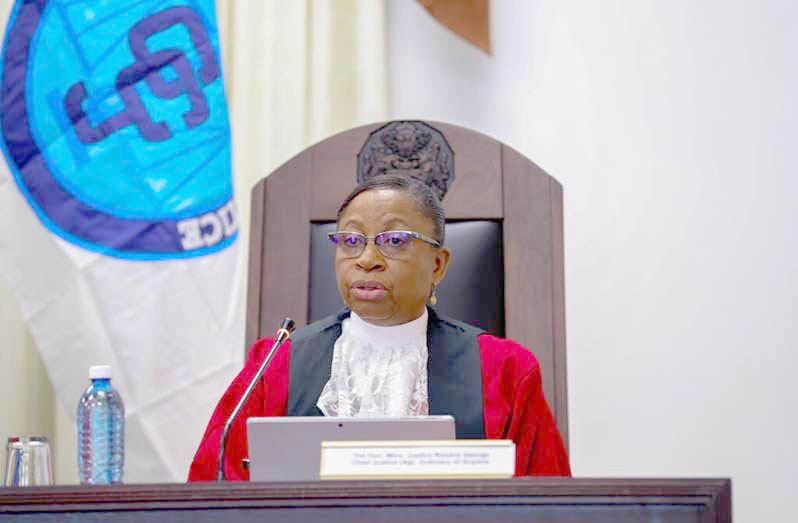
THE judiciary is moving to appoint additional judges and strengthen its case-management systems amid a heavy caseload across Guyana’s courts.
Acting Chancellor of the Judiciary, Justice Roxane George-Wiltshire, SC, disclosed on Tuesday that thousands of civil matters and hundreds of indictments (criminal matters) were filed in 2025.
Delivering an address at the opening of Law Year 2026, the Acting Chancellor said the pressure on the courts, particularly in the High Court and criminal jurisdictions outside Demerara, has made judicial expansion unavoidable.
“Judges, for the most part, are managing their dockets, though it is recognised that the volume of cases remains high,” she said, while outlining the judiciary’s performance and challenges over the past year.
According to the Acting Chancellor, a total of 5,847 civil cases were filed nationwide in 2025 for hearing in the High Court.
These matters were handled by four or five judges in Demerara, one judge in Berbice, and one judge in Essequibo, with the Essequibo judge carrying both civil and criminal responsibilities.
Given this imbalance, she said, “It may become necessary to assign an additional judge to hear civil cases in Berbice.”
Civil matters before the High Court include constitutional and administrative law cases; commercial disputes; family-law matters; adoptions, and applications for grants of representation for estates of deceased persons.
Despite the high filing rate, Justice George-Wiltshire reported that the High Court no longer has a backlog of civil cases in its registry, a development she attributed largely to the Civil Procedure Rules 2016 and the introduction of electronic litigation.
“With the introduction of the e-litigation portal for the High Court in October 2024, most cases are automatically assigned to judges through the portal,” she said, noting that the paperless system allows for greater efficiency and 24-hour access to court files.
On the criminal side, the judiciary recorded 264 indictments filed countrywide in 2025. While the criminal caseload in Demerara has been significantly reduced with four or five judges assigned to that jurisdiction, Justice George-Wiltshire cautioned that Berbice and Essequibo may also require additional judges to effectively manage their criminal dockets.
“Berbice and Essequibo will most likely need additional judges as has been done in Demerara,” she said.
She also emphasised that improving investigations and the quality of evidence would encourage plea bargaining, thereby easing the strain on the courts.
“Better investigations which produce strong evidence will encourage accused to enter into plea bargaining,” she stated, while underscoring the need to enhance the investigative capacity of law-enforcement agencies.
ALTERNATIVE DISPUTE RESOLUTION
Justice George-Wiltshire also urged greater use of alternative dispute resolution to ease pressure on the courts, particularly in civil matters.
She encouraged attorneys to advise clients to embrace mediation and other non-adversarial mechanisms, noting that court-connected mediation is working but needs to be strengthened to become more effective in resolving disputes without prolonged litigation.
The Acting Chancellor further revealed that the established complement of judges for the High Court is the Chief Justice and 20 puisne judges. However, there are currently five vacancies. The Judicial Service Commission, she said, aims to make appointments before mid-year.
Consideration is also being given to introducing masters for the High Court, with discussions ongoing about their jurisdiction and whether they would serve in civil, criminal, or both divisions.
Beyond the High Court, the Acting Chancellor reported that 181 appeals were filed in the Full Court in 2025. These matters, she said, are generally heard and completed within six to eight months of filing.
Meanwhile, the Court of Appeal continues to grapple with a backlog of approximately 2,000 cases, accumulated over several years due to a shortage of judges.
“With the appointment of additional justices of appeal in 2025, a robust case-management system will be implemented for a structured approach to reducing the backlog while addressing current appeals and applications,” she said.
The Land Court also experienced heavy activity, with approximately 1,500 cases filed across the three counties in 2025. Although additional Commissioners of Title have been appointed, Justice George-Wiltshire acknowledged that the backlog in land matters has not yet been fully cleared.
The push for more judges, she noted, must be matched by adequate infrastructure.
“Additional judges will require additional accommodation,” she said, adding that new courts and living quarters are already being designed for Berbice, while Essequibo currently has sufficient facilities.
As the judiciary moves deeper into data-driven administration, the Acting Chancellor stressed the importance of accurate case statistics.
“The judiciary must and will implement a better system for more accurate data collection,” she said, explaining that this would allow for more informed analysis of case disposal and clearance rates.
Ultimately, she said, the goal remains clear: “To encourage and maintain public trust and confidence through an independent, effective and accountable judicial system.”
The judiciary’s move to appoint additional judges and strengthen case-management systems aligns with its 2024–2031 Strategic Plan, titled ‘Pursuing Service Excellence through Investments in Human Resources, Management Systems and Technology.’
The plan emphasises modernising court processes, improving efficiency and ensuring fair and transparent handling of cases to strengthen public trust in the justice system.