






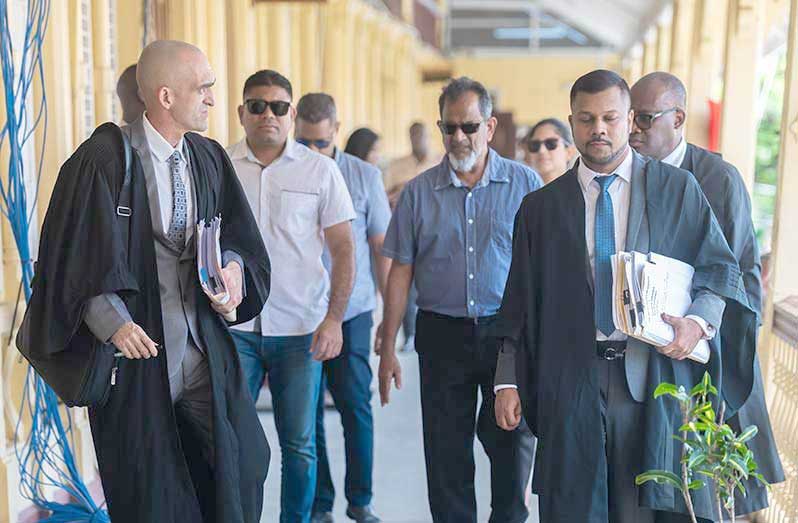
ACTING Chief Justice Navindra Singh is expected to rule on a constitutional challenge and judicial review proceedings filed by United States (US)-indicted businessmen Nazar Mohamed and his son, Azruddin Mohamed.
When the case was called on Wednesday before the acting Chief Justice, attorneys for all sides argued on the constitutional challenge, which challenges sections of Guyana’s Fugitive Offenders Act and the judicial review process in which the applicants are seeking to quash the decision of the Minister of Home Affairs to issue the authority to proceed.
Attorney-at-law Siand Dhurjon, appearing for the Mohameds, along with Senior Counsel Roysdale Forde and Attorney Damian Da Silva, told the court that it is their belief that the extradition process was tainted by presumed and apparent bias, rendering the decision of the Home Affairs Minister to issue the authority to proceed unlawful.
He noted that this bias arose from the minister’s association with the governing party, whose leaders had made public statements portraying his clients as involved in extraditable offences.
Dhurjon argued that these statements demonstrated a position against his clients well before the authority to proceed was issued.

He further put to the court that a decision maker may be disqualified where they are closely connected to a body that has an interest in the outcome of the proceedings.
He argued that the Minister’s role as a senior executive and Cabinet member of a political party that acted as a “pressure group” advocating the applicants’ prosecution placed her in a position similar to a prosecutor.
However, in response to these arguments, Senior Counsel, Douglas Mendes, who appeared on behalf of the Home Affairs Minister along with Attorney Clay Hackett, rejected the claims of bias, arguing that the rules against bias do not apply with the same force to the issuance of an authority to proceed, which he characterised as an administrative and non-adjudicative decision.
The Senior Counsel submitted that the Minister’s role at that stage was limited to determining whether the extradition request was unlawful on its face, not to adjudicate guilt, political motivation or other issues.
As such, he argued that the decision was comparable to a police officer’s decision to lay a charge, which is a step that initiates judicial proceedings but does not determine rights.
Further to this, Mendes stated that the existing act establishes the judicial process with which the courts are expected to consider the allegations.
Additionally, Mendes argued the doctrine of necessity, to which he said that the act specifically assigns the function to a minister of government, and further delegating the decision was not legally permissible nor practical, as extradition decisions inherently involve political and international relations considerations.
Meanwhile, Attorney General Anil Nandlall, the second-named respondent in the case following the hearing, described the judicial review application as fundamentally flawed and argued that it rested on an “absurd” proposition that political disagreement could immunise individuals from extradition.
He said the applicants relied extensively on political speeches and public statements to allege persecution, but ignored the broader factual context, including their long-standing business dealings, prior relationship with the governing party, and the international consequences of U.S. sanctions imposed before they entered electoral politics.

Nandlall argued that the applicants only became politically active after sanctions and an impending extradition request were already public knowledge, and that entering the political arena could not be used as a shield against lawful extradition.
Meanwhile, on the legal front, Nandlall made clear that no allegation was made, nor evidence provided, that the Minister, the Attorney General, the Vice President, the President, or any government official had failed to perform their statutory functions or acted unlawfully under the Act. He said that while the Mohameds alleged bias, they had not shown that any statutory requirement was breached.
He noted that the applicants did not contest that the Minister followed the statutory steps required under the Act in issuing the Authority to Proceed, nor did they argue she had improperly performed any function or acted in violation of the law.
As such, the AG emphasised that the Minister’s decision was made in compliance with the Act and that proof of unlawful conduct or procedural violation, the legal standard for judicial review, was not established.
Meanwhile, Acting Chief Justice Navindra Singh gave attorneys from all sides until January 19 to file all authorities cited to the court and further noted that he will deliver a ruling on February 2, 2025.




