–urges dismissal of businessmen’s ‘frivolous, vexatious’ application on constitutional issues
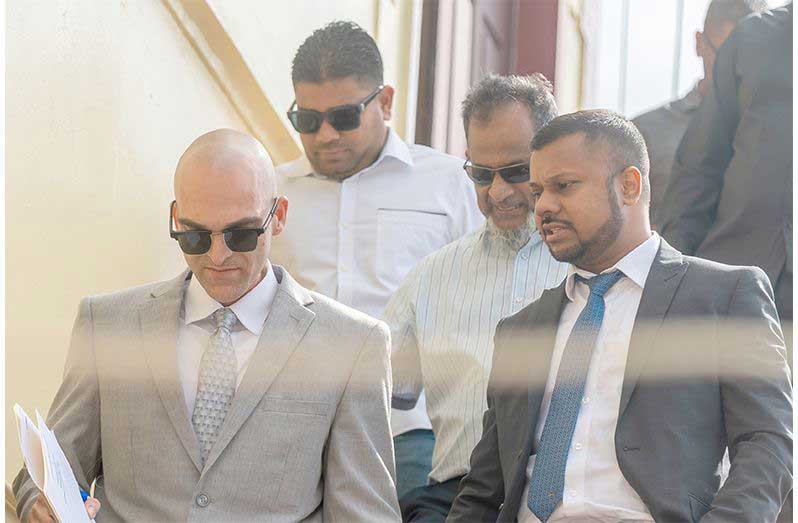
JAMAICAN King’s Counsel Terrence Williams and Senior Counsel Roysdale Forde on Monday presented sharply contrasting arguments as the extradition proceedings for businessman Nazar Mohamed and his son Azruddin Mohamed continued before Principal Magistrate Judy Latchman.
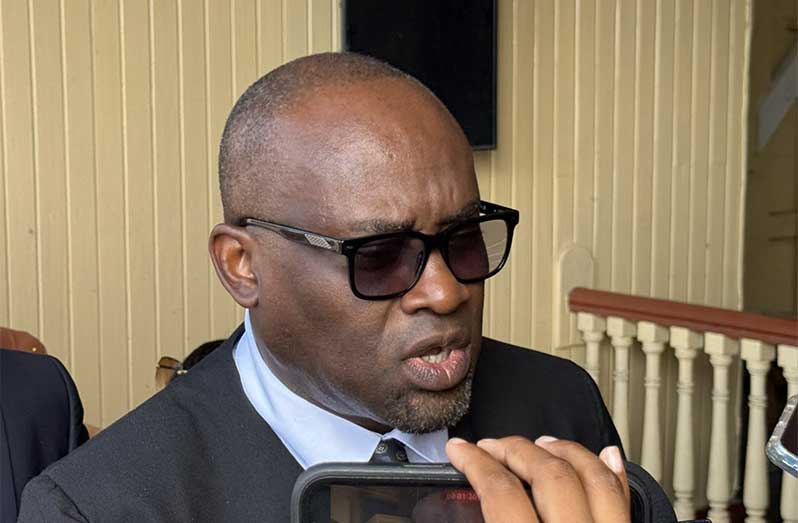
Speaking to reporters after his submissions, Forde, on behalf of the Mohameds, advanced a sweeping constitutional challenge to Guyana’s extradition framework under the Fugitive Offenders (Amendment) Act. He was assisted by Trinidad and Tobago Senior Counsel Rajiv Persad, and attorneys Siand Dhurjon and Damien Da Silva.
The United States—represented by Jamaican lawyer Terrence Williams—dismissed the effort as baseless and intended to delay the process. He was assisted by attorney Glen Hanoman and Jamaican lawyers Herbert McKenzie and Celine Deidrick.
Forde placed the 2009 amendments—specifically Section 8 3(a) and Section 8 3(b)—at the centre of his argument, maintaining that these changes raise constitutional issues serious enough to require an immediate referral to the High Court for proper determination.
He emphasised the seriousness of the questions his team had placed before the magistrate.
“The arguments centred around the unconstitutionality of the amendments made in 2009,” he said, adding, “We believe that we would have presented the arguments clearly, which shows the potential unconstitutionality and the basis for the referral to the High Court.”
Forde outlined three major constitutional concerns. The first involved the power of the Minister of Home Affairs to arrest, detain and extradite a citizen, which he said raised serious questions about the separation of powers.
The second issue was whether Parliament can direct the court in how to interpret a statute and, more troublingly, direct it towards a predetermined conclusion regarding a specific section of the Act. This, he argued, struck at the heart of judicial independence.
To illustrate this, Forde referenced the Barry Dataram extradition case, in which Full Court Justices Ian Chang and William Ramlall found deficiencies in the extradition arrangements between Guyana and the United States.
At that time, he said the court determined that Section 8(3)(b) of the extradition law required the treaty to contain a particular provision on re-extradition—one that simply was not present.
Forde argued that Parliament’s 2009 amendments attempted to rectify this by legislatively instructing the courts to read the missing provision “as if it is in fact” present in the treaty, a move he described as constitutionally suspect.
The third issue raised by the defence involved a clause in the 2009 amendment that prohibited persons facing extradition from challenging illegalities in the extradition arrangements themselves. Forde argued that this effectively barred citizens from defending their rights in the very process that could see them sent abroad for prosecution.
The Senior Counsel also took issue with what he described as a troubling pattern in disclosure during the proceedings. He pointed to the state’s submission of a new diplomatic document from the United States concerning re-extradition protections.
“Once again, that did not happen,” he said, referring to incomplete disclosure before submissions. More critically, he argued that the new document appeared designed to remedy deficiencies identified in case law—yet lacked the legal force required under the statutory scheme.
“More importantly, this disclosure seeks to remedy the very breach of the legislation. We are of the view that currently that document has no legal validity of regard to the scheme of the legislation.” According to him, the document contains assurances from the United States that the Mohameds will not be extradited to a third state.
‘VIOLATION OF RIGHTS’
In essence, Forde argued that the amendments violate his clients’ right to liberty and other fundamental rights, restrict their access to a fair legal process, and should consequently be referred to the High Court for determination under Article 153(3) of the Constitution of Guyana.
While Forde characterised the constitutional questions as integral to the fairness of the proceedings, King’s Counsel Williams was unequivocal in rejecting the defence’s position.
He argued that extradition hearings have specific legal parameters, and the issues raised fall entirely outside them.
“The main argument was that the constitutional issues do not arise for the consideration of the learned magistrate,” he told reporters.
“The application is frivolous and vexatious, because, first of all, there are no real constitutional issues, and they certainly do not arise for consideration at this time.”
Williams stressed that many of the rights the defence relies on do not apply within the context of extradition at all. Williams noted that many of the rights the defence relied on explicitly exclude considerations of extradition.
The magistrate, he added, has a defined statutory role, and “the duty that she has to perform does not include the considerations that the defendants have raised.”
The state attorney further defended his reliance on Justice Jo-Ann Barlow’s decision in the matter of Marvin Williams (aka Troy Thomas) v The Attorney General and the Director of Public Prosecutions, calling it the only judicial pronouncement interpreting the relevant amendments.

“Justice Barlow… is the first, and as far as we know, only pronouncement on the amendment, and it itself reaffirmed what the Court of Appeal had previously said in King v The Director of Prisons et al,” he explained.
For that reason, he said, it was essential to place the ruling before the court.
Williams also addressed the issue of “specialty”—the rule preventing an extradited person from being sent to a third country. He said the defence raised this matter “to the press and not to the court,” prompting the state to respond with a diplomatic assurance.
According to Williams, the note clarified that “the defendants will not be sent to a third state from the requesting state [United States].”
The King’s Counsel submitted that established judicial precedent requires such challenges to be raised only after extradition proceedings have concluded.
Entertaining them at this stage, he argued, would serve no legitimate purpose other than to stall the ongoing process.
Responding to Williams, Forde rejected any suggestion that the application was frivolous, stating the law itself required the court to consider whether the issues were vexatious.
“We articulated the reasons why it’s not frivolous and vexatious to have the questions that we wanted to refer to the High Court be determined by the High Court,” he explained.
In the meantime, the Mohameds’ lawyers have been granted until this morning to submit their arguments regarding the diplomatic note. Principal Magistrate Latchman indicated that she will deliver her ruling on both the constitutional matters and the diplomatic note on Wednesday at the Georgetown Magistrates’ Courts.
BACKGROUND
The Mohameds—owners of Mohamed’s Enterprise—remain on $150,000 bail each, have surrendered their passports and must report weekly to the Ruimveldt Police Station as the extradition proceedings continue.
They were taken into custody on October 31 following a U.S. request for their extradition.
U.S. prosecutors have accused the father and son of running an international criminal network with alleged links to “high offices” in Venezuela, claims Forde has rejected, stating:
“No, nothing like that has been disclosed… There’s not even an allegation of such in the actual extradition document.”
The pair face 11 criminal counts in the U.S. Southern District of Florida involving alleged wire fraud, mail fraud, money laundering, conspiracy, and customs violations tied to what authorities describe as a US$50 million gold export and tax evasion scheme.
The U.S. Treasury’s Office of Foreign Assets Control (OFAC) sanctioned both men in June 2024 for alleged gold smuggling and public corruption.
The U.S. investigation dates back to the mid-2010s and involved multiple agencies, including the DEA, FBI, and the Department of Homeland Security.