







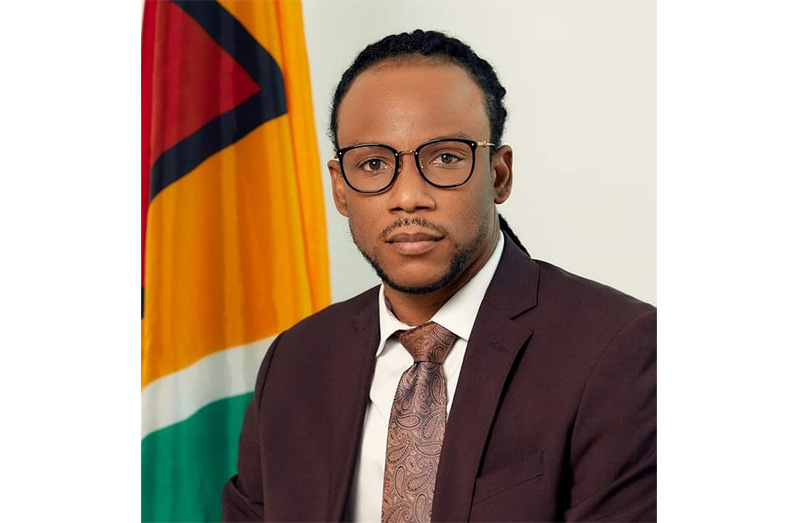
– Figueira says
OPPOSITION Parliamentarian Jermaine Figueira has issued a call for national unity in the face of the immediate and existential threat to Guyana’s sovereignty, following the recent escalatory actions by the Venezuelan government.
In a strongly worded statement, Figueira condemned Venezuela’s recent incursion into Guyana’s Exclusive Economic Zone (EEZ) and its intention to hold elections within Guyana’s territory, the Essequibo region.
He warned that those developments represent a direct violation of international law, the authority of the International Court of Justice (ICJ) and are also a direct threat to the peace, security and territorial integrity of Guyana.
“What we do now, as a collective people, will define our future and echo through time,” he said.
Figueira added, “This is not a time for complacency, silence, or division. It is a time for clarity, courage, and decisive national unity. We must rise above partisan boundaries, personal grievances, and political posturing to come together with a singular purpose: to defend our land, our dignity, and our right to exist in peace.”
The MP stated that the forebears fought and bled for the freedom that Guyanese enjoy now and did not make the sacrifices for the generations now to hesitate or fracture in the face of foreign aggression.
Further to this, he indicated that this is no longer about rhetoric or historical claims, as the threat is immediate and existential.
“Venezuela’s military actions and their plan to install political structures within our territory constitute a flagrant violation of the provisional measures issued by the International Court of Justice, measures which explicitly prohibit Venezuela from taking any steps to alter the status quo while the case is before the Court.
“Moreover, this behaviour shatters the commitments both nations made under the Argyle Declaration to resolve this matter through peaceful and legal means,” he said in his missive.
He urged that these stakes should not be underestimated, as it is not merely a boundary dispute; it is an assault on Guyana’s sovereignty.
Against this backdrop, Figueira emphasised, “We must unify, urgently and unequivocally, regardless of the prevailing social fractures and national mood of despair. We must dive deep within our beings, summon the spirits of our forefathers, all of them, and find a way to speak with one voice, act with one purpose, and stand with one will, in these extant circumstances.”
In an appeal to international partners and regional allies, Figueira said Venezuela’s defiance of the international legal order is a broader threat that should concern all small states.
He urged those nations to speak loudly and act boldly, not just in defence of Guyana but in defence of every principle held dear.
“This is a fight not just for land, but for legacy, for the preservation of hard-won independence, and the right of all nations, no matter how small, to stand free from coercion and intimidation,” he said.
With this, Figueira called on Guyanese regardless of background, political affiliation or belief to rise to the moment and defend Guyana and protect it for future generations.
The Government of Guyana had called on Venezuela to “act responsibly” and comply fully with the legally binding orders of the ICJ, which prohibits Caracas from conducting elections in the disputed Essequibo region.
In the official release from the Ministry of Foreign Affairs and International Cooperation, Guyana had called on Venezuela to comply with the binding Orders issued by the ICJ on December 1, 2023, and May 1, 2025.
The Orders direct Venezuela to refrain from taking any steps such as elections to assert authority over the territory, which the Court confirmed is administered and controlled by Guyana.
The latest ICJ Order came after Venezuela announced in January plans to hold elections for a so-called “Guayana Esequiba State,” a term used by Venezuela to refer to Guyana’s Essequibo region.
“The Government of Guyana expects that the Government of Venezuela will act responsibly… and fully respect the sovereignty and territorial integrity of Guyana,” the statement said.
Guyana had also reiterated that it will not enter into bilateral negotiations with Venezuela over the territory, emphasising that the matter is already before the World Court
That case concerning Venezuela’s rejection of the 1899 Arbitral Award which defined the boundary was referred to the ICJ by the United Nations Secretary-General, in line with the 1966 Geneva Agreement.
Guyana further called on Venezuela to move beyond “lip service” to the Geneva Agreement and to comply with its terms, particularly Article IV(2), which recognises the role of the ICJ in settling the controversy.
“The Court’s judgement will be definitive, final and binding on Guyana and Venezuela,” the statement read.
The Ministry’s response comes on the heel as ICJ ruled 12–3 in favour of Guyana’s request for provisional measures to prevent Venezuela from organising any elections in the contested region, reaffirming Guyana’s stance that the Essequibo is sovereign Guyanese territory.
This is the second time Guyana has sought provisional measures from the Court.
Recently, a Venezuelan naval vessel, the ABV Guaiqueiri PO-11-IMO 469552, entered Guyana’s Exclusive Economic Zone on March 1, 2025, coming dangerously close — approximately 700 meters—to the FPSO PROSPERITY, which was operating lawfully under a licence issued by Guyana.
The Venezuelan vessel made threatening radio communications, falsely claiming that the
FPSO PROSPERITY was operating in Venezuela’s Exclusive Economic Zone.
It then proceeded southwest, repeating the same aggressive message to other FPSOs operating in the region.



