






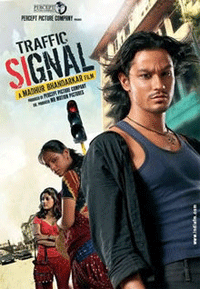
WHEN films become as close and pleasurable to our lives as food, money, and affection, then they can be said to revitalize art to the level of a human necessity.  Madhur Bhandarkar’s ‘TRAFFIC SIGNAL’ of 2007 is such a film, and a masterpiece of India’s filmmaking. The Indian Cultural Centre in Georgetown’s Bel Air Gardens recently offered ‘Traffic Signal’ at its monthly Film Club screenings, which, in terms of local Film Clubs, certainly seems to consistently have the leading edge over others that have had to spring up around the capitol to fill the embarrassing intellectual and social vacuum that has plagued Guyanese society since one of the most exciting public film cultures of quality in the region was thoughtlessly demolished.
Bhandarkar’s difference
I have not used the popular term, ‘Bollywood Film’ to describe ‘Traffic Signal’, nor would I use it to classify Bhandarkar’s earlier classic, ‘PAGE 3’, even though both films are centered in Mumbai, where the most celebrated Bollywood film-stars live, socialise, and produce films.
Films like ‘Traffic Signal’, and directors like Bhandarkar — and there are quite a few — differ enormously from those endless soap-opera Bollywood films with exaggerated sound-tracks and acting, horrifying jealous rages and tragic love affairs, glanced at by housewives while they are cooking, or women with nothing much to do when not gossiping.
The brilliance of ‘Traffic Signal’ originates with its director’s conception of his film as a totally dynamic work of art (in addition to its cinematic art) which builds its entire content and form around a signifier: A busy traffic signal junction in downtown Mumbai.
Films as art
Bhandarkar proves himself one of the most creative and exciting young film directors around today, because his artistic maturity is reflected in what we receive via the firm structural basis of his films, like ‘Page 3’, and in this case, ‘Traffic Signal’, which uses:
(1) The selected popularity of a city that is a new spot in the world’s growth, to project a touching social, yet chic, content;
(2) specific sign structure, like traffic lights at a dense city junction, to serve as a signifier of social realities brought to light via the diverse lives of adults, youths, children of both sexes, who use the stoplights to beg from the wealthy or just solvent commuters in vehicles or on foot; and
(3) and most creative and hilarious of all, his emphasis on ‘acting ‘within acting in the film; the double seam where those acting as beggars also ACT OUT destitute roles and appearances to extract sympathy from commuters, many of whom become familiar regulars who end up enjoying their role as benevolent persons.
Apart from this creatively fraudulent tactic by characters, Bhandarkar goes further by showing where the free civic junction governed by the young ‘hip’ tout, played beautifully by the young actor, Kunal Khemu, is also the training ground for others who can progress into being genuine honest successful people, depending on how they prove their sincerity in being part of the nascent traffic signal community.
The film’s introduction of the slim and wonderfully beautiful Neetu Chandra and her girlfriend as street merchants of fabulous Indian fabrics and clothing at their makeshift traffic light shop proves this potential, as Neetu refuses to be bullied by Khemu’s popular management of the street joint, but comes to understand and adjust to his peculiar social situation.
New Wave progression
‘Traffic Signal’ is one of the best recent examples of New Wave, or Nouvelle Vague filmmaking which, since the 1960s, has remained the most creatively innovative and socially advanced style and form of art, whether in writing, film, Pop music, or painting, to emerge decade after decade worldwide.
Bhandarkar has updated India’s cinematic and musical New Wave potential since the 1960s, and ‘Traffic Signal’, even more than ‘Page 3’, is India’s latest authentic local contribution to the art form, brilliantly bearing a relationship to Jean-Jacques Beinneix’s ‘DIVA’ of 1980, and Luc Besson’s ‘SUBWAY’ of 1985, two films which grasp the New Wave’s skill at projecting values of artistic and social significance from specific modern progressions, such as the new trend of electronic duplication and piracy, as well as multi-cultural integration, which we see in ‘Diva’, or the use of a subway’s underground system to shelter a community of homeless creative Parisian youths in that other touching and positive New Wave film classic, ‘Subway’.
‘Traffic Signal’ takes its place on its own unique terms alongside these films, and other youthful classics of the late 20th Century style.
‘Traffic Signal’ & global New Wave
New Wave culture is the stylish response of artists — of any age — to the conducive social tolerance of specific cities. Mumbai is a recent example of such cities, with its emphasis on film, fashion, and dance music; in Paris, the New Wave has mostly manifested itself in Literature, Film, and Fashion. In Milan: It’s Fashion and Painting; in New York, Toronto, and LA: Literature, Painting, and Pop music; in Rio and Sao Paulo: Film, Fashion, and Painting; in Montreal: Film, Literature, and Painting; in Caracas: Painting, Pop music, and Fashion; in London: Literature and Pop music; in Japan and Hong Kong: Film, Graphic art, and Fashion; in Dakar: Painting and Film.
Tolerance, sexual freedom, egalitarian sentiments, interracial love, and creative ambitions, are some of the prevalent values New Wave films and culture demonstrate. Films like ‘Diva’ and ‘Traffic Signal’ also show where criminal schemes and violence can threaten this exuberant yet fragile international culture.
But Bhandarkar’s ‘Traffic Signal’ holds up film as a liberating artistic medium in our real lives; its visual language is a feast. Colours and forms slide into and across the screen like tinted monochromatic and abstract expressionist paintings; a windowpane filmed at night with traffic below slides down to people sitting in a room below. The sweat, the sun, the design of Indian fabrics and Chicly cut fashion in ‘Traffic Signal’ uphold India’s beautiful modern fashion, male and female; the hip public dance routine, perfectly filmed and climaxed with a sexy female wink-eye, is pure creative style.
The sprawling ethnic posture of Neetu Chandra in her gorgeous clothes, even the upbeat Indian slang, ‘You’re eating my brains!’ heard repeatedly, all confirm ‘Traffic Signal’ as a genuine New Wave masterpiece.




