






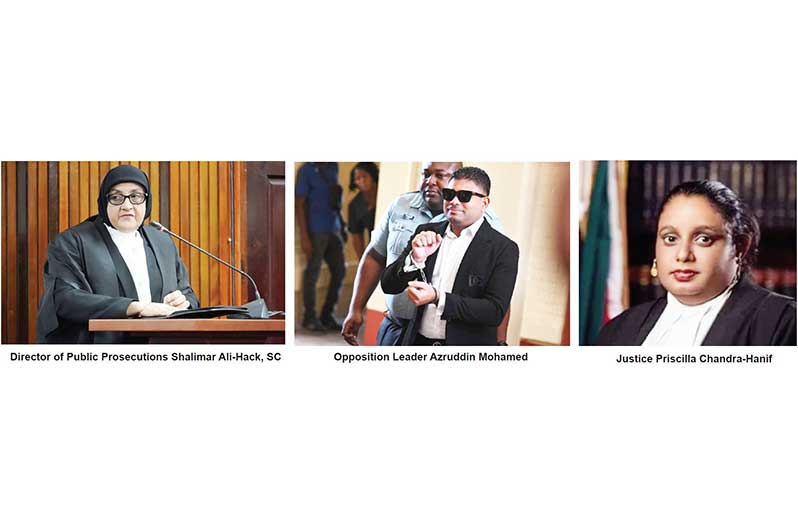
— asks High Court to strike out six disputed passages, citing hearsay and inadmissible statements
THE Director of Public Prosecutions (DPP) is seeking to have several statements excluded from Opposition Leader Azruddin Mohamed’s ongoing High Court bail proceedings on a cybercrime charge.
Among the disputed claims are allegations that government officials and senior police officers were responsible for destroying surveillance footage.
The dispute over Mohamed’s affidavit comes as he remains on remand at the Lusignan Prison following Magistrate Abigail Gibbs’ October 30 decision to deny him bail on a charge under Section 9 of the Cybercrime Act.
Mohamed, 39, and Police Constable Ryan Greene, 20, are jointly accused in connection with the alleged unauthorised access to and sale of footage obtained from the Safe Country Surveillance System.
The footage reportedly captured the October 12, 2026 shooting outside the Barr Street, Kitty, Georgetown residence of Senior Superintendent Prem Narine, who heads the Guyana Police Force’s Special Branch. The incident allegedly involved Mohamed and two of his workers.
According to the prosecution, the footage was obtained without authorisation from a computer system at the Police Command Centre in Liliendaal and subsequently transferred to Mohamed for $800,000.
Police Constable Ashton Chappelle, 24, called “Chappy”, was also charged in connection with the alleged unauthorised access and transfer of the recording and was subsequently remanded to prison by Magistrate Gibbs.
The DPP contended that Mohamed has failed to identify the sources of several claims contained in his supplemental affidavit, including information purportedly received from members of the public and allegations concerning the destruction of police recordings.
The objections were outlined by Deputy Director of Public Prosecutions Diana O’Brien in a sworn affidavit supporting an application filed on Monday, November 9, by King’s Counsel Darshan Ramdhani and State Counsel Madana Rampersaud.
The DPP is asking Justice Priscilla Chandra-Hanif to strike out paragraphs 16, 45, 53, 59 and 61, along with the first sentence of paragraph 76, from Mohamed’s 112-paragraph supplemental affidavit filed on November 4.
In explaining the prosecution’s objections, O’Brien identified several statements that she argued were not supported by evidence demonstrating Mohamed’s personal knowledge of the matters raised.
She referred specifically to the use of expressions such as “complaints received”, “social media and the nation at large”, information Mohamed “had received”, and matters described as “well known”. According to O’Brien, “No person is named as the source of any of them.”
The Deputy DPP also challenged allegations contained in paragraph 61 concerning the purported destruction of surveillance recordings.
That paragraph, according to her affidavit, alleged that government officials and high-ranking police officers were responsible for the deletion and destruction of footage.
O’Brien maintained that no source had been identified to substantiate the allegation. She further pointed out that the individuals accused of wrongdoing were not parties to the proceedings.
The prosecution’s objections extend beyond the disputed factual claims to legal arguments included in Mohamed’s affidavit.
O’Brien identified paragraphs 53 and 59 as containing interpretations of the Cybercrime Act and submissions attributed to Mohamed’s legal representatives, rather than evidence of events.
She argued that such matters should not form part of the affidavit evidence before the court.
The DPP is relying on provisions of the Civil Procedure Rules 2016 and the Evidence Act governing the admissibility of affidavit evidence.
Central to the application is the requirement that affidavits generally contain facts that the person making them can establish through personal knowledge.
O’Brien acknowledged that Section 73(4) of the Evidence Act permits statements of belief and the grounds supporting those beliefs in interlocutory proceedings.
However, she contended that Mohamed’s application falls outside that exception because it seeks substantive relief through originating proceedings.
The DPP is also relying on the court’s authority under Rule 30.02(3) of the Civil Procedure Rules to remove scandalous, irrelevant or otherwise oppressive affidavit material.
Despite challenging the six passages, the prosecution has not sought to exclude Mohamed’s entire affidavit.
The DPP acknowledged that most of the document concerns matters within Mohamed’s own knowledge and has raised no objection to those portions.
The application also expressly preserves the prosecution’s right to respond to the substantive bail proceedings through further affidavit evidence.
Additionally, the DPP has stated that its application and supporting affidavit should not be treated as accepting any of the factual allegations made by Mohamed.
The court is now being asked to determine whether the disputed passages satisfy the legal requirements for admissible affidavit evidence.
Following the refusal of bail, Mohamed’s mother, Bonita Mohamed initiated judicial review proceedings challenging Magistrate Gibb’s decision.
She is seeking to have that decision overturned and her son admitted to bail pending trial.
A separate application filed by her on November 8 also seeks interim bail while the substantive proceedings are pending.
In support of that request, Bonita has cited Mohamed’s compliance with bail conditions in separate extradition proceedings, his family responsibilities, fixed address and position as Leader of the Opposition. She has also proposed conditions restricting his travel and contact with his co-accused and prosecution witnesses.
Both the interim bail application and the DPP’s application to strike out the disputed passages are scheduled for November 12 before Justice Priscilla Chandra-Hanif, who will also preside over the substantive judicial review proceedings fixed for hearing on November 23.
Mohamed is represented by Senior Counsel Roysdale Forde and attorneys Damien DaSilva and Siand Dhurjon.




