…as IOM, Government launch SOPs for probe, prosecution of TIP cases
…eight convictions for TIP so far for this year
By Navendra Seoraj
TRAFFICKING in Persons (TIP) continues to be a global scourge which has proven to be difficult to arrest, but Guyana has taken a step further towards reducing and eradicating cases of TIP by launching the Standard Operating Procedures (SOPs) for investigation and prosecution of such cases.
These SOPs are expected to provide the basic guidelines for police officers, prosecutors and other key stakeholders on local procedures to interview victims and suspects, and to investigate and prosecute cases of TIP in Guyana.
The SOPs, which were compiled by the Ministerial Task Force on TIP in collaboration with the International Organisation for Migration (IOM), were launched at the Police Training College, on Wednesday.
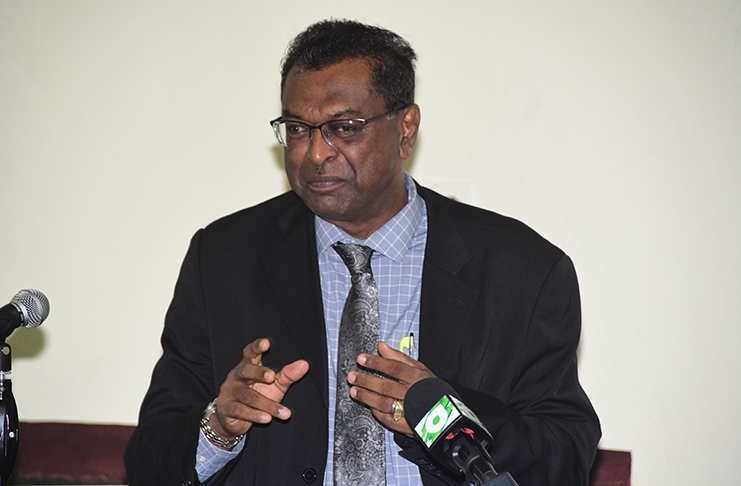
“SOPs are part of a greater effort to build capacity among the key stakeholders to ensure the rights of the victim and the accused are emphasised…The SOPs will ensure that all persons involved in the investigation and prosecution will be guided by best practices,” said Minister of Public Security, Khemraj Ramjattan, during his remarks at the launch of the procedures.

He said the creation of the SOPs would not have been possible without funding from the United States Department of State’s Office to Monitor and Combat Trafficking in Persons.
Consultations on the SOPs commenced in December 2017. From the inception, workshops were held with technical anti-trafficking stakeholders including members of the Task Force, TIP Units and civil society.
Consultation meetings were also held with the Chancellor of the Judiciary, Ministry of Public Security, the Chambers of the Director of Public Prosecutions, the Crime Chief and the Ministry of Social Protection.
Minister Ramjattan believes the SOPs are crucial now more than ever because Guyana is on the cusp of development with its new oil and gas sector, which is expected to attract people from all over the world.
“We are going to have more of this kind of TIP with the oil and gas industry…the sector is going to be a magnet for people all across Latin America and the Caribbean…so if we do not set up the preparatory work then we are not going to be that successful,” said Ramjattan, adding that TIP has a “polluting effect” on law enforcement officers and even on law enforcement in general.
The public security minister said TIP is synonymous to modern-day slavery since it creates big empires and profits from the exploitation of people.
According to the United Nations Office on Drugs and Crime (UNODC): “TIP shall mean the recruitment, transportation, transfer, harbouring or receipt of persons, by means of the threat or use of force or other forms of coercion, of abduction, of fraud, of deception, of the abuse of power or of a position of vulnerability or of the giving or receiving of payments or benefits to achieve the consent of a person having control over another person, for the purpose of exploitation.”
The UN authority said exploitation shall include at a minimum the exploitation of prostitution of others or other forms of sexual exploitation, forced labour or services, slavery or practices similar to slavery, servitude or the removal of human organs.
“That is why having SOPs are important…what they do primarily is ensure that we all know that there is a hymnbook that we are singing from,” said Minister Ramjattan.
He said the procedures and other anti-TIP initiatives will help Guyana to have a society which is not damaged by traffickers. The procedures will allow officers to be sharp in their investigations and even encourage them to look beyond the immediate pieces of information.
Over the past few years, there has been evidence that the police and other stakeholders have been working to ensure that cases of TIP do not go undetected.
Minister Ramjattan made reference to statistics which showed that there were 18 suspected cases of TIP between January and November this year. There were 138 victims of TIP, all of whom were females. About 115 victims were below the age of 30 years old and seven were below the age of 18 years.
According to additional statistics, which were presented by the minister, there were 50 suspects and eight convictions.
Meanwhile, in 2018 there were 32 suspected cases of TIP, 245 victims of TIP of which 224 were females. There were 58 suspects and 17 charges.
Minister Ramjattan said a glaring similarity in the statistics for both years was the fact that most of the cases were recorded in Region Four (Demerara-Mahaica) and involved a lot of Venezuelans. He also alluded to the fact that the primary purposes of most of those cases were sexual and labour exploitation.
“The ministry has been catering for victims of TIP…we have established victim care facilities outside of the capital city… we even have children spaces and we are doing spaces for adult males,” said Minister Ramjattan, noting that more needs to be and will be done in the area of victim services.
Guyana’s efforts toward combatting TIP earned it a Tier one ranking by the United States State Department for three consecutive years.
Chief Justice (ag) Roxanne George-Wiltshire said Guyana will continue to do more to end the scourge of TIP and evidence of the continued effort are the SOPs.
Attorney-at-Law and Legal Consultant, Diana Shaw, who aided in crafting the SOPs, said the compilation is not an external document which is being imposed on Guyana. Instead, she said the SOPs were created to standardise existing best practices which were used to get Guyana to a Tier one ranking.
She said the Caribbean and the rest of the world will now look to Guyana and observe how the SOPs are implemented, so that they can replicate it in their country.
Regional Coordinating Officer for the Caribbean and Chief of Mission for IOM, Robert Natiello, said while the stakeholders move to implement the current SOPs, work has commenced on the finalisation of another set of SOPs which will govern the protection of victims of TIP.
“We believe SOPs are important additions to the local framework to responding to TIP… but now that those SOPs have been established, the hard work begins and we have to work together for the implementation of the SOPs,” said Natiello.