






…to be handed over to AFC for input this week
THE revised Cummingsburg Accord is in its draft stage and the A Partnership for National Unity (APNU) is hoping to conduct a final examination of the document this week before it is handed over to the Alliance for Change (AFC) for input.
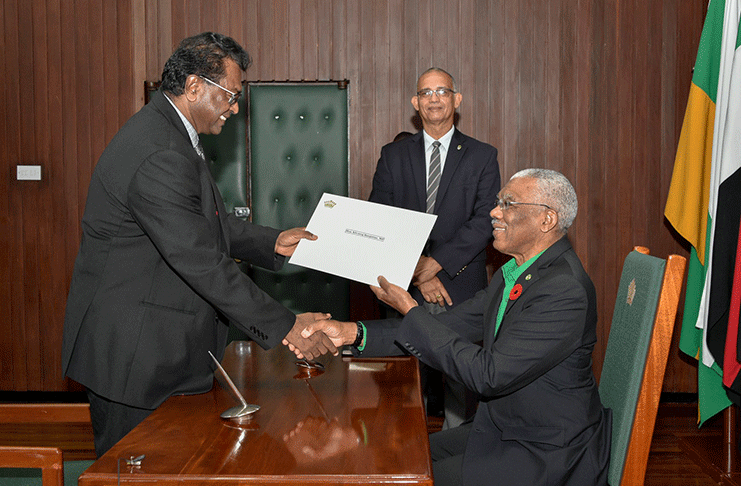
This was the update provided by President David Granger, on Wednesday, on the sidelines of a Letter of Credence ceremony at the Ministry of the Presidency. “It has been revised…the APNU Executive Council, hopefully, will be scrutinising the revised draft this week, hopefully by Friday. It has been written already and, as soon as that is done, we’ll submit it to the AFC for their consideration,” the President said.
The APNU and AFC will be contesting the 2020 General and Regional Elections as a single unit and will soon sign a new Cummingsburg Accord—the document which brought the two political parties together as a coalition in 2015. Under the new accord, the AFC will retain certain Cabinet posts. However, in the National Assembly, it will only get 30 per cent of the seats secured by the coalition based on a new 70:30 ratio agreed upon with APNU.
The formula will also guide the allocation of seats at the level of the Regional Democratic Councils (RDCs). AFC and the APNU reached a consensus in November during a high-level meeting with AFC’s Leader, Khemraj Ramjattan and APNU’s Chairman, President David Granger. APNU’s Chief Negotiator Volda Lawrence and her counterpart, David Patterson were also part of the negotiating teams.
The Guyana Chronicle had reported, in September, that the parties had committed to upholding the Constitution of the Cooperative Republic of Guyana and to ensure that no agreement or action collided with or contradicted articles of the Constitution.
As part of the core principles, the parties agreed and committed to the establishment of a system of inclusionary democracy and the advancement of the country’s Green State Development Strategy, Vision 2040.
They also committed to seeking electoral majorities at the general and regional elections and local government elections and agreed to select candidates for the aforementioned elections, through participatory and transparent processes, which guarantee that candidates enjoy the majority of their respective constituencies and satisfy all legal criteria for election.
On the issue of allocation of seats in the National Assembly, the Cabinet, Regional Democratic Councils, Municipal and Neighbourhood Democratic Councils, the sides agreed that this would be done on the basis of a formula. The sides agreed, too, that the prerogative of the President to appoint members of cabinet and ministers and to assign specific ministerial portfolios is explicitly embodied in the Constitution and is inviolable.
Meanwhile, other aspects of the core principles include the cultivation of respectful relations and, at all times, the parties will act collectively in the best interest of the coalition. They also agreed to speak with one voice on issues of public policy, to support a common manifesto and to issue joint media bulletins and releases on electoral matters.
Additionally, the parties agreed to abide by the principle of collective responsibility in respect of decisions emanating from Cabinet and to holding common positions on bills, motions and resolutions in the National Assembly. Each party also pledged to inform the other, in advance, of its inability, at any time, to support any measure in the National Assembly. Other areas covered in the core principles are that of the publishing of a joint manifesto comprising 12 broad fields: constitutional reform, good governance, economic growth and development, education improvement, energy sector, environmental protection, indigenous peoples, infrastructural development, international relations, social protection and social cohesion, security and human safety, women, gender equality and youth.




