






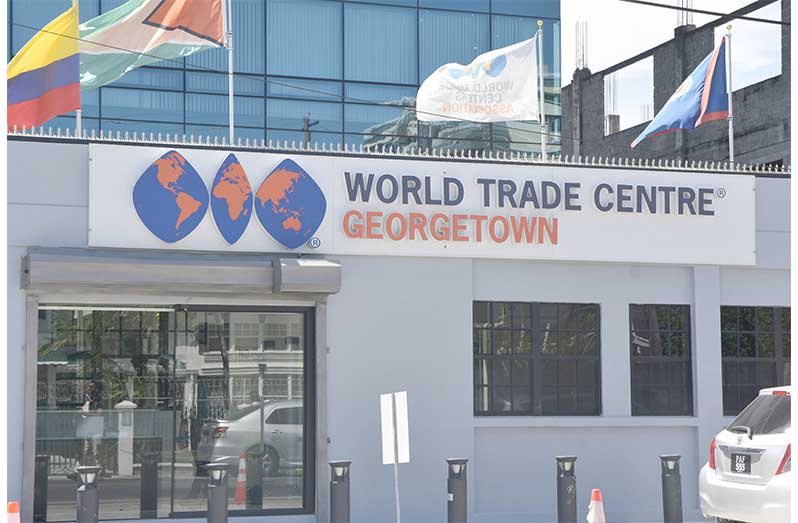
–Ambassador Neumann tells WTCG conference
AS Venezuela’s economy begins to reopen, Guyanese businesses may be positioned to benefit from a wave of new trade and investment opportunities, according to former Venezuelan Ambassador to the United Kingdom Vanessa Neumann, who urged Guyana to use the moment to build a diversified, resilient economy that does not rest on oil alone.
Delivering the keynote address at the recently concluded World Trade Centre Georgetown (WTCG) International Trade and Investment Conference 2026, Ambassador Neumann told business leaders, investors, policymakers and international delegates that Venezuela’s evolving circumstances carry real commercial promise for its neighbour, according to a WTCG press release.
Ambassador Neumann said Venezuela’s reconstruction and development needs could create openings for Guyanese firms in food supplies, logistics, construction, maintenance and technical services.
She expressed hope that Venezuela’s recovery would benefit both Venezuelans and Guyanese, observing that a neighbour’s recovery need not come at Guyana’s expense.
She was careful to add that opportunity should not be mistaken for certainty. Commercial access, she cautioned, should not be confused with political legitimacy or institutional stability.
Guyanese companies exploring the Venezuelan market must ensure that transactions are lawful, buyers are credible and payment arrangements are dependable.
She underscored the importance of resolving differences peacefully through international law, and encouraged businesses and policymakers to monitor developments in official policy, maritime activity, border conditions and insurance arrangements.
The Venezuela opportunity, she suggested, fits into a larger challenge. Ambassador Neumann argued that Guyana’s ambition should extend beyond becoming a successful oil-producing nation to becoming a successful country: one that is secure in its sovereignty, competitive in its businesses and generous in the opportunities it provides its citizens.
The true measure of development, she said, will be not just the wealth generated from natural resources, but also the capabilities Guyana retains and builds through transparent, productive and mutually beneficial partnerships.
She warned against making long-term investment decisions on the assumption of permanently high oil prices.
Focusing on the conflict involving Iran and its effects on trade, energy markets and shipping, she outlined three possible scenarios over the next six to 12 months, from continued shipping disruption and higher prices, to de-escalation, to further escalation hitting critical infrastructure and supply chains. Volatility, she said, deserves more attention than any single price prediction.
She urged businesses to diversify critical suppliers, verify delivery capacity, maintain affordable operational buffers and review freight, insurance and price-adjustment arrangements, so they can withstand simultaneous pressures from delayed shipments, higher input costs and slower customer payments.
Any expansion of regional trade, including with Venezuela, depends on secure waters. Ambassador Neumann called for stronger maritime security co-operation with regional and international partners through shared reporting, joint training and effective mechanisms for responding to incidents at sea.
Shipping operators, ports, offshore companies and insurers should be part of a coordinated effort, she said, describing maritime security as an essential condition for attracting and sustaining investment, rather than simply a defence expense.
She pointed to emerging technologies such as Quartermaster’s SmartMast platform, which combines vessel-mounted cameras, radio sensing, onboard artificial intelligence and satellite communications to improve maritime awareness.
A carefully structured pilot, backed by independent performance assessments, cybersecurity safeguards and clear data-access arrangements, could extend surveillance through participating commercial vessels, she suggested.
Ambassador Neumann acknowledged the importance of Guyana’s local-content framework, but argued that the next stage should help local companies move into higher-value activities, develop recognised technical expertise, win more sophisticated contracts and eventually compete internationally.
DIVERSIFYING PARTNERSHIPS
Diversifying partnerships, she stressed, must not come at the expense of high standards or Guyana’s ability to make independent decisions in its national interest.
On technology, she identified cyber-secure automation as a strategically valuable investment for Guyana at this stage, cautioning against adopting artificial intelligence simply because it is fashionable.
Meaningful automation, she noted, does not always require AI; often the greatest gains come from systems where information is entered once, consistently verified and properly recorded.
She identified ports and customs as areas where better integration of documentation, inspection decisions and cargo tracking could improve efficiency without weakening regulatory oversight.
Turning to tourism as a route to diversification, she stressed that investor confidence depends on secure property ownership, contractual rights and the continuity of lawful business arrangements.
Hotel and tourism investments require large, long-term capital commitments and confidence that titles, leases and legitimate operating rights will be respected.
Property rights, she said, must protect Guyanese owners and foreign investors alike while respecting Indigenous and community rights, environmental safeguards and lawful public-interest acquisition procedures. A predictable environment would spread the benefits through demand for local agriculture, construction, transportation and cultural experiences.
Ambassador Neumann closed by challenging participants to turn conference connections into tangible deals.
She proposed a voluntary 90-day follow-up mechanism through WTCG to track business introductions, negotiations, export-readiness efforts and obstacles facing prospective partnerships.
She encouraged international partners to bring investments that leave lasting capabilities behind, including technology local people can master and transparent commercial agreements that withstand scrutiny.
Her closing message was that true sovereign strength lies in a country’s ability to choose its partners, resolve disagreements, withstand external shocks and place economic opportunities in the hands of its citizens.
The WTCG International Trade and Investment Conference 2026 brought together business leaders, investors, policymakers and trade promotion organisations from Guyana, the Caribbean, South America and beyond to identify practical approaches to expanding trade, investment and economic co-operation, particularly for Guyana and the smaller economies of the Caribbean.




