






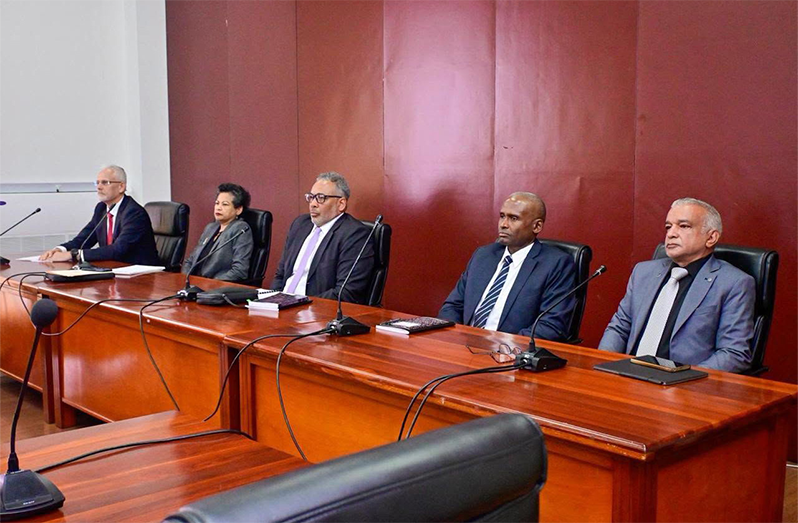
—Flores defends prompt response; new rescue centre expected to receive distress alerts directly next week
A COMMISSIONER acknowledged the robust effort of the MV Barima emergency response team on Thursday, telling MARAD’s Captain John Flores that responders had done “quite well” in the circumstances and crediting his experience with helping to bridge institutional gaps.
The acknowledgement followed Flores’ account of a multi-agency operation involving the Coast Guard, police, disaster-response personnel, civilian boats and foreign vessels after the ferry sank on July 18.
“I think in these circumstances, I’m sure you all did quite well,” the commissioner said, while stressing that lessons must be translated into policy, training and exercises to ensure a consistent response regardless of who is in charge.
Flores, Coordinator of the Maritime Administration Department’s Emergency Operations Division, defended the response as prompt, saying personnel were already on duty handling another distress case when the alert arrived.
“We responded promptly because my staff are there all the time… I think it was reasonably well done,” he told the Presidential Commission of Inquiry on Thursday.
Flores said the Lighthouse forwarded the distress alert to him via WhatsApp at approximately 11:03p.m. on July 18. However, the emergency beacon’s registration was incomplete, and responders were initially unable to determine whether the signal came from a vessel, an aircraft or another source.
He said verification was necessary because false alerts have been received over the years. Coast-Guard assets were nevertheless dispatched from the Pomeroon towards the coordinates, while checks continued.
“The only delay we had was because we were not sure what it was. That happens in real life all the time,” Flores said.
By 12:09am, MARAD had confirmed that the Barima had capsized. Flores then summoned the full coordination team, alerted the Civil Defence Commission and mobilised additional vessels.
He said most survivors were rescued during the night, with 53 people brought out by 5:13am. A survey vessel located the wreck on Monday, July 20, at 4:00pm lying on its starboard side about nine miles offshore, in roughly 33 feet of water.
Flores also explained to the commission the role of foreign vessels, particularly from Trinidad and Tobago and Brazil, in providing assistance to the operation, which continued until July 30.
Flores said Coast Guard officers worked alongside him, while police and CDC representatives helped coordinate their agencies’ resources.
He described the liaison officers’ presence as particularly valuable in passing information and requirements to personnel on the ground and at sea.
The Region Two disaster-response system also mobilised volunteers. MARAD separately hired approximately four boats from Charity, coordinating their participation and payment.
Flores maintained direct contact with foreign vessels, assigning search areas and arranging logistical support. He acknowledged a disconnect between that arrangement and the on-scene commander’s coordinating role, saying it had been identified during the subsequent review.
An inter-agency after-action session was held under the CDC to examine the response. Commissioners requested a copy of the report and emphasised stronger procedures and a shared operational picture across agencies.
Flores identified communication as a principal challenge but said a new Maritime Rescue Coordination Centre (MRCC) is expected to be commissioned by the end of next week.
The facility will receive satellite-distress alerts directly, removing the current relay through the air traffic control tower at Timehri.
“We will be receiving signals directly from the satellite by the end of next week,” he said.
The project followed Guyana’s 2018 International Maritime Organisation audit and was not initiated in response to the Barima tragedy.
Flores said equipment has been installed, with familiarisation training and formal handover remaining. Staff already have Global Maritime Distress and Safety System training.
Planned coastal sub-centres, supported by satellite and radio systems, are expected to improve communication coverage to approximately 90 per cent, he told commissioners.
Questioning later shifted to Flores’s former responsibilities as Director of Maritime Safety, including ferry certification, stability documentation and inspection records, questions that were highly technical and legal in nature.
Recognising that the questions were beyond the scope of what Flores had come prepared to answer, the commission advised him that he could seek independent legal advice and have counsel present during further questioning.
“This is dealing not with what is the response; this is dealing with my appointment as the director of maritime safety,” Flores said, requesting legal advice and additional preparation time.
The commission asked him to return prepared to address whether ferries enjoy any legal exemptions from the documentation requirements. No such exemption has been established.
Questioning was paused to permit preparation, with Flores to receive adequate notice before returning. The chairman thanked him for his patience, noting that he had been answering questions since 9am.
Having heard from 33 witnesses in seven days, the commission will pause oral hearings until November 10 while commissioners review a stack of documents described by Chairman Justice Godfrey Smith as “at least one foot in height, if not more.”
Meanwhile, the secretariat will use the time to gather further evidence, including statements from survivors in their communities. The commission will resume public hearings on Tuesday, November 10, 2026.




