






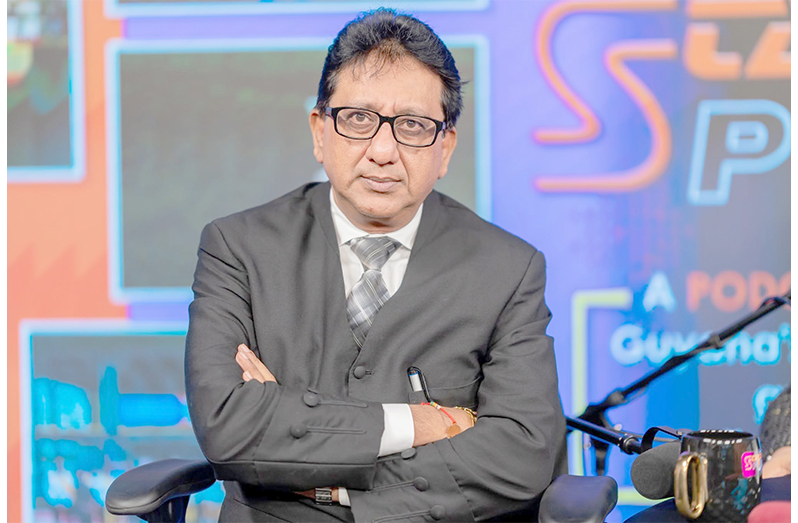
-new legislation, court infrastructure, technological upgrades being introduced
ATTORNEY GENERAL and Minister of Legal Affairs Anil Nandlall, SC, has noted that Guyana’s rapid development is being matched by an expanding legal framework, with new legislation, modern court facilities and technological upgrades being introduced to support the country’s transformation.
Speaking on the Starting Point podcast on Sunday, Nandlall said the government has been working to establish the legal foundations needed to regulate emerging industries, protect local interests and ensure that major investments operate within a clear statutory framework.
He pointed to the oil and gas sector, where he said the country had to develop an entirely new legislative foundation after the government took office in 2020 and do ongoing work to regulate modern port facilities and the natural-gas plant. “The development cannot take place without a commensurate legal architecture to go with it. I have always said that the most transformational projects in whatever field of endeavour requires a legal framework to cradle it,” he said.
Using the oil and gas industry as an example, Nandlall said the government introduced legislation to establish the regulatory framework needed for a sector that was largely without such a foundation when it assumed office. Among the measures he identified was the Local Content Act, which he said was designed primarily to protect local employment and strengthen Guyanese investments in the industry. He also highlighted the recently passed oil-spill legislation.
He noted, “We recently passed the oil-spill legislation. That is another comprehensive, modern, environmentally strong piece of legislation to guard against or to provide for, God forbid, if we have an environmental disaster in the oil and gas sector.”
The legislation, he explained, outlines the protocols to be activated in the event of a spill, provides for regulatory agencies to exercise their statutory responsibilities, and includes provisions for compensation to affected persons and measures to prevent further damage. The Attorney General said legislation is also being developed to support other major infrastructural projects, including the proposed deep-water harbour and modern port facilities, while a completed bill for the natural-gas plant was undergoing final consultations.
Nandlall also pointed to changes within the justice system, particularly the abolition of preliminary inquiries in murder cases and their replacement with paper committals. Under the original process, accused persons could spend three or four years in the Magistrates’ Court awaiting a determination on whether sufficient evidence existed for a trial in the High Court. Under the recently implemented paper-committal system, police evidence and witness statements are submitted to the Director of Public Prosecutions, who reviews the file and can request additional information before making a recommendation. The evidence is then served on the defence, which can challenge whether a prima facie case has been established. Nandlall said the new process could reduce a procedure that previously took years to one lasting weeks.
STRONGER JUDICAL SYSTEM
The Attorney General also pointed to the construction and upgrading of Magistrates’ Courts across the country, including in hinterland and remote communities, as evidence of the investments being made in the justice system. He identified Port Kaituma, Matthews Ridge, Lethem, and Kwakwani as being among the locations where new court facilities had been built, describing them as modern buildings equipped with air conditioning, internet access, microphone systems, and technology to facilitate electronic hearings. He said the facilities also include living quarters for magistrates and court staff, allowing the justice system to be better supported outside the major population centres.
“Wherever you go in Guyana and there is a court, it is fully air conditioned. It is brand new. It has living quarters for the magistrates and the court staff. It has microphone systems. It is equipped with the apparatus to do electronic hearings,” Nandlall said.
He also highlighted changes in judicial staffing, noting that the number of High Court judges had increased to approximately 20, alongside about four Land Court judges.
Nandlall said the Court of Appeal had also been strengthened through legislative changes that increased its number of judges from seven, with 11 now appointed and a vacancy remaining. He said each judge now had a judicial research officer to assist with legal research, while recent negotiations between the Judiciary and the Executive had resulted in salary increases for public servants working within the judicial system.
He also pointed to the construction of a new Court of Appeal building with two courtrooms, allowing two appeals to be heard at the same time. Alongside the physical expansion, he said the Judiciary had introduced electronic filing through an online portal. Work is also ongoing to introduce the same system in the Magistrates’ Courts, while automated voice-recording technology has replaced the need for magistrates and judges to write proceedings word for word by generating transcripts electronically.
Despite the investments and reforms, Nandlall acknowledged that challenges remain, particularly in the timely handling of cases and the delivery of judgments. He said the backlog of High Court cases that had previously existed meant matters could take at least five years, and in some instances as long as 10 years, to reach trial, has been eliminated.
He said a backlog has emerged at the Court of Appeal as cases move through the system, adding that work was being undertaken to address it.
Meanwhile, the Attorney General maintained that the Judiciary had received substantial resources and that progress had been made in disposing of cases, but said improvements are still necessary in the time taken by some judges to deliver decisions.
He noted that the law requires judgments to be delivered within 120 days after the hearing and submissions in a case have concluded, a requirement he said was not being observed consistently.
“The judiciary cannot say that they are not adequately resourced. Tremendous progress has been made in terms of the disposal of cases,” he said, while stressing that the continued delays in delivering judgments will be addressed as Guyana’s legal system develops.




