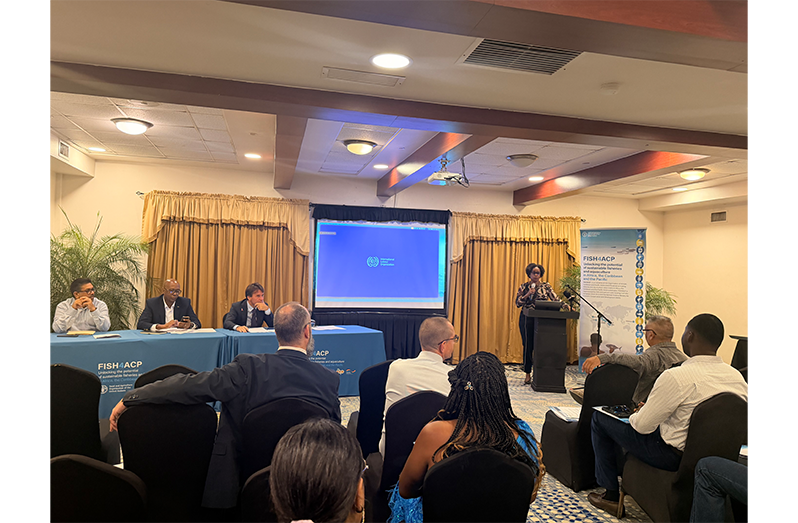
THE Food and Agriculture Organization of the United Nations (FAO), in collaboration with the Ministry of Agriculture and other key partners, will soon complete the FISH4ACP programme in Guyana.
According to a press release, the main aim for this programme was to build a stronger Atlantic Seabob shrimp value chain.
At the closing legacy event on Thursday in Georgetown, representatives from government, the private sector, fisherfolk organisations, development partners and project beneficiaries reviewed the results and discussed future efforts to build on these achievements.
The FAO Representative for Guyana, Dr Gillian Smith, highlighted the concrete achievements of the work to boost the country’s shrimp value chain.
“FISH4ACP has significantly advanced the plan to upgrade the Atlantic Seabob value chain and make it more sustainable, well-managed and resilient. It has improved data collection, stock management, food safety and quality, and safety at sea, with a focus on reinforcing fisheries cooperatives,” she said.
FISH4ACP introduced CALIPSEO, a digital fisheries information system developed by FAO. Data from it enables the fisheries department to make decisions that support fishers, strengthen the sector and protect fish stocks for the future.
The programme has also delivered training on the safe and healthy handling of Seabob products. To help fishers stay safe at work, it has developed a manual containing practical advice, the Safety Guide for Artisanal Seabob Fishers in Guyana.
The programme has also supported cooperatives made up of artisanal fishers and worked with informal groups. This was made possible by working with the International Labour Organization (ILO) and the Cooperatives Department of the Ministry of Labour. The support provided included training in governance, membership engagement, financial management and organisational planning.
Joni Musabayana, Director, ILO Decent Work Team and Office for the Caribbean, stressed the transformative power of developing cooperatives.
“One fisher or processor alone may struggle to secure finance, reach better markets, buy inputs at a reasonable cost, influence decisions or access services,” he said.
“However, as organised groups, you can pool resources and knowledge, strengthen governance, negotiate from a stronger position and make your voices heard much louder.”
Participants at the legacy event discussed how institutions, fishing communities and industry partners could continue the work that the programme has done over the years.
Dr. Richard Blair, Advisor to CARICOM and the Ministry of Agriculture, highlighted the Government’s continued support for the fisheries sector, having invested almost $4 billion from 2025-2026, including the refurbishment of landing sites and direct assistance to almost 6,000 fishers.
He also highlighted the Seabob Working Group as a key FISH4ACP achievement, bringing government, fishers, processors, exporters and researchers together to address sector challenges. “This collaborative approach will be crucial going forward,” he said.
Future efforts will be guided by a vision statement that outlines a 10-year period ending in 2032. The aim is to strengthen Guyana’s position as a leading exporter of seabob shrimp globally.
The plan is to do this by ensuring a sustainable and resilient industrial and artisanal value chain that is well-regulated and supported by data, with improved infrastructure for artisanal fishers, expand fish cooperatives and continue to empower women and youth.
“Cooperatives are not social organisations; they are businesses that create opportunities for their members,” said Mr. Aslin Singh, Adviser to the Minister of Labour and Manpower Planning.
He noted that the Department of Cooperatives will continue to support cooperatives with registration, management and proper record-keeping.
“We will also continue to work hand-in-hand with the Ministry of Agriculture, the Seabob Working Group, the ILO and FAO to protect and build on the achievements of FISH4ACP,” he said.
Mr. Singh reminded fisherfolk that cooperatives belong to their members and encouraged them to manage with integrity and transparency, involve members in decision-making, and continue learning from one another.
Luca Pierantoni, the EU’s Ambassador to Guyana, Suriname and CARICOM, said, “FISH4ACP has done impressive work to make the shrimp value chain stronger and more sustainable, especially in areas like digital infrastructural upgrading which is critical for ensuring accurate information and informed decision-making. In future, it would be great to see Guyana spread its expanded capacities to other countries in the region.”
FISH4ACP is an initiative of the Organisation of African, Caribbean and Pacific States (OACPS) to improve the sustainability of fisheries and aquaculture value chains in Africa, the Caribbean and the Pacific.
It is implemented by FAO with funding from the European Union (EU) and the German Federal Ministry for Economic Cooperation and Development (BMZ).