






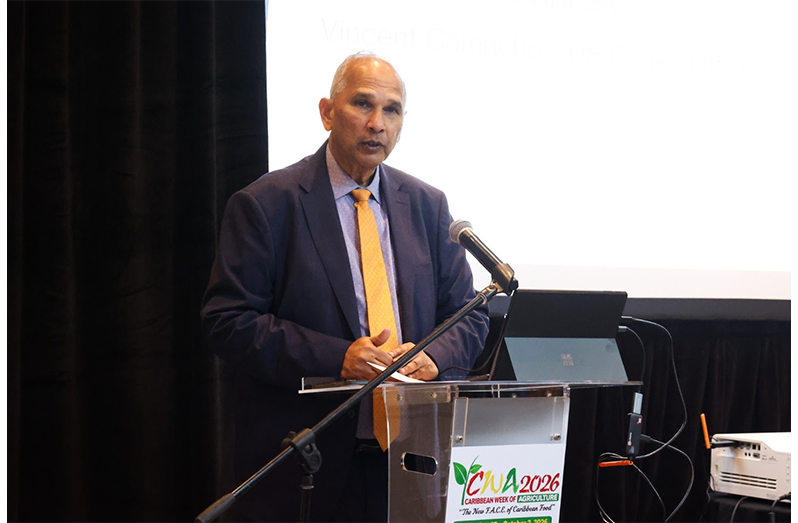
–acknowledge efforts of Director General Ibrahim
CARIBBEAN ministers of agriculture and directors and representatives of international and regional organisations acknowledged the efforts of Muhammad Ibrahim, Director General of the Inter-American Institute for Cooperation on Agriculture (IICA), to strengthen food security and improve productivity in the region.
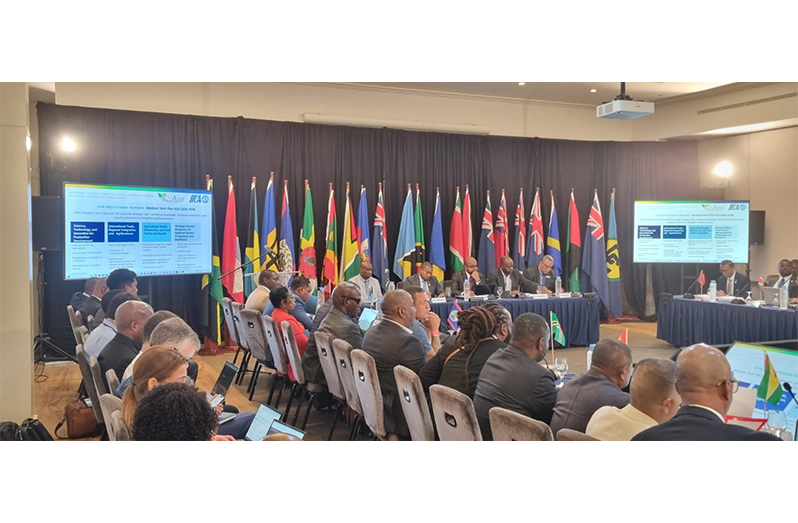
They did so during the meeting of the agriculture subcommittee of the Caribbean Council for Trade and Economic Development (COTED), where Ibrahim presented IICA’s 2026–2030 Medium-term Plan and the strategic actions it contains designed to address the specific challenges facing the region.
IICA’s strategic plan for the Caribbean will focus on three strategic priorities: transforming and underpinning sustainable production systems; modernising agricultural health, food safety and quality systems; and facilitating the development of agribusiness and trade.
To underpin efforts to reduce Caribbean countries’ dependence on food imports, Ibrahim announced the establishment of a regional centre for innovation and sustainable agriculture, an initiative spearheaded by Brazil and Guyana and facilitated by IICA; a regional centre of excellence in agricultural innovation, which will be located in Jamaica; and an agricultural health and food safety centre, headquartered in Barbados.
At the meeting, the ministers highlighted IICA’s important work in promoting horizontal co-operation — for example, with Argentina, Brazil and the University of Florida, United States.
In the case of Argentina, the strategic areas identified include soil health and water management, beekeeping, digital and precision agriculture, the mapping and management of meteorological phenomena, and the rearing and management of small ruminants.
Ibrahim stressed that Argentina is playing a key role in the diversification of agricultural production in the Caribbean.
“IICA,” he explained, “has facilitated agreements with the government of Argentina, which is a leading country in the use of science and technology in food production, and has proposed several technical co-operation projects to help strengthen regional capabilities.”
The discussions with Brazil focused on how to more actively involve the Brazilian Agricultural Research Corporation (EMBRAPA) – an internationally renowned state-owned institution specialising in science and innovation – to scale up regenerative practices and genetic improvements in forage crops, soybeans, and livestock.
The sectoral subcommittee of COTED — a key body of the Caribbean Community (CARICOM) whose mission is to promote trade, economic development and sustainable growth — met at the close of the Caribbean Week of Agriculture in Jamaica.
The event, which has been held since 1999 and this year brought together 670 delegates from 34 countries, served to demonstrate the importance of agriculture and rural life for the economic, social and environmental stability of countries in the region.
IICA was one of the organisers, along with CARICOM, the Caribbean Agricultural Research and Development Institute (CARDI), and the Food and Agriculture Organization (FAO).
In his remarks during the opening ceremony, Jamaica’s Prime Minister, Andrew Holness, said that agriculture in the Caribbean has considerable potential to foster innovation, generate wealth, contribute to economic development, and attract young people.
During the Caribbean Week of Agriculture, Ibrahim and his team also met with officials from the U.S. Department of Agriculture’s Animal and Plant Health Inspection Service (USDA-APHIS), where they reviewed the hemisphere’s transboundary disease agenda, with a special focus on the Caribbean. They also met with Achim Fock, Director of the World Bank’s Caribbean Division, to explore areas in which IICA and his organisation could collaborate to support Caribbean agriculture.
At the meeting, Ibrahim reaffirmed IICA’s commitment to strengthening its technical programmes to address transboundary pests and diseases such as African Swine Fever (ASF) and the New World Screwworm.
TOOLS FOR ENCOURAGING YOUNG PEOPLE TO SETTLE IN RURAL AREAS
One of the core issues that IICA addressed with ministers and other key actors in Caribbean agriculture was tools that can be used to encourage young people to settle in rural areas. The aging of the farming population is a critical challenge, as is the decline in the number of professionals trained to provide services in the region’s agrifood systems.
Therefore, the agency agreed to collaborate with CARICOM and the University of the West Indies (UWI) — founded in 1948 and with a presence in 15 Caribbean countries and territories — to promote youth leadership, particularly in areas such as access to credit, participation in decision-making in the rural sector, the strengthening of leadership skills, and the fostering of agro-bio-entrepreneurship.
The Director General and his team also met with members of the CARICOM Agriculture Youth Advisory Body (CAYAB) to identify areas of collaboration, and determine how IICA can support CAYAB in carrying out its work with young people in the Caribbean region.
During the Caribbean Week of Agriculture, several countries also worked with IICA to continue developing and designing co-operation projects aimed at making agriculture a driver of development in the region.
While challenges remain, both the public and private sectors in the Caribbean are strongly committed to transforming agriculture and strengthening food security. Countries have launched the “Vision 25 x 2025 + 5” programme, designed to significantly reduce dependence on food imports by 2030 through higher production, increased investment and trade, and more dynamic regional collaboration.
IICA’s Director General warned that the transformation of Caribbean agriculture is crucial given its vulnerability to external economic shocks, the frequency of extreme weather events, and the fact that most countries belong to the group of so-called Small Island Developing States.
“We are currently in an even more precarious situation due to rising geopolitical tensions, the increasing complexity of global trade dynamics, higher energy costs, and new and emerging sanitary and phytosanitary threats,” Ibrahim said.
For that reason, IICA designed a specific strategy for the Caribbean within the framework of its 2026–2030 Medium-term Plan, which recognises the region’s unique characteristics and was discussed with the countries and regional organisations.
Ibrahim noted that far from starting from scratch, IICA had been working intensively for some time to help reduce the Caribbean’s dependence on food imports. He provided details of the projects it is implementing in collaboration with various actors.
“IICA,” he emphasised, “remains firmly committed to supporting the region’s efforts to achieve its development goals. However, we recognise that this effort is beyond the capabilities of any single organisation or government, making it essential that we work together to meet the challenge of building more efficient and productive agrifood systems in the Caribbean.”




