
Farmer urges youth to embrace climate-smart agriculture
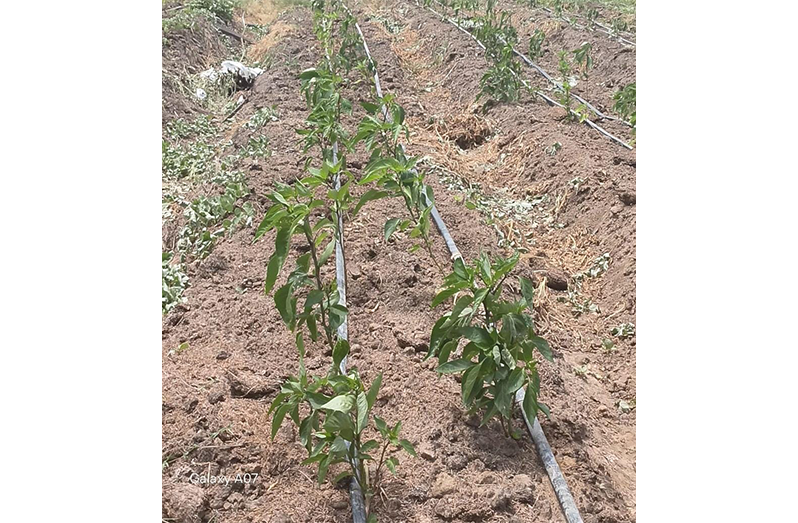
ON just two acres of rich soil in Hopetown Village, West Coast Berbice, 34-year-old father of two, Neil Benjamin, is quietly engineering a high-tech agricultural turnaround. Every week, crisp pak choi, lettuce, sweet corn and plump boulanger are sold from Benjamin’s Farm and land directly on the tables of Guyana’s growing restaurant scene.
Powered by modern drip irrigation, motorised tillers and zero-waste ambition, this modest plot in Hopetown Village is the launchpad for a bold, climate-resilient model of integrated farming, proving that technology and diversification can transform a backyard garden into a thriving commercial powerhouse.
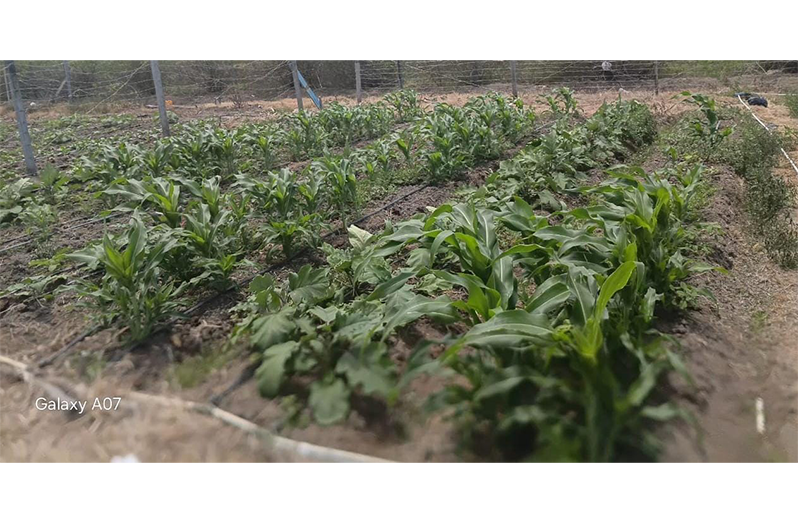
Benjamin is not content with traditional crop farming alone. He is actively engineering a transition to a fully integrated, climate-resilient agricultural ecosystem that seamlessly integrates crop cultivation, poultry, swine, and apiculture under a single, sustainable banner.
The drive towards diversification was born as much of necessity as of ambition. Not long ago, vandals targeted and destroyed Benjamin’s apiary, devastating his honey-producing hives and wiping out a crucial source of household income. For many, a blow of that magnitude might have prompted a retreat. For Benjamin, it was an eye-opening lesson in risk management.
Determined to rebuild his lost hives, he resolved never again to rely on a single income stream, realising that a resilient farm must feature multiple interconnected enterprises so that a setback in one area does not bring the entire operation to a halt.
This forward-thinking mindset is the natural evolution of a lifelong journey in agriculture. Benjamin’s love for the soil began simply enough in his family’s backyard.
Following his grandmother’s advice to pursue a practical trade after secondary school, he studied electrical installation at the Guyana Technical Institute (GTI). He then joined the Guyana Sugar Corporation (GuySuCo), where he gained valuable hands-on cultivation experience while continuing to garden at home.
Later, formal studies at the Guyana School of Agriculture (GSA) provided the business acumen and technical expertise needed to turn a personal passion into a commercial livelihood.
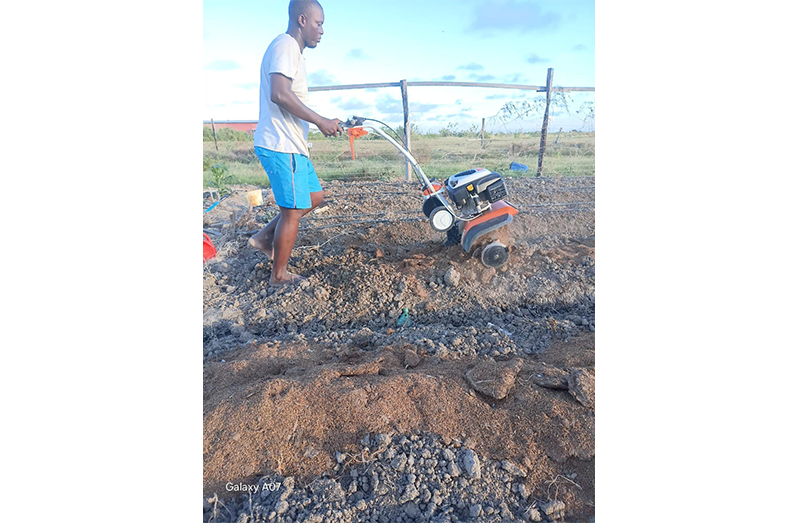
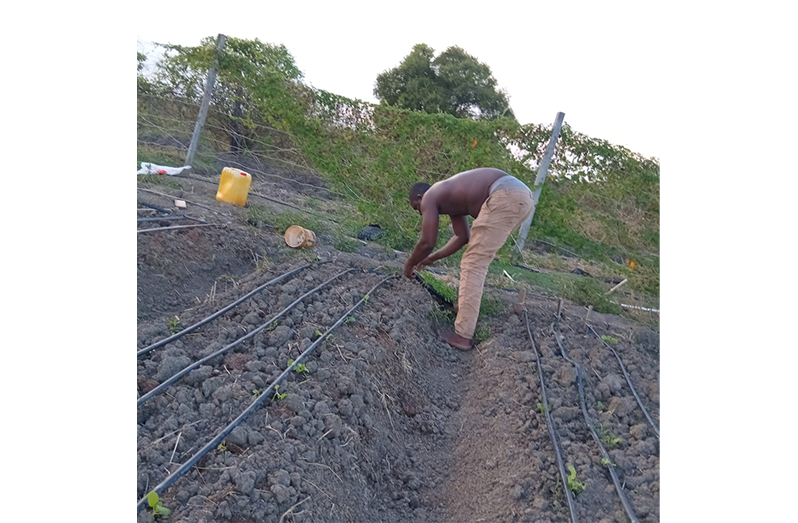
Today, modern tools have replaced backbreaking manual labour on his plot. With a motorised tiller and drip irrigation, Benjamin manages his soil, labour and water with precise efficiency.
He views climate-smart technology as essential to reducing waste and boosting profitability. His immediate structural objective is to build larger shade houses that will protect his delicate vegetables from extreme weather spikes and allow him to supply local buyers consistently year-round.
To realise these goals, Benjamin is tapping into government support systems designed to empower independent producers.
He hopes to benefit directly from the National Agricultural Research and Extension Institute’s (NAREI) shade house initiative, building upon training provided by the Ministry of Agriculture (MoA).
The core principles of integrated circular farming are already underway at Hopetown. Benjamin regularly collects nutrient-rich manure from the modern, tunnel-ventilated poultry facility at nearby Onverwagt to enrich his soil.
That success has spurred plans to raise his own flock of layers and broiler birds, producing fresh eggs and meat for market while securing a steady, on-site supply of organic fertiliser for his crops.
He is very grateful for the support and technical guidance from the Guyana Livestock Development Authority (GLDA) Region Five Extension Officer, Kyle George, who has helped Benjamin turn his ideas into an environmentally sound operational plan focused on clean, high-quality food production.
At the same time, Benjamin is laying the groundwork for a specialised swine unit. Eager to master the artificial insemination technique for his sows, he aims to introduce top-tier breeding genetics without the steep, ongoing overhead of housing and feeding a herd boar.
Through strategic herd management, artificial insemination will let him precisely control breeding cycles and maximise earning potential.
Even as new livestock ventures take shape, reclaiming his lost beekeeping enterprise remains a deep personal goal.
Benjamin plans to re-establish his apiary within the nearby mangrove forest, offering bees ideal foraging conditions while bolstering coastal ecology.
With technical backing from the GLDA, he looks forward to seeing fresh, locally produced honey return to his product line-up.
Scaling an integrated farm of this magnitude requires capital. Benjamin has initiated the application process for a G$3 million loan through the Guyana Development Bank, a financial institution he views as a critical lifeline for skilled, ambitious producers who lack large initial reserves.
If approved, the funding will go directly towards shade house construction, poultry housing, farm security and infrastructure enhancements needed to complete his integrated model.
Looking ahead, Benjamin is confident that market demand will easily absorb his expanded output.
As Guyana’s economy grows, he foresees an increasing appetite for fresh, locally produced foods.
His long-term vision includes establishing a dedicated farmers’ market in Hopetown, creating a direct sales hub for himself and fellow neighbourhood growers.
Above all, Benjamin hopes his journey inspires young people to see agriculture not as a legacy of toil, but as a modern, technology-driven business.
With modern equipment, expanded training, accessible start-up resources and flexible credit options, he believes the barriers to entry are lower than ever.
Through innovation and determination, Benjamin has turned a simple backyard garden into a thriving enterprise and provided a practical blueprint for farming’s future in Guyana.