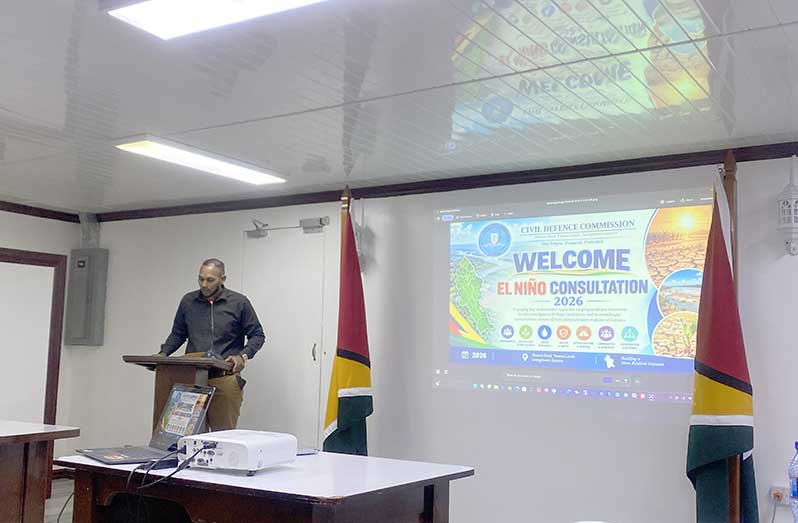
THE Civil Defence Commission (CDC) on Wednesday hosted an El Niño preparedness consultation in Region Two, bringing together regional officials and stakeholders to strengthen coordination and preparedness in anticipation of possible weather-related impacts.
In his opening remarks, Regional Chairman Devin Mohan stressed the need for stronger coordination among the region’s agricultural sector, the CDC, Neighbourhood Democratic Councils (NDCs) and other essential services.
Mohan said the region must strengthen its capacity for rapid response, particularly in identifying water shortages, and ensuring that vulnerable residents, including the elderly and persons with disabilities, can access water and other essential services.
“We must strengthen coordination and close collaboration among agriculture, CDC, NDCs and other services in the region,” Mohan said, while emphasising the importance of having a real-time rapid response system that can move quickly when needs arise.
He said preparedness must be measurable, with clearly defined responsibilities and timelines.
The Regional Chairman also called for greater attention to investments in agricultural infrastructure and the effective utilisation of resources.
“As we think ahead, we must value our investments in agricultural infrastructure, and ensure that these investments are fully utilised and carefully managed, while reaching farmers when they need assistance,” Mohan said.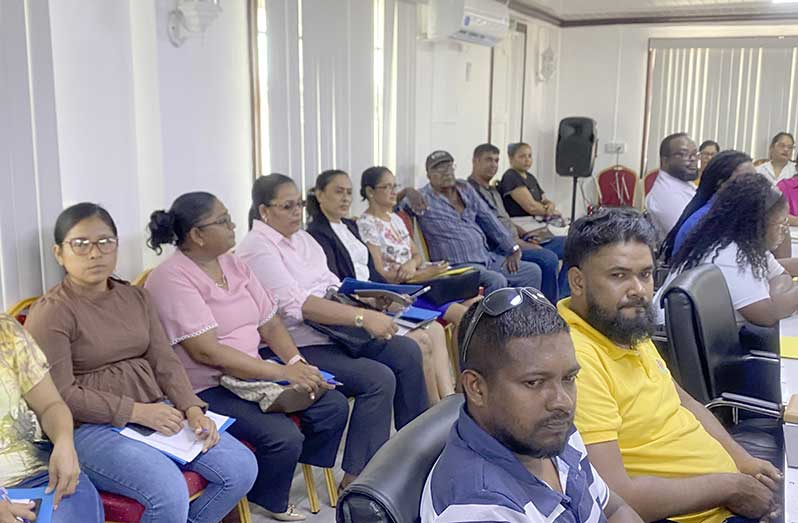
He added that the region must identify risks early, take appropriate action, and safeguard communities to ensure that Region Two remains prepared for whatever conditions may arise.
Providing an overview of El Niño and its potential impacts on Guyana, CDC representative Maria Harrinarine Singh said the Commission was pleased to host the consultation as part of efforts to empower stakeholders to better understand, prepare for and respond to the phenomenon.
Singh highlighted the importance of preparedness and response, particularly in relation to health, agriculture, and crop management. She said stakeholders must understand what to expect and take the necessary measures to reduce the potential impacts.
An overview of El Niño impacts and weather projections was also presented by the Hydrometeorological Service’s Komchand Dhiram, who used a PowerPoint presentation to explain anticipated weather patterns, and provide alert maps and forecasts to assist stakeholders in planning ahead.
Dhiram said a drought warning is currently in effect for Region Two, and noted that forecasts are updated monthly.
He highlighted the possibility of above-normal daytime temperatures and hot spells, which he identified as a key concern for the region.
Dhiram explained the climatology of hot spells, noting that November can experience at least 15 hot-spell days, while October represents the peak period. For October, eight days are currently predicted to experience hot-spell conditions.
For Region Two, he said the number of hot-spell days could range between 40 and 50 for the period, with conditions expected to reduce from November due to the influence of El Niño. However, he noted that forecasts extending into March next year indicate the possibility of above-normal temperatures.
Dr. Leslynann Garraway of the CDC shared information on national preparedness measures and the Commission’s coordination framework.
She explained that the CDC serves as the coordinating hub, working through regional systems to lead and coordinate preparedness and response efforts. The approach includes pairing awareness with available resources, building community capability and escalating response measures as risks evolve.
Divisional Officer (ag) for Region Two, Suresh Persaud also made a presentation focusing on the increased risk of vegetation and bush fires during dry conditions.
Persaud said that dry vegetation and grasslands can ignite readily and support the rapid spread of fires.
He also pointed to the accumulation of rubbish in communities and along access routes as an additional source of combustible material.
According to Persaud, windy conditions can further increase the rate at which fires spread and carry embers into nearby vegetation and structures.
He noted that limited water availability in some communities could delay fire suppression efforts and increase reliance on tankers and bowsers.
Persaud also highlighted the particular challenges faced by remote and Indigenous communities, where longer response times can make prevention, local capacity-building and early notification critical.
He said repeated vegetation fires can affect homes, farms and public infrastructure, while also disrupting community livelihoods. Participating agencies include Guyana Police Force, Guyana Livestock and Development Association, Guyana Water Incorporated, Ministry of Health, Environmental Protection Agency, Guyana Fire Service, Guyana Power and Light amongst others.
The consultation formed part of ongoing efforts to strengthen preparedness, coordination and community resilience as Guyana continues to monitor the potential effects of El Niño and associated dry and hot conditions.