– Chief Meteorological Officer assures, urges Guyanese to stay calm
AS Guyana continues to prepare itself for what has already been a record-breaking El Niño season, Chief Meteorological Officer Dr Garvin Cummings is urging Guyanese to stay calm, noting that while heat remains a major concern for the Hydrometeorological Service, Guyana has stable access to water.
Answering questions and engaging in discussions during the 21st National Climate Outlook Forum (NCOF), Cummings noted that rainfall in the first half of the year has ensured that Guyana’s conservancies remain readily equipped, providing a stable water supply, while calling on the public to conserve water.
Speaking on Tuesday, Dr Cummings noted that Guyana saw consistent rainfall in the early months of the year, with March 2026 seeing some of the highest rainfall recorded in 2026. While Guyana is heading into drier months, Dr Cummings noted that the soil remains moist.
“We had a lot of rainfall for the first half of the year. We had some months, like March, that was really, really wet, for example. It means that the conservancies are at full supply level. It means that we have enough water to take us through. The soil moisture is pretty high, so from a crop perspective, there should be enough water to take us to the end of November,” he stated.
Moving forward, Dr Cummings noted that the main aim remains on monitoring the rainfall for the rest of the year and heading into next year.
He shared, “What is happening apart from the temperatures is really not so much off the charts, because there is a good supply of water. We have enough water for the farmlands, we have enough water for foraging the livestock and the poultry and so on. So, the concern is not access to water,” he said.
While Guyana has adequate access to water, Dr Cummings shared that managing and mitigating heat are the biggest challenges amid El Niño. He explained that with Guyana recording consistently warmer temperatures, greater attention needs to be paid to cattle and livestock.
“The problem is the temperatures. If we are not going back to that 27 degrees Celsius average temperature, and we stay at 30, then you have got to think about how the chickens are going to survive in the pen, or the cow and the sheep and so on are going to survive within that sort of temperature. Good water supply, but outside of the rainy season, the rainy period, the temperatures are still very high,” he said.
In addition to the available water supply, Cummings noted that preparations are already being made to ensure farmers can access irrigation water if needed. He said the National Drainage and Irrigation Authority (NDIA) has already begun positioning mobile pumps to supply irrigation water to farm communities, villages and other areas in need.
LESS RAIN, DRY CONDITIONS
The 21st National Climate Outlook Forum also worked to release the national climate outlook for the next three to six months. Presented by Komalchand Dhiram, Specialist Meteorologist, the outlook points to below-normal rainfall conditions across Guyana, with the forecast showing a strong probability of drier-than-normal conditions from October through December.
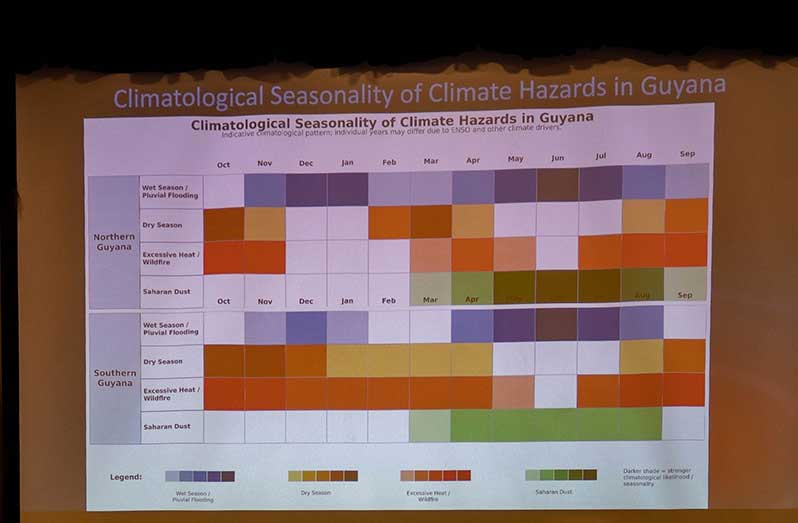
While the northern parts of the country are normally wetter than the south during this period, the forecast indicates that rainfall is likely to remain below normal levels for both areas. The outlook for January to March also shows a strong probability of below-normal rainfall, suggesting that the drier conditions could continue into the first quarter of 2027.
The monthly outlook indicates that October is likely to be particularly dry, with rainfall expected to remain below the levels normally recorded during the month. While rainfall may begin to return in November, the forecast points to a drier start with significantly lower amounts than usual.
By December, the rainfall is expected decrease, despite the month normally bringing increased rainfall that provides relief for farmers and water supplies. While some showers are expected, the outlook indicates that drought risk will remain high. The short-term drought outlook, which covers July to December, has also shifted from a drought warning to a drought emergency alert. This assessment takes into account rainfall recorded during July and August, as well as the forecast for September through December, with the two months recording less rainfall than expected and the outlook continuing to indicate below-normal rainfall. However, the long-term drought outlook, covering April 2026 to March 2027, remains a low level of concern. This is because the assessment is still being influenced by the relatively good rainfall recorded during April, May, June and July. As the year progresses and more of the forecast rainfall is incorporated into the assessment, the long-term drought status is expected to change.
Despite the overall below-normal rainfall outlook, Guyana could still experience isolated periods of intense rainfall. For October to December, the forecast indicates that coastal areas could experience approximately two to four days with rainfall of at least 25 millimetres, while there remains a possibility of one or two events reaching 50 millimetres during the three-month period. Such rainfall events can still result in flooding, particularly in areas vulnerable to water accumulation.
Meanwhile, temperatures are expected to remain above normal during the coming months, with the forecast indicating a higher probability of above-normal daytime maximum and nighttime minimum temperatures. Guyana’s hot-spell season generally runs from August into early November, with the number of hot-spell days typically peaking around October. However, this year, the country may have already reached its peak in August, with a significant number of hot-spell days already recorded by September.
For the remainder of 2026, coastal areas are forecast to experience between 50 and 60 additional hot-spell days, underscoring the continued influence of the current El Niño conditions. The heat is expected to persist, even as Guyana remains susceptible to isolated showers and flash-flood events.
The temperature outlook also extends into March 2027, with above-normal daytime and night-time temperatures expected to continue. The outlook therefore highlights the need for continued monitoring of rainfall and temperatures as Guyana moves through the drier months, while preparations remain in place to support agriculture and water supply should conditions worsen.