







-warmest August on record spotlighted as experts warn of hotter nights, El Niño lasting until March 2027
METEOROLOGISTS, agricultural stakeholders and other officials gathered on Tuesday for the 21st National Climate Outlook Forum (NCOF) to examine Guyana’s latest climate information and to prepare for the impacts of the ongoing El Niño phenomenon.
Hosted by the Hydromet Service Guyana, the forum comes as August 2026 was recorded as Guyana’s warmest August on record. Chief Meteorological Officer Dr Garvin Cummings spoke on the current El Niño episode and previous episodes, while the national three- and six-month climate outlook for October 2026 to March 2027 was also presented.
On Tuesday, the Hydrometeorological Service used the opportunity to warn of the potential for suppressed rainfall during the secondary rainy season.
The forum also featured presentations on climate and health, climate and agriculture, as well as discussions among stakeholders on the climate outlook for the months ahead and its potential impact on key sectors across Guyana.
Offering opening remarks, Chief Hydrometeorological Officer Dr Garvin Cummings noted this year’s National Climate Outlook Forum was prompted by recent weather patterns.
He explained that while the annual forum is typically held in April and November, ahead of the primary and secondary rainy seasons, the timing of this year’s event was sparked by Guyana’s current weather and climate pattern.
“It is typical for us to have this forum in April and then November, to usher in the primary rainy season and the secondary rainy season. For obvious reasons, we thought it necessary to have NCOF in September because of the current situation that we are in with our weather and climate,” he said.
Cummings was keen to emphasise that the forum aims to share important information with stakeholders from a number of sectors, noting, “The purpose of bringing you into this room is not just to inform you, it is [also] to make sure that as we move through this El Niño event, all of you, whether government, private sector, or NGO, have the most recent and up-to-date information to take appropriate action.”
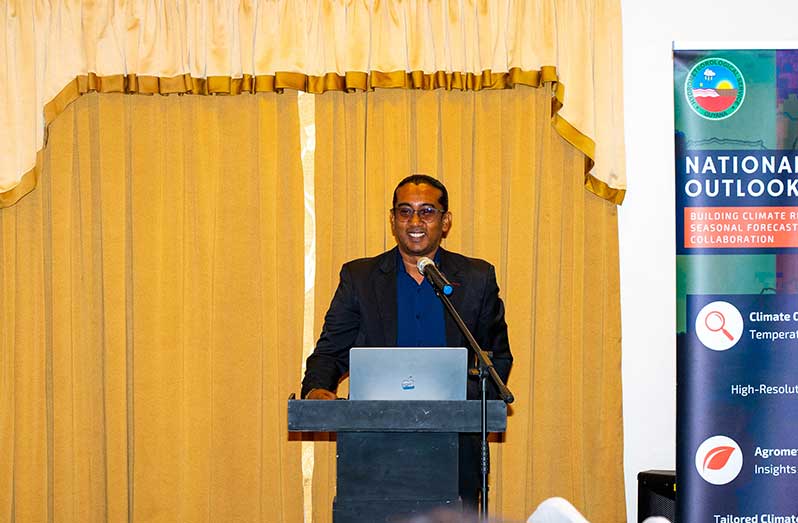
The forum sought engagement from members of the agricultural, water, health, energy, tourism, engineering and infrastructural sectors on staying resilient through what Cummings described as a challenging period.
While the forum sought to highlight a number of issues and potential impacts of unpredictable weather patterns, Dr Cummings noted that El Niño heat remains the major concern.
According to him, because of the rainfall Guyana saw in recent months, water supply still remains stable. However, Cummings noted that heat in the next three to six months remains a challenge, with August 2026 being the hottest August on record.
“The water supply to some extent is still stable and still regular,” he told the gathering, adding, “August has broken our record as the warmest August on record. We have to be ready. We have to be steady. We have to be prepared to deal with the impacts of this type of weather.”
A core priority of the forum is the national climate outlook for the next three to six months.
Presented by Specialist Meteorologist Komalchand Dhiram, the seasonal outlook noted that in the months of October, November and December, sea-surface temperature is predicted to be above normal, impacting both the timing and the intensity of the rains.
Speaking on the likelihood of continued dry conditions, he said, “We continue to see that approximately 90 per cent chance of El Niño, or that is how confident we are, that we can go all the way towards the end of March,” he said.
Looking at Guyana specifically, Dhiram noted that Guyana has been experiencing warm temperatures since January. Moving forward towards the end of the year and toward next year, Dhiram noted that Guyanese could also expect hotter nights.
Guyana has also recorded changes in rainfall patterns. Dhiram noted that when compared to the historical January to August period, northern Guyana has actually been relatively wetter than usual.
Highlighting the national average, Dhiram stated that the normal January–August rainfall total is 1,778 mm, while this year’s rainfall reflects 1,715 mm. This is not a significant gap, he stated, adding that Guyana has still seen a ‘good wet season,’ although it was not among the most aggressive.
Currently, there is a 90 per cent chance that El Niño conditions will continue here, with models predicting that through the early months of 2027, there is more than an 85 per cent chance that Guyana will see strong El Niño conditions.
Moving forward, the Hydromet Service Guyana will continue to share updates to better help Guyanese prepare for the weather ahead.




