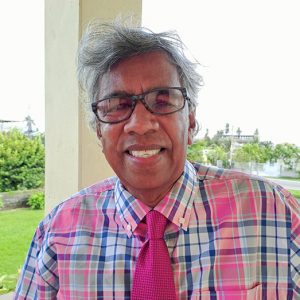
DAVID Patterson, the present head of the Alliance For Change and I have always had a good relationship. It didn’t deteriorate when he acquired state power; it just was held in abeyance. I didn’t socialise with him after he became minister in May 2015. I stopped getting his birthday invitation after May 2015.
But you can say that the relationship was badly parked after 2015 because my daily columns were punctuated with large doses of criticism of state power by the AFC. Because of the music and permeating conversations of the guests, David and I walked up the road to talk about his politics back then.
He let me know that he resents me classifying him as a member of the MCC – Mulatto/Creole class. When someone hardly gives me a chance to talk in a conversation, then you know the world is coming to an end. I am a loud-mouthed aggressive Wortmanville madman, but David hardly gave me a chance to talk. Maybe I am no longer mad.
David was irritated about my MCC description of him. He exclaimed: “Banna, I born in Lodge, you ask Lodge people about me.” For those who don’t know, Lodge is the Georgetown ward east of Wortmanville where I came from. My brother, “Lightweight” Kissoon and my mother’s cousin lived their entire lives in Lodge, so I know Lodge very well.
I could see he was upset. I kept interjecting, saying: “I hope you give me a chance to talk when yuh finish.” When my chance came around, I told David that class thinking can occur because of association. Who told me to say that! David yelled out: “Wuh association you talking about. That is nonsense.” I attempted to deconstruct the word “association” away from its normal grammatical connotation. But David thought my application of the word to describe people’s social-class standing was nonsense.
I used another angle – social classes are not fixed; they change form and substance over time. A proletarian person can achieve middle-class status through education. A middle-class human can become a petite bourgeois. A rising petty bourgeois can embourgeoisify him/herself through capital accumulation and become a member of the bourgeoisie. A peasant through investment can become a member of the petite bourgeoisie.
That is the nature of class changes in society. Society is a formation with its inherent dynamism that allows for constant changes. A more fundamental agency of permanent change is the dialectic. I wasn’t able to convince David about the MCC ownership of the AFC because he personalises class standing. He looks at the existence of social classes based on how he sees himself in society. For him, his class origin determines his class standing.
This is a huge misunderstanding of social classes. A person’s class origin does not exist in perpetuity. People achieve social elevation and transform their economic existence, thus moving from low-income stratum to middle-income stratum and the dynamism inherent in society allows for further integration into higher income brackets.
I finally got in a sustained argument of mine which I used to show David the relationship between classes and ideology. You can cling to your working-class origin, even though you lost your proletarian existence and have become middle class or petite bourgeois and still proclaim your working-class standing. This is where ideology comes in.
If you were born into the proletariat class but along the way, you achieve higher class standing you can still describe yourself as a working-class boy, because your ideology is in support of the working people and your personal lifestyle accommodates relationships with the proletariat.
Objectively, your economic status makes you petite bourgeois and you cannot change that fact.
But you can make serious claim to being working class through ideology. This is where the founder of Marxism, Karl Marx comes in. Marx employed his scholarship in service to the liberation of the proletariat class. Marx was not a working-class economist or philosopher, but he used philosophy to liberate the proletariat across the world. In Guyana, Jagan is the perfect example where ideology can be used to create social conditions that favour the masses.
My point to David was that if he were a working-class boy as he claimed he is, then he did nothing for the Guyanese working people when he had power, because he did not have a proletarian ideology and his party was a purist MCC entity.
We agreed to disagree but the conversation ended on a note that was mentally satisfying for me. He told me about the one regret he has about being in power. Based on my contribution to Guyana, he still regrets that he did not reach out to me. No hard feelings though, David. We’re still friends.
DISCLAIMER: The views and opinions expressed in this column are solely those of the author and do not necessarily reflect the official policy or position of the Guyana National Newspapers Limited.