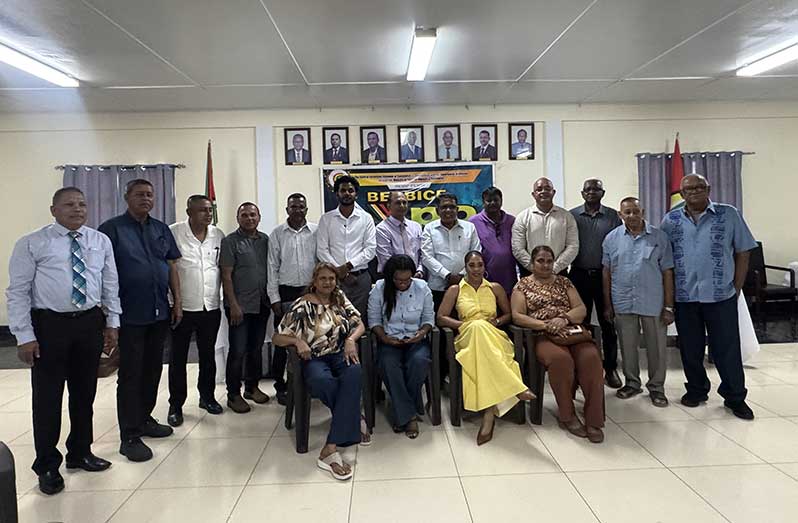
— billions in infrastructural, agricultural and business investments driving Region Six transformation
By Bebi Shafeah Oosman
BERBICE is being positioned to become a major agriculture, trade, logistics and investment hub as the government continues to roll out billions of dollars in infrastructure, agricultural development and business-support initiatives across the region.
Minister of Agriculture, Zulfikar Mustapha, outlined this vision while delivering the feature address at the launch of the 20th Berbice Expo and Trade Fair which will run from October 2 – 5 at the Rose Hall Estate Community Ground in East Canje Berbice.
The Minister said the transformation taking place across Berbice is being supported by major investments in agriculture, transportation, tourism, technology, agro-processing and other productive sectors, creating new opportunities for farmers, businesses and young people.
This year’s Expo is being held under the theme, “Harnessing AI to transform the future: while enhancing our People.” As such, Mustapha said the theme is particularly relevant as Guyana embraces technology and Artificial Intelligence (AI) to improve productivity and service delivery.
“Artificial Intelligence is no longer a distant concept; it is a practical tool that can help our farmers increase yields, our agro-processors improve efficiency, our businesses reach wider markets, and our young people access new skills and opportunities,” he said.
However, he stressed that people must remain at the centre of the transformation, with technology being used to enhance human potential rather than replace it. Mustapha then pointed to the Farmers Connect App as one of the ways technology is already transforming Guyana’s agriculture sector.
The platform provides farmers with access to agricultural information and services and includes an AI-driven assistant developed specifically for Guyana’s agricultural environment.
According to the Minister, the app has attracted 4,389 subscribers, including 2,212 active farmers.
The Agriculture Information System (AIS) is also being used to improve the Ministry’s ability to collect and utilise information on farmers, farms and agricultural activities.
Through partnerships with the Food and Agriculture Organization (FAO) and the Inter-American Institute for Cooperation on Agriculture (IICA), the Government is also pursuing AI-driven production systems and large-scale agricultural innovations, including hydroponics and climate-resilient crop and livestock management.
Meanwhile, the Pesticides and Toxic Chemicals Control Board’s Licensing and Registration System, launched on July 1, 2026, has registered 325 users and issued 752 licences.
MAJOR TRANSFORMATION
Mustapha further stated that under the leadership of President Dr. Mohamed Irfaan Ali, Guyana’s development is advancing at an unprecedented pace, while emphasis continues to be placed on building a diversified economy beyond oil and gas.
Among the major projects expected to transform Berbice is the US$285 million Berbice Deep-Water Port at the mouth of the Berbice River. Situated on approximately 30 acres north of Crab Island, the development is expected to support oil and gas operations while expanding Guyana’s trade and logistics capabilities.
The Minister said the Government is also finalising negotiations for a new four-lane, high-span bridge across the Berbice River, which is expected to remove existing weight and transit limitations and integrate with the planned four-lane highway towards Moleson Creek.
Other transformative investments highlighted included the 10,000-seat Palmyra International Multi-Purpose Stadium, the planned municipal airport at Rose Hall, Canje, and the Hospitality and Tourism Training Institute at Port Mourant.
The Government’s Model Village Initiative has also been extended to Region Six, with communities including Port Mourant, Rose Hall Town and Skeldon targeted for improvements such as modern internal roads, drainage, street lighting, CCTV cameras and green spaces.
Mustapha also spoke of the modernisation of the Skeldon Market and surrounding infrastructure, including upgrades to approximately 9,277 metres of roads, which are expected to benefit some 720 households, vendors and businesses.
Specialised business clusters for poultry, egg production and commercial hatching are also expected to be supported through financing from the Guyana Developnment Bank.
AGRICULTURE REMAINS CENTRAL
Despite Guyana’s rapid industrialisation, Mustapha said agriculture remains central to the government’s development agenda, pointing to the $113.2 billion allocated to the sector in the 2026 National Budget.
In Region Six, more than $600 million has been invested in the brackish-water shrimp industry. Production reached approximately 1.557 million kilogrammes in 2025 and has since expanded to approximately 145,000 kilogrammes per month in 2026.
At Black Bush Polder, a state-of-the-art seed-processing facility, retrofitted with a 10-tonne dryer and seed cleaner at a cost of $75 million, is serving more than 600 farmers.
The government is also moving to open approximately 35,000 acres of new agricultural land while pursuing additional international markets for rice.
Mustapha said significant investments are also being made to revitalise the sugar industry, particularly at the Albion, Blairmont and Rose Hall estates. The objective is to increase production and efficiency while positioning the industry to satisfy regional demand for industrial-grade white sugar and other value-added products.
Flood protection and drainage infrastructure are also being strengthened, with two high-level, Hope-like drainage canals being developed at Number 52 Village and the Lancaster area.
Farm-to-market roads at Numbers 52 and 58 villages are improving access to more than 50,000 acres of agricultural land, while all-weather trails are being advanced from Moleson Creek towards riverine communities, including Orealla.
Communities along the Canje River, including Baracara, have also benefitted from heavy land-clearing equipment and drainage works aimed at increasing cash-crop production.
In the livestock sector, approximately 6,000 acres have been dedicated for new pasture lands in Region Six, while investments are also being made in feed production.
Mustapha also highlighted the Tunnel Ventilated House Poultry Project at Onverwagt, where pens are designed to accommodate between 20,000 and 45,000 birds, with birds reaching market weight within five to six weeks.
Agro-processing and new markets
AGRO-PROCESSING, NEW MARKETS
Modern agro-processing facilities have also been established at Crabwood Creek and Orealla to reduce post-harvest losses, increase farmers’ earnings and encourage value-added production.
The Crabwood Creek facility is fully operational and provides services including dehydration, milling, blending and juicing.
Mustapha urged farmers and agro-processors to utilise the facility to improve product quality and expand production.
He further announced that the Agriculture Ministry will invest in a dedicated cold-storage plant to help reduce spoilage and post-harvest losses for perishable crops.
Another initiative will establish stronger direct linkages between Region Six farmers and the hospitality sector.
Under the initiative, hotels will be connected directly with local producers of fruits, vegetables, poultry and other agricultural products. Mustapha said this should reduce dependence on middlemen and imports while providing farmers with more reliable markets and fairer returns.
EL NIÑO SUPPORT
Addressing current El Niño conditions, Mustapha said the Agriculture Ministry and its agencies are implementing measures to safeguard agricultural production.
These include maintaining irrigation and drainage infrastructure, pumps, canals and conservancies, while providing farmers with technical support on water conservation and climate-resilient farming practices.
Rice farmers are being guided on water-saving practices, drought-tolerant varieties and adjusted planting schedules, while farmers are also being encouraged to utilise mulching, micro-irrigation and water-harvesting techniques.
The Minister also pointed to direct financial interventions aimed at reducing production costs.
More than $490 million in subsidies was distributed to Berbice rice farmers, while $3.2 billion worth of urea fertiliser was distributed to 15,460 rice farmers nationally.
Mustapha also highlighted the availability of collateral-free and interest-free financing through the Guyana Development Bank, saying greater access to financing will allow farmers, agro-processors and entrepreneurs to expand viable businesses.
Reflecting on the 20-year milestone of the Berbice Expo and Trade Fair, Mustapha congratulated the Central Corentyne Chamber of Commerce for sustaining an event that has become an important platform for regional businesses.
He said the Expo provides businesses, farmers and investors with opportunities to showcase products, establish market linkages, network and explore new investments.
“Berbice is quickly emerging as an investment hub, offering a range of opportunities across key industries,” Mustapha said.
With continued investments in infrastructure, logistics, agriculture and value-added production, he said Berbice is poised to play an increasingly important role in Guyana’s economic growth and the wider Caribbean agricultural economy.
“Let us work together to transform Berbice into a beacon for agricultural excellence and a driving force in Guyana’s economic development,” the Minister said.