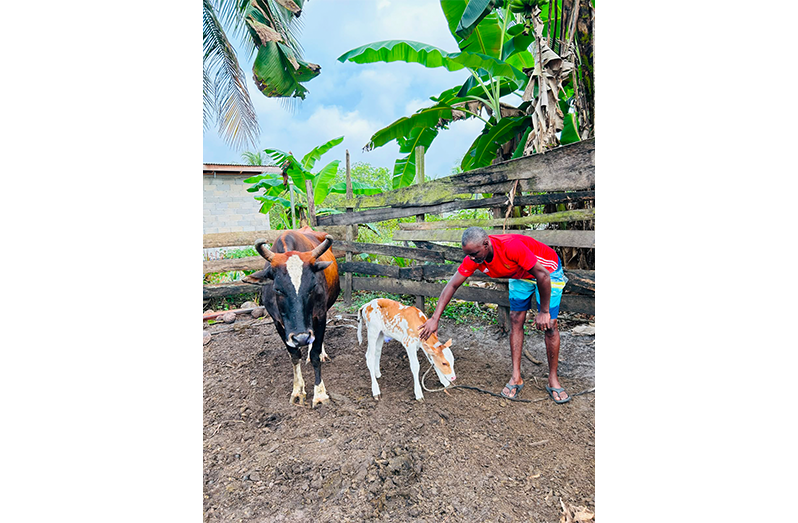
IN Amelia’s Ward, Linden, where generations have known the town through the legacy of bauxite mining, Otubbo Headley is quietly writing a different kind of economic story, one measured not in tonnes of ore but in gallons of milk and the steady improvement of a cattle herd.
For nearly two decades, Headley has built a dairy enterprise in an environment where designated pasture is scarce, and livestock production is under pressure from a growing community.
Yet, with determination and support from the Guyana Livestock Development Authority (GLDA), he is moving beyond simply keeping cattle to deliberately improving them.
Through artificial insemination, veterinary care, extension services and access to improved genetics, Headley is demonstrating how science and technical support can help a smallholder farmer turn environmental constraints into an opportunity for greater productivity, efficiency and resilience, offering a compelling glimpse into how agriculture can contribute to Linden’s economic diversification and local food security.
Family legacy
Headley’s journey into cattle farming began in 2008, when Linden was grappling with economic uncertainty.
For generations, bauxite mining had been the town’s economic backbone, sustaining employment, businesses and families. However, changes within the industry were creating growing economic pressures and highlighting the need for alternative sources of livelihood.
As a young family man, Headley relied on intermittent work, but the irregular income made it difficult to meet his household’s demands.
Seeking greater economic stability, he turned to cattle production, an enterprise operated by his father-in-law, a cattle farmer, setting in motion a journey that would eventually transform both his livelihood and his family’s future.
Encouraged by his father-in-law, Headley began with a cow he received as a gift. He later purchased two more from a village pastor, gradually expanding the herd through reinvestment and hands-on experience.
Today, he has approximately 25 cattle, predominantly Holstein-Zebu crosses, which have become an important source of income for his family.
Reflecting on the years he spent raising his family, Headley regards the value of his cattle as best measured by the opportunities milk sales created for his seven children.
Income from his dairy enterprise helped finance their education and laid the foundation for their careers.
Two became teachers, one became a nurse, another is self-employed, and another works for a private company.
His youngest child, now 19, recently completed trade school. For Headley, their achievements are a lasting testament to the economic security his cattle provided and to the transformative power of what he proudly calls “milk money”.
“If it wasn’t for ‘milk money’, I don’t know what would have happened, but the money I got from selling cow’s milk assisted me in sending my children to school,” he said.
Farming within Linden’s limits
That history explains why Headley remains committed to cattle farming despite the challenges of raising livestock in Linden.
Unlike Guyana’s expansive cattle-producing areas, he does not have extensive designated pasture for his animals.
His cattle are allowed to graze in available areas and are brought home in the afternoon. While this system has enabled him to maintain the herd, it also requires constant supervision because the animals can stray into residential areas, creating conflicts with residents.
On occasion, Headley has even had to visit the police station to resolve issues arising from wandering cattle.
Yet these challenges have strengthened rather than weakened his determination to improve the way he farms. With limited land and pasture, simply increasing his herd is not necessarily the most practical path to growth.
Instead, Headley has increasingly focused on improving the quality, health and productive potential of the cattle he already owns.
It is this shift, from maintaining a herd to deliberately improving it, that has brought genetic improvement to the centre of his farming ambitions.
Improving the Herd Through Science
For years, Headley had wanted higher-quality dairy animals within his herd, but conventional breeding could be expensive for a small farmer.
Maintaining a breeding bull, for example, requires additional feed, space, veterinary care and management.
Accessing superior genetics can also be difficult for small-scale farmers. Through the Guyana Livestock Development Authority’s (GLDA) artificial insemination programme, however, Headley has been able to access selected genetics without the need to maintain male breeding stock on his farm.
Four of his heifers have benefitted from the AI programme, and the results have given him renewed confidence in the possibilities of genetic improvement.
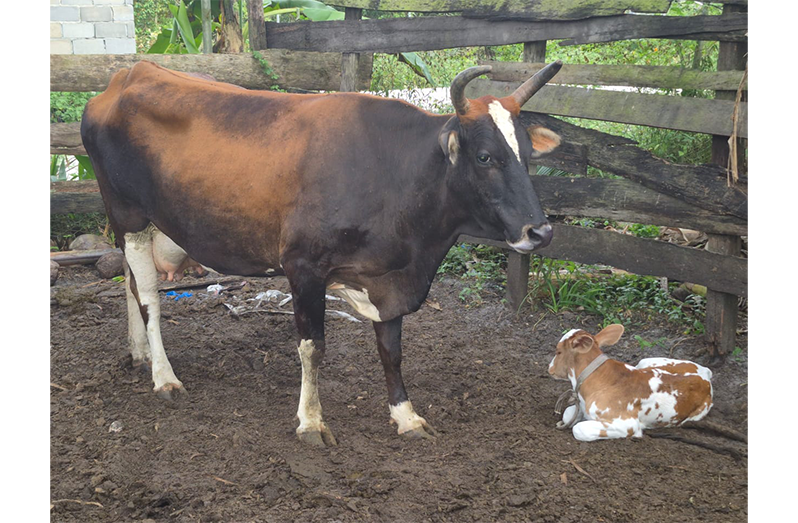
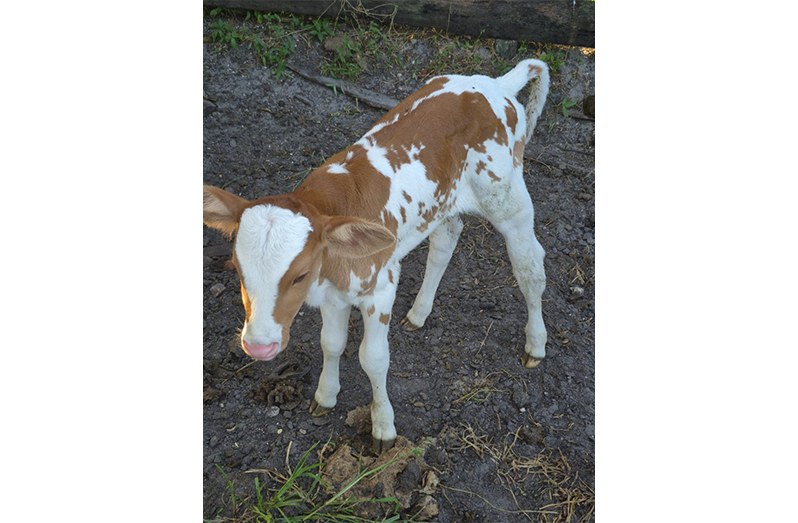
The most significant development came on August 14, 2026, when one of his Holstein-Zebu crossbred cows gave birth to Emily, a Gir calf produced through artificial insemination.
For Headley, Emily represents more than the addition of a new animal to his herd. Her birth is tangible evidence that modern reproductive technology can reach smallholder farmers and can be applied within a production system such as his.
It also marks the fulfilment of a long-standing ambition to improve the genetic quality of his cattle.
Looking at the newborn calf, Headley expressed his delight at what he sees as a significant step forward for his herd.
“To me, this newly birthed calf resembles a pure-bred Holstein I would see at shows, and I am very happy to have it as a part of my herd; the colour is just right,” he said.
Although Emily exhibits the characteristics of a high-quality dairy calf, she has Gir genetics; her dam is a Holstein-Zebu cross, a combination well suited to Headley’s tropical production environment. Originating in India, the Gir is a Bos indicus breed recognised for its heat tolerance, environmental adaptability, hardiness and dairy potential.
Its capacity to maintain milk production under tropical conditions, coupled with relatively high milk-fat content, makes Gir genetics particularly valuable in tropical dairy breeding programmes.
Those characteristics are especially relevant to Linden, where Headley operates without extensive pasture and must manage his cattle within a relatively constrained environment. His animals are exposed to tropical temperatures and must utilise the available grazing and feed resources efficiently.
The introduction of Gir genetics into a herd that already contains Holstein and Zebu ancestry therefore offers the potential to combine dairy productivity with the adaptability required for tropical smallholder production.
For Headley, the significance of genetic improvement lies precisely in this balance. He is not seeking to replicate the production system of a large commercial dairy farm; rather, he wants animals capable of producing efficiently within the realities of his own operation.
By progressively improving the genetic potential of each generation, he can enhance productivity without proportionately increasing herd size or placing additional pressure on scarce land resources.
Improved production
The economic implications are equally significant. Headley currently produces approximately two to three gallons of milk daily, depending on the productivity of his milking cows.
He sells milk to consumers within the community and distributes any surplus when production exceeds local demand. Improved genetics could enhance milk yields, increase farm income and optimise the use of his existing resources.
Artificial insemination also offers an economic advantage by reducing the need to maintain breeding bulls.
For a farmer with limited pasture, avoiding the additional costs of feeding, housing and caring for male breeding stock can help reduce operating expenses.
In this respect, genetic improvement is not simply a breeding strategy; it is part of Headley’s broader effort to create a more efficient and economically sustainable production system.
Satisfied with the AI service, Headley is now looking towards the next stage. He hopes to participate in the GLDA’s embryo-transfer programme, which he believes can further accelerate genetic improvement within his herd.
His interest in embryo transfer reflects his growing appreciation that the productivity of his farm will depend increasingly on the quality of its genetics and the effectiveness of its management.
Technical Support Beyond Breeding
Genetics, however, cannot deliver its full potential without healthy animals and sound management, and this is where the GLDA’s continuing technical support has become critical. Headley credits the GLDA Region 10 Extension Team, led by Regional Coordinator Ms Roxanne Langevine, together with Dr Grey, the GLDA veterinarian, and Ms Ronique Bremmer, the livestock extension assistant, with contributing significantly to the development of his herd and his knowledge of livestock management.
The team’s involvement extends beyond reproductive services. Regular farm visits allow the officers to monitor the health of the animals, provide practical guidance and screen the herd for transmissible diseases, including tuberculosis.
This integrated support is particularly important because improved genetics can only translate into greater productivity when animals are healthy, properly managed and able to express their genetic potential.
The extension team’s guidance has also highlighted the importance of proper livestock records. Headley acknowledges that record-keeping remains an area for improvement but recognises that accurate records of animal identification, breeding, treatments, disease history and production are fundamental to effective herd management.
As his participation in genetic improvement expands, such records will become increasingly important in evaluating animal performance and making informed breeding decisions.
For Headley, his engagement with the GLDA has extended beyond access to services to encompass the development of technical knowledge.
Although he began farming with limited formal training, years of practical experience, reinforced by guidance from the Region 10 team, have deepened his understanding of animal health, breeding and herd management.
He now adopts a more systematic approach to cattle production, recognising the interdependence of these factors in improving overall productivity.
Headley also recognises the agricultural policies of the PPP/C Government, led by President Dr Mohamed Irfaan Ali, particularly its emphasis on genetic improvement and on providing government-supported services that enable smallholders to participate.
As a livestock farmer with a relatively small herd in Linden, access to artificial insemination (AI) and other advanced breeding services would otherwise be difficult to obtain.
While acknowledging the scope for continued programme improvement, he values the opportunities these initiatives provide to smallholder farmers and their contribution to strengthening Guyana’s livestock sector.
A Wider Future for Linden Agriculture
His experience is particularly relevant to Linden’s broader economic context. The town’s identity has long been shaped by bauxite mining, but the challenges associated with dependence on a dominant industry have highlighted the need for greater economic diversification.
Headley recognises that agriculture will not replace bauxite; however, enterprises such as his can provide supplementary household income, strengthen local food availability and generate employment within the community.
Headley’s approach demonstrates that economic diversification does not necessarily require large-scale expansion.
With limited pasture, increasing herd size could intensify pressure on available resources. Enhancing herd quality and productivity therefore offers a more sustainable pathway.
Improved genetics, supported by sound animal health and management practices, can enable farmers to derive greater value from existing resources.
This principle now informs Headley’s vision for the future. He aims to maintain a healthy herd, increase milk production, strengthen record-keeping practices, reduce operating costs and progressively improve herd genetics.
His positive experience with artificial insemination has encouraged him to explore embryo transfer, while continued technical support from the GLDA extension team provides a foundation for advancing these goals.
Nearly two decades after receiving his first cow, Headley has entered a new phase of his farming journey. What began as a response to employment insecurity has evolved into a dairy enterprise with enduring personal and community significance.
Income from milk sales has supported his household, financed his children’s education and provided consumers in Linden with locally produced milk.
Today, genetic improvement is extending this legacy by enabling him to develop a more productive, resilient and better-adapted herd.
Emily’s birth is perhaps the clearest symbol of that transition. She represents the intersection of farmer determination, improved genetics, reproductive technology and professional extension support.
More importantly, she demonstrates that modern livestock technologies can produce meaningful results even within a smallholder operation operating under significant land and production constraints.
And as Emily grows within the herd, she carries with her more than the promise of improved genetics.
She represents what can happen when a determined farmer is given access to the right technology, professional guidance and an opportunity to turn experience into progress.
In Amelia’s Ward, Headley’s experience demonstrates how farmer commitment, complemented by strategic public-sector support, can strengthen smallholder livestock enterprises.
Beginning with a single cow, he has progressively improved his herd through enhanced genetics, animal health and management, supported by the GLDA’s veterinary and extension services.
His experience underscores the value of targeted public investment in equipping farmers with the knowledge, technologies and technical assistance required to overcome resource constraints and improve productivity.
The convergence of farmer initiative and institutional support is contributing to the modernisation of livestock production in Linden and the wider transformation of Guyana’s agricultural sector, with important implications for food security, rural livelihoods and the resilience and sustainability of national livestock production.
Photos saved in Graphics Pepperpot on August 30, 2026, as Emily, Emily and her mom, and Headley and his cows