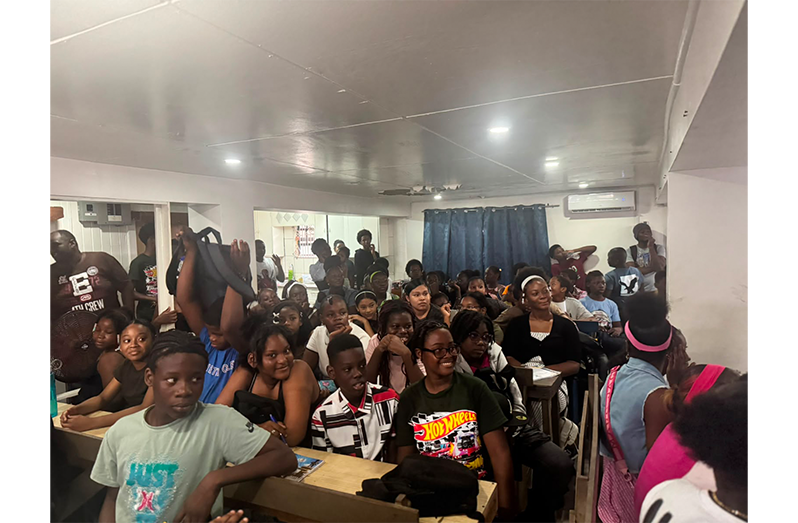
Inside an after-school classroom where ‘I can’t’ is transformed into ‘watch me’
By Andrea Hendricks
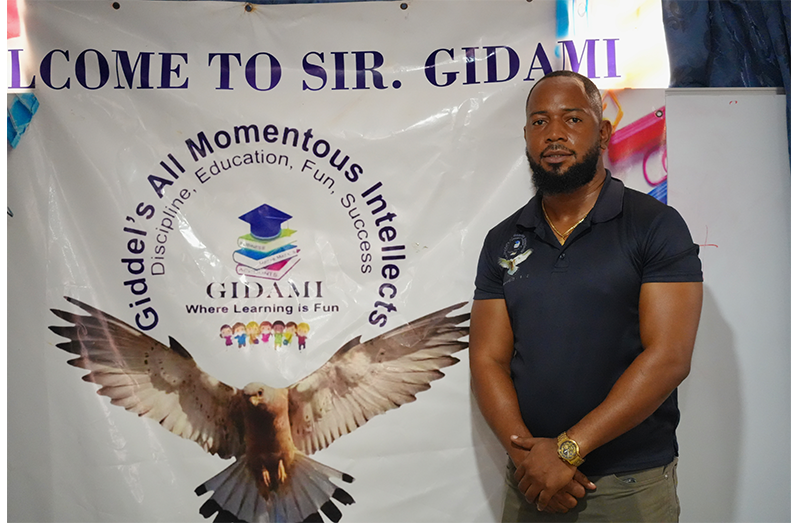
THE gate at 562 Go-slow Avenue opens onto an ordinary Georgetown street and then, almost immediately, into something that feels like momentum. Inside Sir Giddel’s All Momentous Intellects (GADAMI) in Meadow Brook Gardens, class begins with an everyday question, something students recognise from home, school, the minibus or the shop. From there, Giddel Thompson builds the mathematical equation step by step, out loud, with the room participating.
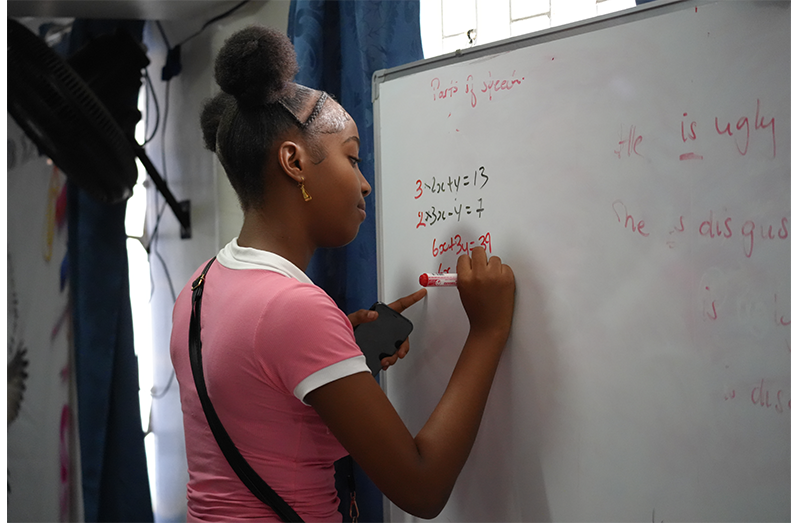
He is an after-school educator with a simple refusal at the centre of his method: he will not let abstract theory be the reason a child decides they are ‘not a Maths person’. His sessions are practical and interactive, pushing students to the board to explain, show their working and correct errors without shame. “One of the techniques that is not working is the use of textbooks to meet the challenge in the Maths class,” he has said of the textbook-only approach. At GADAMI, books are tools, not the whole plan.
He starts with real-life situations, then has students demonstrate the method back to the class. Understanding shows up in posture, in eye contact, and in the moment a voice steadies at the whiteboard, while classmates learn to listen, question, and try again.
“Daily, I would sit and think about ways to explain topics differently without the use of a maths textbook…instead of using theoretical explanations,” Thompson explained. He keeps sessions fun and interactive as a memory strategy and has students teach concepts back to their peers, rehearsing both the steps and the confidence to perform under pressure when exams arrive.
Parents and students return for that translation of difficult ideas: clear, not watered down. Thompson’s aim is not only to cover the syllabus but also to build independence by showing working, checking for errors, and practising until the process feels familiar.
Though GADAMI is often described as an after-school programme, it runs with the seriousness of a small institution. Thompson works across readiness levels, slowing down to rebuild foundations when needed, then accelerating. The message is consistent: gaps can be closed, but only with time, practice and steady support.
And while Mathematics is the flagship subject, it is not the only one. GADAMI teaches Mathematics alongside English Language, Principles of Business, Office Administration, Principles of Accounts, Social Studies, Integrated Science, Human and Social Biology, and Biology. Instruction runs from Grade 4 to CSEC level, with adult sessions and private tutoring also available. The building on Go-slow Avenue is a place where extra lessons come with a wider sense of academic direction and responsibility.
When the programme ended, the results kept the institution’s name moving by word of mouth. On average, a 92 per cent pass rate in Mathematics and 100 per cent in Business are just a few of the results highlighted in GADAMI’s overall performance. For Thompson, the numbers point to what structure and steady practice can do, even for students labelled ‘average’, ‘weak’ or ‘not interested’. For Destiney Thomside, whose favourite subjects are Maths, English and Chemistry, two years at GADAMI in Maths and English helped her secure passes in Maths (Grade 3) and English (Grade 2).
“Sir Giddel always pushed us to do our best and made sure we understood the work,” she said. Her outcome echoes the programme’s larger point: interest can be taught by making the content feel possible.
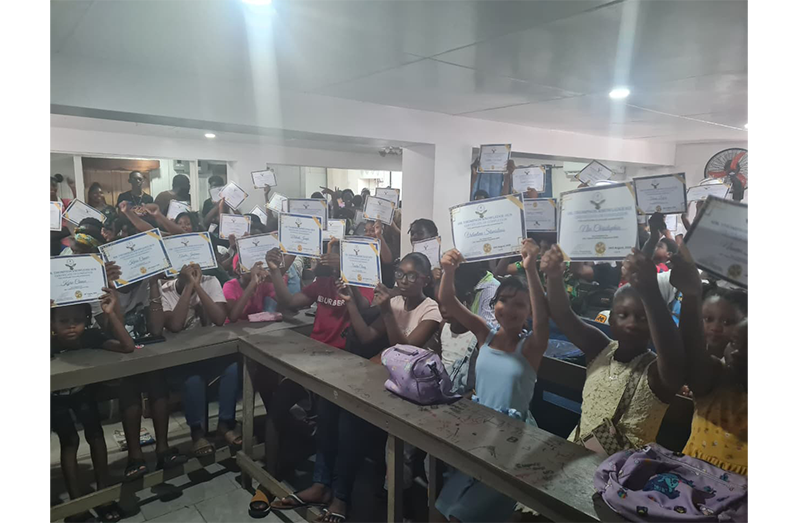
The closing session, held last week, was designed as more than a goodbye: a handover from summer routines back to daily life. A Ministry of Education official spoke about dietary health; a representative from the Guyana Police Force warned against drugs and substance abuse; a Toastmasters representative guided students in public speaking for oral presentations, interviews and leadership; and an invited creative artist offered encouragement on discipline and imagination.
Thompson’s own message was direct and familiar to many of his students. ‘Potential is a beautiful thing, but potential alone isn’t enough; it must be developed with guidance, patience and consistency,’ he told them. If they remembered nothing else, he urged them to ‘believe, work and continue’. He ended with a personal challenge wrapped in affirmation: ‘I believe in you, but now is your turn to believe in yourselves.’
The story of GADAMI is also the story of how Thompson became a teacher before he had the title. He discovered his calling at 17, after writing CSEC Mathematics a year early while still in a lower grade. After changing secondary schools, he noticed students struggling, not because they were incapable, but because the delivery was not connecting. He started helping anyway, beginning with his then-girlfriend, one of only two students who excelled in that year’s exams. One student at a time, he learnt what worked.
That early experience still shapes how he teaches. He urges early preparation so gaps can be closed before exam season tightens, but he also works with students who start later. For Thalia Devonish, although Principles of Business is her favourite subject, Maths was a struggle.
“I did poorly in Maths and needed help,” she said. Introduced to GADAMI eight months before her exams, she worked within the limited time span and secured a pass with a Grade 2.
“We all know Maths is a difficult subject, but Sir Giddel is also one of the best teachers you can ever find,” she told this publication. The standard at GADAMI is not perfection; it is progress, reinforced through practice.
Over time, GADAMI expanded beyond its beginnings in Sophia, where seating was limited, and the operation was smaller. From its Meadow Brook location, it offers more subjects in a more spacious environment, and Thompson says preparations are underway to transition to a full-time educational institution in Guyana, an ambition tied to the impact of consistent support on community outcomes.
The milestones are also personal: teaching two of his sisters, one of whom later became an educator, and watching a student who once failed Mathematics return the following year, rewrite the subject and earn a Grade One after rebuilding confidence through instruction and practice. For Abica Hetsberger, who started attending GADAMI in 2024 and studied five subjects, Maths was her favourite.
“I enjoyed challenging myself and finding different ways to solve problems, and Maths did that for me,” she told this publication. She said, “The lessons helped me become more confident and disciplined.The early mornings and late-afternoon sessions, with practising past papers and solving difficult questions, helped strengthen my understanding. The formula book created by Sir Giddel was extremely helpful.”
These stories never fit neatly into a pass-rate percentage, but they explain why he keeps refining his method.
Looking ahead, Thompson wants his signature practical approach documented and shared. For now, he continues to apply it across levels, reminding students that progress requires repetition and that practice is the bridge between knowing and performing when it matters.
For parents, students and adults interested in registering and securing tuition spots, registration is available online, with an online payment option. Information can be obtained via the contact numbers (592) 642-1721 and (592) 696-5705.
At GADAMI, formulas matter, but the deeper lesson is steadier: belief is a practice, too. In Thompson’s classroom, belief is taught the same way as Mathematics: by example, by participation, by correction that does not shame and by continuing until the work feels real. The stories that follow students out of the building are not only about grades but about the moment ‘I can’t’ becomes ‘watch me’ and the quiet discipline that keeps it that way.