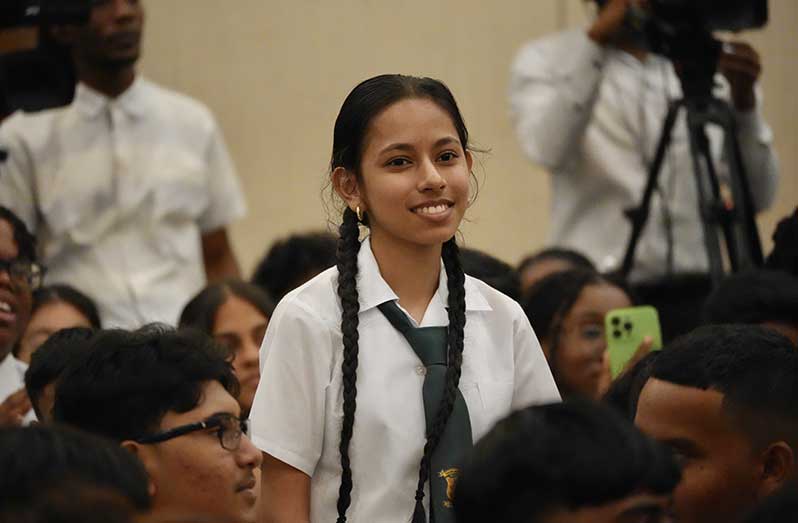
HUNDREDS of students across Guyana on Tuesday celebrated strong preliminary performances in the Caribbean examinations, with several emerging among the country’s leading performers in the CSEC and CAPE examinations.
The preliminary results for the Caribbean Secondary Education Certificate (CSEC), Caribbean Advanced Proficiency Examination (CAPE), Caribbean Certificate of Secondary Level Competence (CCSLC) and Caribbean Vocational Qualification (CVQ) were released as students, parents and schools began assessing their performances.
Education Minister Sonia Parag recognised several of the outstanding students during the announcement, while stressing that the preliminary results remain subject to review and could change before the official results are finalised.
Among the standout performers is Nitya Narine of Tagore High School, who, according to the preliminary results, secured 26 Grade Ones and one Grade Two.
Former Education Minister Priya Manickchand congratulated Narine in a Facebook post and described the performance as a record for Guyana. She also highlighted Narine’s unusual academic journey, noting that she did not spend a day in Grade Six and, while in Grade Five during the COVID-19 lockdown, was granted permission to sit the National Grade Six Assessment (NGSA).
Narine subsequently earned a place at The Bishops’ High School but chose to remain in Berbice.
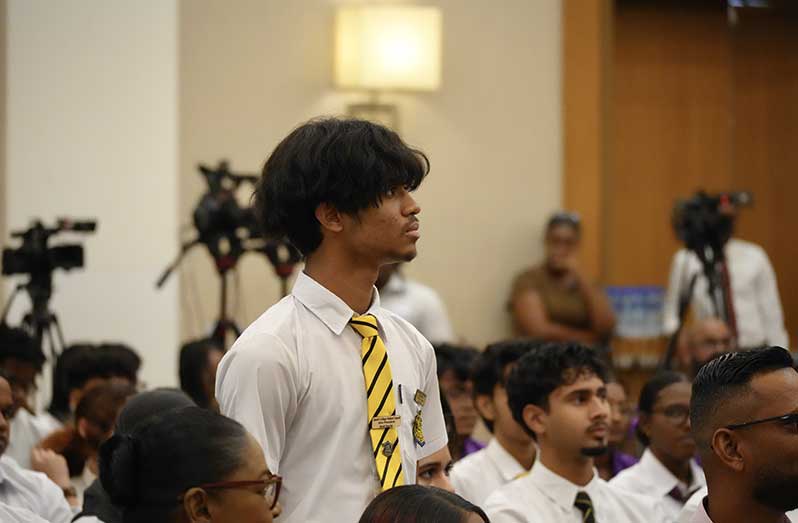
Reflecting on her performance, Narine attributed her results to consistent preparation over several years rather than last-minute studying.
“My preparation was progressive study, I did not wait until grade 11 to begin studying. It was from since I began high school,” she said.
She said she made a habit of paying attention in class, reviewing lessons at home and seeking assistance whenever she encountered difficulties. She also credited her parents, teachers and lesson teachers, as well as educational videos and past papers, for helping her prepare.
Narine plans to attend the University of Guyana to pursue law, with the goal of helping others and fighting for justice.
At the CAPE level, Queen’s College student David Sugrim secured 11 Grade Ones and seven Grade Twos and is preparing to pursue medicine.
Sugrim, who has previously featured among the school’s top performers at both CSEC and CAPE Year I, said he hopes to become a neurosurgeon. His interests, however, extend beyond medicine to areas including law, technology and tourism.
“I have always had an interest in medicine, but I have always cross-streamed and taken an interest in every other subject area as well,” he said.
Sugrim encouraged students preparing for CAPE to begin their preparations early, given the volume of work associated with multiple units and internal assessments.
“My advice is to start really early, it is not a full year to exams, so it is intensive from the start, especially with so many units,” he said.
He also urged students to remain focused on their ambitions and not allow negative opinions from others to undermine their goals.
Another Queen’s College student, Fatima Grant, entered 20 subjects and recorded 14 Grade Ones, five Grade Twos and one Grade Three.
Grant said procrastination was among the biggest challenges she faced during her preparation, at times making her question whether she wanted to continue.
“My biggest challenge was procrastination, sometimes you think, I do not want to do this anymore, I am fed up with exams,” she said.
She credited her peers, teachers and parents with helping her overcome those moments and remain focused.
Grant intends to reapply to Queen’s College for CAPE and advised other students to measure themselves against their own goals rather than the expectations of others.
“It does not matter how late you start, or what other people’s expectations are for you, all that matters is what you expect for yourself, what you think you deserve, and how you plan on getting there,” she said.
Meanwhile, Queen’s College student Maleia Baharally recorded 17 subjects at CSEC and said the results reflected the benefits of maintaining a strong academic foundation throughout secondary school.
“I am very proud of myself. I am quite surprised, but with the constant work I was putting in, this was definitely going to be the outcome,” she said.
Baharally credited her parents for investing in extra lessons and supporting her academic development from her first year of secondary school.
She said, however, that maintaining a healthy balance between academic demands and life outside school was one of her biggest challenges.
Her advice to other students was to focus on the quality of their preparation rather than simply the number of hours spent studying.
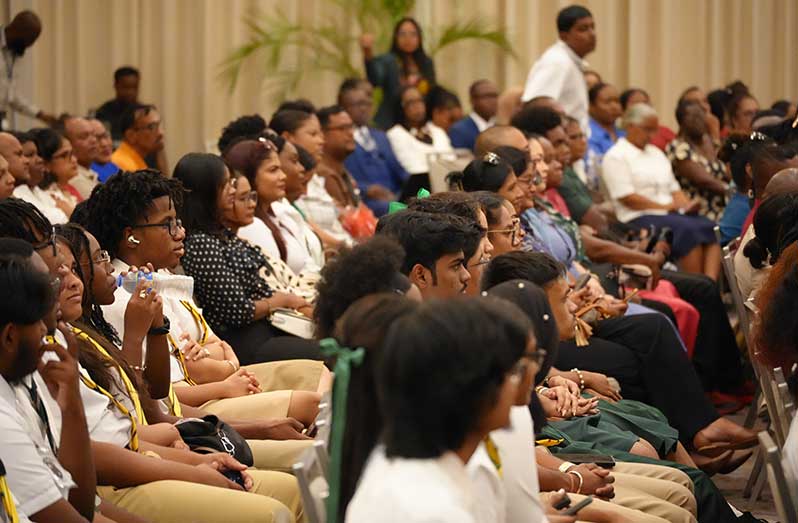
“Quality is much better than quantity, the quality of work you put in will be much more beneficial than the number of hours you study. And do not compare yourself to others,” she said.
Samira Khan was another strong CSEC performer, earning 13 Grade Ones and one Grade Two from 14 subjects.
Khan described the examination period as strenuous but said she was pleased that her efforts placed her among the country’s leading performers.
Her preparation included maintaining a regular sleep schedule, eating on time, using school textbooks, watching educational videos on YouTube and following Caribbean educators.
Khan said one of her biggest challenges was developing confidence in her own ability.
“My biggest challenge was having the confidence to believe in myself,” she said.
She said she eventually developed greater confidence and discipline and is now looking towards the University of Guyana, where she hopes to pursue petroleum engineering.
Khan said she sees the field as increasingly important to Guyana’s economy and wants to contribute her skills and knowledge to its continued development.
“I would like to pursue petroleum engineering. It is a growing field in Guyana’s economy, and it’s very significant, I’d like to invest my time, my skills, and my knowledge into that field,” she said.
She encouraged other students to practise consistently, make use of available educational resources and avoid burnout.
The performances have provided an early indication of the academic achievements being recorded by Guyanese students across several examination streams, while also highlighting the different approaches students have used to overcome academic and personal challenges.
For parents, educators and policymakers, the preliminary results offer more than a measure of individual achievement. They also provide an opportunity to examine the support systems, teaching strategies and learning habits contributing to student performance across the country.
As the authorities continue the process of reviewing and finalising the results, the achievements of the students already identified among the top performers are being celebrated as examples of the potential of Guyanese youth.
Their experiences point to a common thread: sustained preparation, discipline, support from families and teachers, and the determination to remain focused despite challenges can make a significant difference in examination outcomes.
The final national results are expected to provide a fuller picture of Guyana’s performance once the review process is completed.