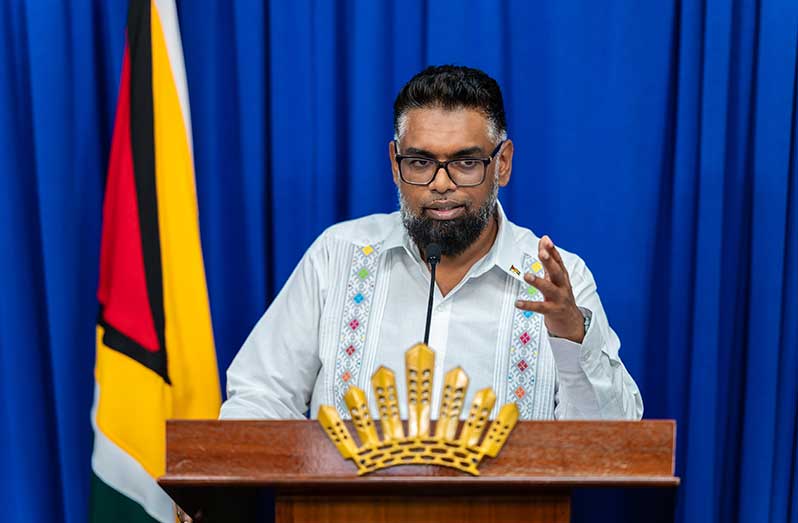
— President Ali outlines rising national oil share
PRESIDENT Dr Irfaan Ali on Tuesday announced that Guyana’s fifth oil production vessel is due to arrive offshore this week, pushing the country’s crude output above 1 million barrels per day for the first time.
Speaking at a press conference, the President said the new floating production, storage and offloading (FPSO) vessel, built in Singapore at a cost of US$12.7 billion, is expected to deliver first oil in the fourth quarter of 2026.
“Our fifth production vessel set sail from Singapore in early August 2026 and is expected to arrive off Guyana’s coast this week, with first oil targeted for the fourth quarter of 2026,” Dr Ali said.
The vessel, the largest FPSO to operate in Guyana’s waters to date, is designed to add approximately 250,000 barrels per day, taking total national output to more than 1 million barrels per day.
President Ali noted that the country’s four operating FPSOs — Liza Destiny, Liza Unity, Prosperity and One Guyana — are currently producing between 900,000 and 920,000 barrels per day.
PROFIT OIL AND COST RECOVERY
The Head of State stressed that the production sharing agreement (PSA) governing the Stabroek Block remains unchanged from the 2016 terms.
“The production sharing formula has never changed. It remains exactly what was written in the 2016 agreement — royalty first, then up to 75 per cent of production can go to cost recovery, and whatever is left is split evenly between Guyana and the Stabroek co-venturers,” he explained.
Dr Ali said Guyana’s share of Stabroek Block oil has risen sharply as the initial capital investments have been recovered faster than anticipated.
“Guyana’s share of Stabroek Block oil has increased from 12.5 per cent to 39.8 per cent. This has occurred because the cost bank has been recovered two years earlier than originally expected,” he said.
He explained that previously, 75 out of every 100 barrels produced went towards cost recovery, but that figure has now fallen significantly.
“In terms of barrels, 75 of every 100 barrels produced went to cost recovery. Today, only about 20 barrels go to cost. The US$5 billion expenditure was paid off; the cost bank is not saturated or entirely depleted, but the 20 barrels today account for operating and other costs,” the President outlined.
He stressed that the remaining crude constitutes profit oil, which continues to be shared equally between Guyana and the oil companies.
“That which is left, which is called the profit oil, is split evenly between Guyana and the companies. Guyana’s half is about 39.8 barrels out of every 100. The companies’ matching 39.8 barrels is split three ways between the co-venturers,” Dr Ali said.
MAJOR OVERHAUL OF PUBLIC PROCUREMENT
Turning to governance and public sector reform, President Ali announced that the administration is on course to fully modernise the national procurement system through a comprehensive e-procurement platform to be completed and integrated by the end of this year.
“As we had promised in the manifesto, we will continue the modernisation of our national procurement system, and I’m pleased to tell you that the Finance Secretary is leading the effort to have, before the end of this year, completed the e-procurement system,” he told reporters.
The system will comprise a digital bidders’ register, an e-tender lifecycle module, a national e-tender portal and an e-marketplace, replacing the existing paper-based processes.
“This will remove all of the need for the massive papers and move from a paper-based system to a complete e-system, an electronic system that is trackable throughout the process,” the President said.
The expanded digital bidders’ register will capture key information on contractors, suppliers and consultants, including beneficial ownership, tax and social security compliance, classification by size — small, medium and large — past performance, and records of debarments and suspensions.
The e-tender portal will serve as a single window for all public procurement activities, where procurement plans, tender notices, bidding documents, clarifications, bid submissions and award notices will be published online.
Meanwhile, the e-tender lifecycle module is intended to convert what is now a manual, fragmented, paper-driven process into a secure, end-to-end digital workflow.
“The proposed e-tender lifecycle module will transform procurement into a secure end-to-end digital workflow, covering procurement planning, tender creation, publication, bid submission, evaluation, contract award, contract administration, variation, payment processing, and real-time tracking,” Dr Ali explained.
He added that the module would automate routine checks, flag compliance risks, support evaluation teams with structured scoring tools, detect anomalies and potential red flags, and generate dashboards for management oversight, while preserving the existing statutory approval framework.
SUPPORT FOR SMALL AND MEDIUM-SIZED ENTERPRISES
President Ali also highlighted plans for an e-marketplace for routine, low- to medium-value goods and standard services to be supplied by pre-qualified vendors using standard specifications and published prices.
He noted that this would allow procurement agencies to purchase from pre-qualified suppliers using standard specifications, published prices, framework arrangements and electronic purchase orders, which, he said, would help small and medium-sized enterprises.
He indicated that, in line with international practice, the government is examining the possibility of setting aside 25 to 30 per cent of procurement for small and medium-sized enterprises (SMEs), as part of efforts to ensure broader local participation in public contracts.