






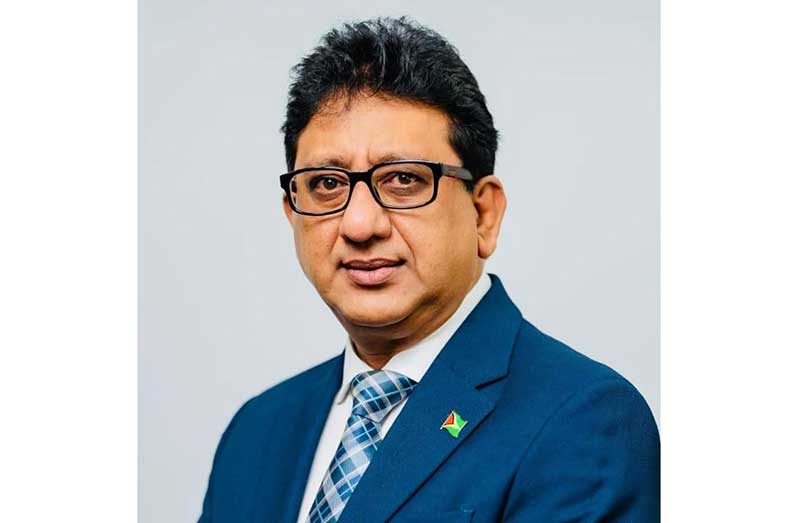
— says constitutional right to protest does not extend to disrupting meetings or infringing on the rights of others
ATTORNEY GENERAL and Minister of Legal Affairs, Anil Nandlall, SC, has warned that people who go beyond peaceful protest and engage in unlawful assembly, disorderly behaviour or riotous conduct can be arrested and charged.
Nandlall made the statement during his weekly programme, Issues in the News, while discussing the constitutional right to peaceful assembly and demonstration and the limits placed on that right by law.
He said the Constitution of Guyana guarantees citizens the freedom to assemble, associate and demonstrate peacefully, but stressed that those rights cannot be exercised in a manner that interferes with the rights of others.
“You have a right to protest and to do so peacefully, but in the exercise of your right to protest, you can’t interfere with the other people’s right to assemble, to attend the meetings,” Nandlall said.
He was addressing recent tensions surrounding political meetings, including an August 4 government outreach in Linden, Region 10 (Upper Demerara-Berbice), led by Vice President Dr Bharrat Jagdeo, where opposition supporters staged a protest over several issues, including the MV Barima tragedy.
The opposition-led demonstration outside Watooka House breached security barriers and disrupted a Government outreach event.
Among other demands, protesters called for the removal of Minister of Public Works Juan Edghill and Minister of Public Utilities and Aviation Deodat Indar over the MV Barima tragedy and the election of a Chairman and Vice Chairman for Region 10.
Nandlall said that Opposition Leader and United States-sanctioned, criminally indicted businessman Azruddin Mohamed, along with members of the A Partnership for National Unity (APNU), broke through a barrier while attempting to prevent or disrupt the meeting.
He argued that the people inside the meeting had the same constitutional right to assemble as those outside who were protesting.
“These rights have to coexist,” he said. “I must be allowed to go to my meeting while you must be allowed to protest.”
According to Nandlall, however, a protester cannot lawfully use the demonstration to prevent another person from attending a meeting or disrupt the proceedings.
He said the Constitution itself recognises that legislation may be enacted to protect the rights and freedoms of other people.
Nandlall pointed specifically to laws dealing with unlawful assembly, disorderly behaviour and public riotous conduct, stating these provisions are intended to prevent individuals from using their own freedoms to infringe on the rights of others.
“There is a law that says that you can’t have unlawful assembly. You can’t be protesting violently,” he said.
The Attorney General said conduct such as breaking down barriers or engaging in threatening behaviour could not be regarded as peaceful protest.
He noted, “The Constitution talks about peaceful protest. Peaceful protest cannot be wanting to beat another Member of Parliament and calling him ‘p*$#y’ and ‘house slave.’ That is not peaceful protesting.”
Nandlall said persons who engage in unlawful or disorderly conduct can face legal consequences, including arrest and criminal charges.
The Attorney General said the Criminal Law (Offences) Act provides for offences including disorderly behaviour, public riotous conduct and unlawful assembly, which can result in criminal charges when individuals interfere with public meetings or infringe on others’ right to associate.
He maintained that the existence of these offences does not undermine the constitutional right to protest, but instead provides a legal framework for ensuring that competing rights are protected.
The Attorney General also criticised political leaders whom he accused of encouraging supporters to engage in confrontational behaviour while avoiding direct consequences themselves.
“They mislead people,” Nandlall said. “You hardly ever see the politicians getting arrested. They go behind the barrier but they put the ordinary people in front.”
Nandlall contrasted this with protests he said were conducted by the People’s Progressive Party (PPP) while it was in Opposition between 2015 and 2020.
He said he, President Dr Irfaan Ali, Vice President Jagdeo and other PPP leaders participated in protests during that period, but emphasised those demonstrations were conducted with police permission and without incidents of serious misconduct.
“For five years we protested and we never had, first of all, we had permission to hold the march or the protest,” he said. He said protesters at the time also wore armbands identifying their demonstrations as peaceful protests.
Nandlall subsequently cited a Court of Appeal decision in Frank Hope v New Guyana Company Limited, in which Justice R.H. Luckhoo addressed the consequences of unrestricted freedom.
Quoting from the judgement, Nandlall said: “Freedom uncontrolled will sooner or later result in anarchy or totalitarianism leading to its overthrow.”
He used the passage to argue that constitutional freedoms must be exercised responsibly and within the boundaries established by law.
Nandlall said, “I put this out there so that leaders will exercise due restraint and will act responsibly when they are shepherding their flocks.”
He accused some opposition leaders of displaying increasingly disorderly behaviour and said political leaders have a particular responsibility to ensure that their supporters understand the limits of lawful protest.
The Attorney General maintained that the issue was not whether citizens should be allowed to demonstrate, but whether they could use demonstrations to prevent others from exercising their own constitutional rights.
“When we exercise our rights to protest, we must understand that other people have rights too,” he said.
Nandlall also warned that freedom of expression has legal limits, particularly where statements damage another person’s reputation.
“Not because you have a right to express yourself means that you will do so and tarnish the reputation of others,” he said. “That is not freedom of speech. That is defamation.”
His comments come on the heels of a series of protest actions over the MV Barima tragedy, with demonstrators demanding accountability and justice following the July 18 sinking of the vessel.




