A SEPARATE contract for a 75-megawatt (MW) powership operating in the Demerara River is expected to end later this year, with any decision on its future to be guided by the progress of the government’s gas-to-energy project.
Meanwhile, the government has extended by two years the contract for a 36MW powership stationed in the Berbice River.
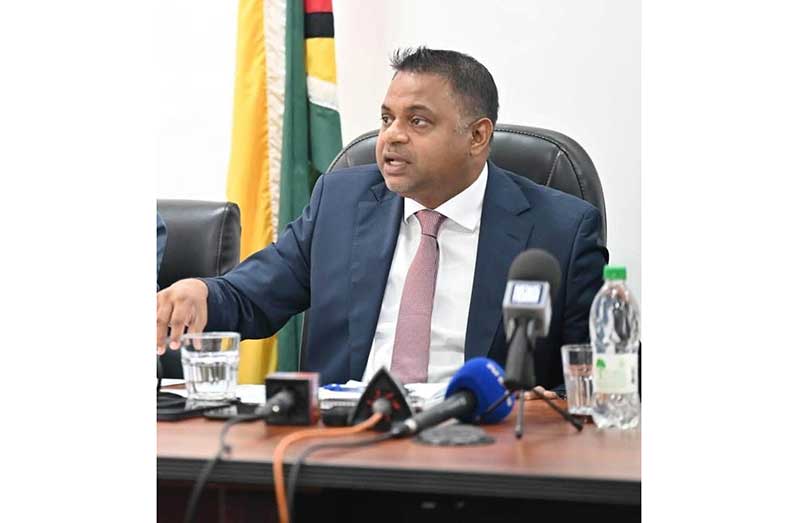
Minister of Public Utilities and Aviation Deodat Indar made the disclosure during a press conference last Friday, while responding to questions about the government’s electricity-generation contracts and the cost of the rented generation vessels.
The government first moved to secure emergency generation capacity in April 2024, when Guyana Power and Light (GPL) signed a two-year contract with Urbacon Concessions Investments (UCI), a subsidiary of UCC Holdings, to charter a 36MW powership.
UCC Holdings has a strategic alliance with Karpowership International.
The vessel arrived in Guyana in May 2024 and was connected to the national grid at Everton, East Berbice, to support the Demerara-Berbice Interconnected System (DBIS) amid growing electricity demand and generation shortfalls.
It subsequently reached its full generating capacity of 36MW, providing additional electricity to the DBIS.
Indar said the decision to extend the contract was linked to the need to improve the voltage level in that section of the electricity network.
“There’s a reason why we put the 36MW in Berbice. We put it there so that you can bring up the voltage level on that side,” he said.
The original agreement for the 36MW powership was signed in April 2024 for two years. Under the initial arrangement, GPL paid a charter fee of 6.62 US cents per kilowatt-hour and an operations and maintenance fee of 0.98 US cents per kilowatt-hour.
Indar said the government had secured the original 36MW arrangement at a negotiated concessional rate of 7.62 US cents per kilowatt-hour for the first two years.
He said the renewed contract carries a rate of 9.5 US cents per kilowatt hour, divided between a capacity charge and an operations and maintenance charge.
As electricity demand continued to rise, GPL signed a second agreement in November 2024 with the joint venture Karpowership Global DMCC and UCC Energy International LLC to charter another powership.
The second vessel has an installed capacity of 75MW and is stationed in the Demerara River near Ruimveldt, in the vicinity of the Demerara Sugar Terminal and Banks DIH. It was initially dispatched to the national grid at 60MW.
The government is now moving to take the remaining 15MW from the vessel. Indar said 10MW of the additional capacity was already being taken, with the remaining 5MW expected by the end of this month.
“We were already taking 10 out of the 15. We’re waiting on five more to come at the end of this month,” he said.
The minister said the contract for the second powership is expected to end this year.
He said the government intends to take the full 75MW from the vessel until the gas-to-energy project comes on stream and provides sufficient generation capacity to replace the rented power.
The 75MW powership agreement was signed for two years and requires GPL to pay a charter fee of 8.52 US cents per kilowatt-hour, along with an operations and maintenance fee of 0.98 US cents per kilowatt-hour. GPL is also responsible for supplying the heavy fuel oil required to operate the vessel.
He added, “At the point when gas-to-energy comes on board and we have generative capacity to offset that, we will be the first to produce. You know why? Because we will be using gas as the feedstock. We will be producing power at five cents per kilowatt. Those vessels that are rented there, we use heavy fuel oil, which is very expensive.”
Indar said he and Prime Minister Brigadier (Retired) Mark Phillips had secured a commitment from the project contractor to deliver one of the gas-to-energy project’s turbines, which has a generating capacity of approximately 57MW, by the end of 2026.
He said the government will review the powership contracts once the gas-to-energy project provides sufficient additional generating capacity, taking into consideration the exit clauses contained in the agreements.
Indar said the two powerships are currently essential to maintaining a reliable electricity supply across the country.
Once the second vessel reaches its full 75MW output, the two powerships will provide a combined 111MW of additional generating capacity to the national grid.
Indar also pointed to recent reductions in electricity costs in Bartica and parts of the hinterland, attributing those savings to the displacement of diesel generation through renewable energy sources.
He said electricity costs in Bartica have already been reduced by 25 per cent, while power costs in Region One have been reduced by 30 per cent through the use of solar generation to complement and displace diesel-powered generation.
According to Indar, the savings from reduced reliance on fossil fuels are being passed on to consumers.