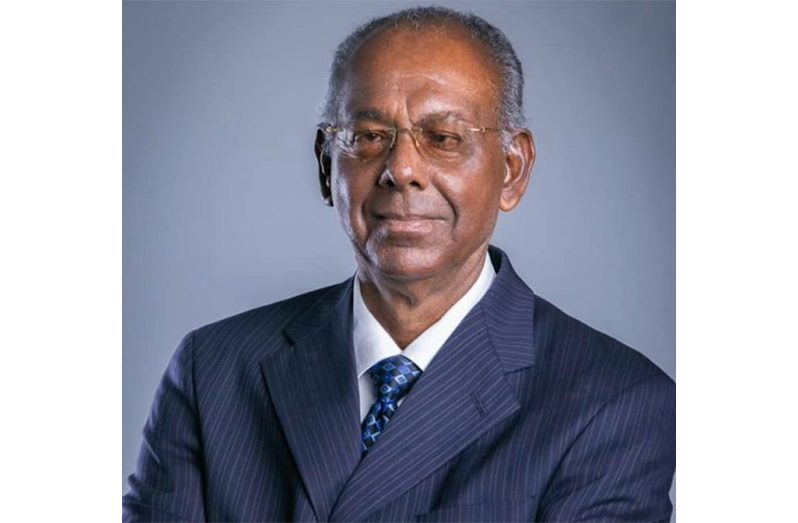
ATTORNEY-AT-LAW and former Speaker of the National Assembly, Ralph Ramkarran S.C., has argued that if the Regional Justice and Legal Services Committee (RJLSC) proceeds with a proposed review into allegations concerning Caribbean Court of Justice (CCJ) President Justice Winston Anderson, it should also examine the unauthorised disclosure of the court’s confidential internal business.
Ramkarran made the argument in his Conversation Tree blog article titled “Rumble in the CCJ,” published on August 16, 2026, in which he examined the controversy surrounding leaked emails involving disagreements among judges of the CCJ, Guyana’s final appellate court. He said the information disclosed in the emails was limited and incomplete and, based on Justice Anderson’s subsequent response, the sweeping allegations of wrongdoing against him were not justified.
The allegations contained in the leaked correspondence included claims that Justice Anderson directed judges regarding court dress, pressured judges in relation to cases, including the recent Mohamed case, and improperly influenced the composition of judicial panels.
Ramkarran noted that, before Justice Anderson’s detailed response, he had initially regarded the dress-code issue as relatively minor, while pointing out that the Mohamed case did not appear to support an allegation of pressure because the decision was unanimous. He also observed that determining the composition of judicial panels was a responsibility of the CCJ President.
According to Ramkarran, Justice Anderson subsequently provided explanations for the issues raised. The President said the dress-code matter arose after a judge insisted on wearing national dress while appearing in matters being heard in Chambers. After discussions with judges failed to resolve the issue, a draft Judicial Dress Code was prepared for consideration by the RJLSC.
Justice Anderson also reportedly explained that the alteration of a judicial panel was made because of the disagreement over the wearing of national dress. He rejected any suggestion that judicial views were suppressed or that judges were directed to reach particular conclusions in cases.
The controversy has also raised questions about the RJLSC’s role. Ramkarran said it had been reported in the local and regional press that the committee had acknowledged allegations concerning Justice Anderson and announced that a “transparent and independent review” would be undertaken.
However, he contends that the RJLSC does not have the jurisdiction to conduct such a review.
Ramkarran pointed to Article V of the Agreement Establishing the Caribbean Court of Justice, which sets out the powers of the RJLSC. These include appointing judges other than the President, making appointments and determining the terms and conditions of service of court officials and employees, exercising disciplinary control over judges other than the President, and making recommendations to the Heads of Government concerning the appointment and removal of the President.
He argues that nothing in those functions gives the RJLSC jurisdiction to investigate the President, review his conduct or examine issues arising from leaked correspondence concerning the internal functioning of the court.
Ramkarran nevertheless said that if the RJLSC proceeds with a review despite what he considers to be its lack of jurisdiction, the examination should not be confined to Justice Anderson’s conduct or his approach to resolving differences with his fellow judges.
He argues that the committee should also examine whether the CCJ has been brought into disrepute by the unauthorised disclosure of confidential correspondence and internal business of the Court.
“If there is to be a ‘review’ by the RJLSC, notwithstanding the lack of jurisdiction,” Ramkarran wrote, “and the RJLSC ‘reviews’ Justice Anderson’s conduct or his approach to resolving differences, it should certainly also ‘review’ whether the CCJ has been brought into disrepute as a result of the unauthorized disclosure of the CCJ’s confidential business.”
The article also addresses Justice Anderson’s intervention concerning the confirmation of the appointments of Guyana’s Chancellor and Chief Justice.
Ramkarran said the intervention could be understood in the context of concerns publicly expressed by two of Justice Anderson’s predecessors about the independence of Guyana’s judiciary, particularly in relation to the failure to secure confirmation of the appointments of the country’s two most senior judicial officers.
However, Ramkarran believes Justice Anderson underestimated the extent of Guyana’s political divisions and the level of suspicion and bitterness surrounding politically sensitive issues.
“Justice Anderson may have overestimated the goodwill he expected. Now he knows!” he concluded.
Ramkarran is a veteran member of Guyana’s legal profession. He was appointed Senior Counsel in 1996.
He also served as a member of the Bar Council for more than 10 years and is a former secretary of the Guyana Bar Association. Ramkarran chaired the Constitution Reform Commission from 1999 to 2000 and served as Speaker of the National Assembly from 2001 to 2011.