






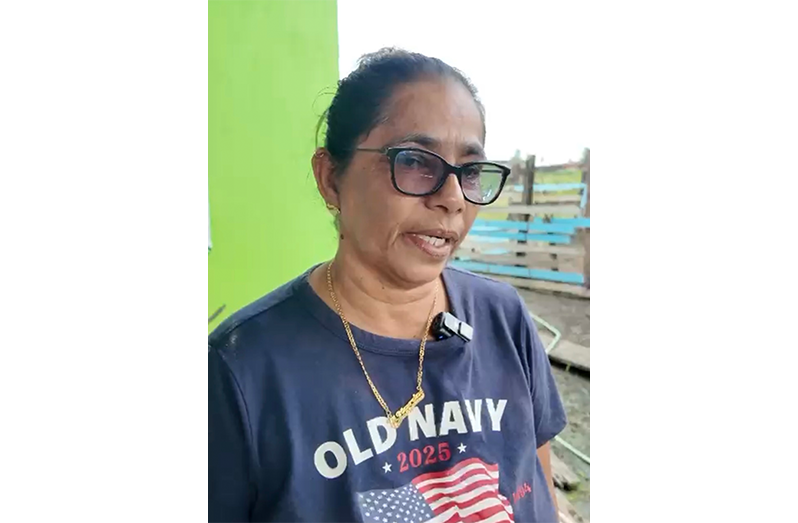
By Bebi Shafeah Oosman
FOR more than a decade, a woman from Black Bush Polder has been quietly building a livelihood through livestock farming, turning her dedication to the work into a growing small business with the continued support of agricultural services provided through the Ministry of Agriculture.
Youwattie Hardatt, popularly known as “Meena,” of Johanna North, Black Bush Polder, has been involved in livestock farming since 2008.
What began as a means of earning a living has, over the years, developed into a profitable small business, sustained by her commitment to the animals and her willingness to embrace the support and services available to farmers.
For Hardatt, livestock farming is more than a business but rather a livelihood that has required patience, hard work and a willingness to learn.
She has also benefitted from the assistance provided through the Ministry of Agriculture’s agricultural support services to strengthen and expand her operation.
Her story is one of resilience and determination, highlighting the important role that support services can play in helping small farmers, particularly women, to develop their agricultural enterprises and create sustainable livelihoods in their communities.
The woman said that she has been rearing livestock as a means of supporting her household since 2008.
She recalled, “since 2008, me minding goat and then me sell out the goats and buy sheep.”
Over the years, this small livestock enterprise has provided her with an important source of income, particularly because her husband is no longer employed and now receives a pension.
She said that when the animals mature and begin producing offspring, she can sell them to generate income for the household.
In addition to sheep, the couple also rear a small number of chickens and other animals, which she said helps to supplement their livelihood.
As she put it, “when them get ram and get big me can sell it and get one money,” highlighting the role of livestock sales in meeting the family’s financial needs.
According to the woman, veterinary support has also been important to the sustainability and growth of her livestock enterprise.
She has received veterinary services through the Guyana Livestock Development Authority (GLDA), under the Ministry of Agriculture.
These services have helped her to maintain the health and productivity of her animals, thereby supporting her ability to continue rearing livestock and earning income from the sale of mature animals.
“And me does get contact with the vet and them does respond to me and them does come the same day or sometime next day and them does come look after the animal… This vet here is a new vet too and this is the third time he be here with me and me thankful and grateful,” the farmer said.
Hardatt related that she has made a request to obtain a ram and remains hopeful that her request will be fulfilled.
She said that having her own ram would be a significant benefit to her livestock-rearing activities, as it would allow her to breed her sheep more easily and strengthen the sustainability of her small business.
“Me should glad if me get one ram because me would a happy and thankful,” she said, expressing both her anticipation and gratitude at the possibility of receiving one.
Hardatt related that, at present, she sometimes has to depend on other livestock owners by borrowing their ram sheep for breeding purposes.
However, having her own ram would therefore reduce her reliance on others and give her greater control over the breeding of her sheep.
She believes that this would help her increase the number of animals in her flock, which could ultimately provide her with more sheep to sell when they mature and generate additional income for her household.




