






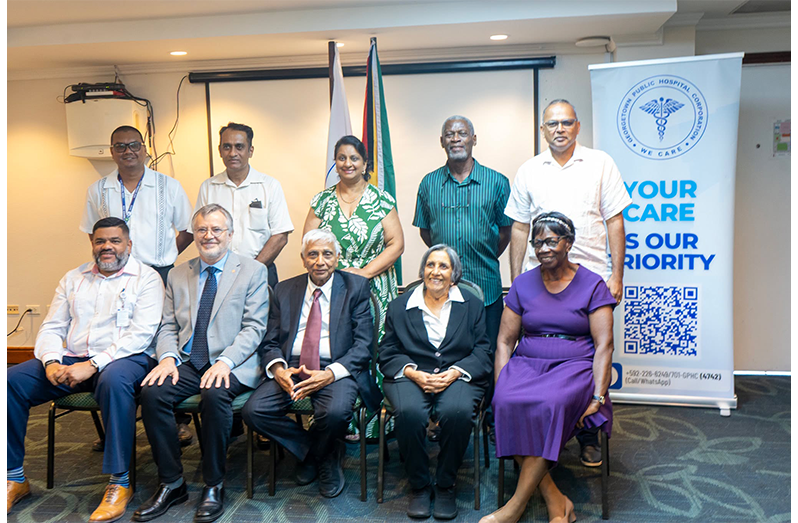
THE Georgetown Public Hospital Corporation (GPHC) has honoured Harry and Pamela Harakh and the Caribbean North Charity Foundation (CNCF) for their pioneering role in establishing Guyana’s first dedicated Burns Care Unit, recognising a contribution that has transformed the treatment of burn injuries and saved countless lives over the past two decades.
At a recognition ceremony held recently, hospital officials and government representatives paid tribute to the Foundation’s vision and humanitarian commitment, which led to the establishment of the specialised facility that officially opened on November 11, 2002.
The Burns Care Unit was the first of its kind in Guyana and marked a major milestone in the country’s public healthcare system by providing specialised treatment and rehabilitation for patients suffering from severe burn injuries.
The Caribbean North Charity Foundation, made up largely of Guyanese who migrated to Canada during the 1990s, became involved in the initiative after organising humanitarian medical missions to Guyana in the late 1990s.
Led by Harry and Pamela Harakh, the Foundation partnered with volunteer Canadian medical professionals to provide treatment for patients with cleft lip and palate deformities and severe burns. During those missions, the team identified the urgent need for a dedicated burns facility after observing that critically injured burn patients were being treated in general hospital wards.
Working alongside the Ministry of Health, GPHC and Canadian healthcare professionals, the Foundation mobilised funding, medical equipment and technical expertise to make the specialised unit a reality.
Speaking at the ceremony, GPHC Chief Executive Officer, Robbie Rambarran, reflected on the project’s early days, recalling that he joined the hospital in 2002 as a warehouse clerk and was responsible for receiving many of the construction materials used to build the unit.
He noted that the area now occupied by the Burns Care Unit had previously served as the hospital’s pharmacy warehouse before being converted into a modern specialised treatment facility.
Highlighting the impact of the unit, Rambarran said it has significantly strengthened Guyana’s capacity to care for burn victims.
“Without this unit, without the capacity that we have built over those years, we would have been unable to save countless lives and prevent long-term disfigurement and disability,” he said.
He also expressed appreciation to the Canadian volunteers whose dedication made the project possible.
“People who contribute to us don’t necessarily have to. They can choose to spend their vacation in some other country, but they leave the comfort of their own home, and they come here to help us improve what we do,” Rambarran added.
According to the hospital’s records, the six-bed Burns Care Unit admitted 76 patients in 2024, 116 in 2025 and 68 patients so far this year, underscoring its continued importance in the national healthcare system.
Minister of Health, Dr Frank Anthony, also reflected on the state of burn care in Guyana before the unit was established, recalling that during the 1990s patients with severe burns were treated in general wards where infection control and specialised care posed major challenges.
He said the introduction of a dedicated burns facility significantly improved patient outcomes and reduced burn-related mortality.
“With a specialised unit, we were able to bring that down significantly. And that was what made a difference to our patients,” the Minister said.
Head of the Burns Care Unit, Dr Shilindra Rajkumar, described the facility as instrumental in shaping both his professional career and the development of specialised burn care in Guyana.
He said the establishment of the unit not only created opportunities for advanced medical practice but also demonstrated how strategic investments in healthcare infrastructure can transform patient care.
Dr Rajkumar stressed the importance of remembering the journey that led to the unit’s creation, noting that understanding the healthcare system’s past allows greater appreciation of the progress achieved.
A dedicated Burns Care Unit is regarded as essential because patients with severe burns require specialised treatment in a controlled environment to reduce the risk of infection, manage complex wounds, replace fluids, control pain, perform reconstructive procedures and provide long-term rehabilitation. Such care typically involves a multidisciplinary team of healthcare professionals trained specifically in burn management.
The ceremony concluded with GPHC expressing profound gratitude to Harry and Pamela Harakh and the Caribbean North Charity Foundation for their enduring commitment to Guyana’s healthcare sector, noting that their vision continues to benefit generations of patients more than 20 years after the facility first opened.




