






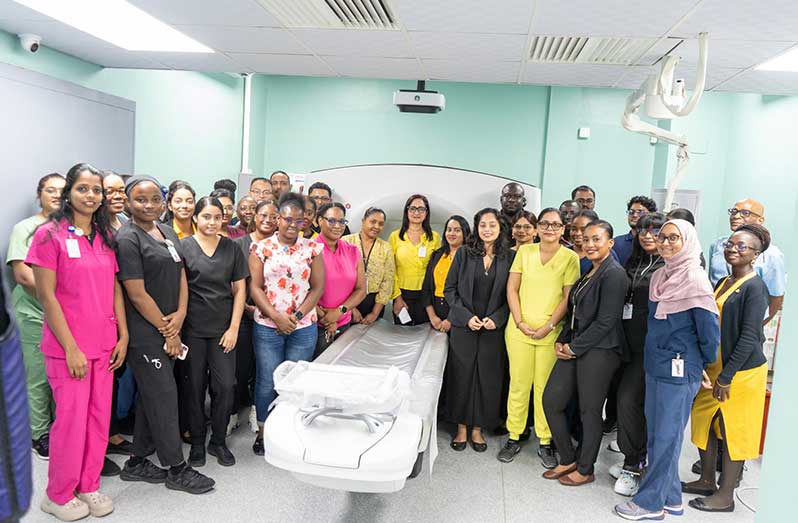
The Georgetown Public Hospital Corporation (GPHC) is advancing its diagnostic capacity through the expansion of medical imaging services, including the construction of a dedicated Medical Imaging Centre and the planned introduction of an Electronic Health Record (EHR) system aimed at improving access, efficiency and coordination of patient care.
As Guyana’s national referral hospital, GPHC provides medical imaging services to patients from all 10 administrative regions, supporting emergency care, routine examinations, complex surgical procedures and specialised treatment.
The hospital’s Medical Imaging Department offers a range of diagnostic services, including X-ray imaging, ultrasound, computed tomography (CT) scans, magnetic resonance imaging (MRI), mammography, fluoroscopy and interventional radiology.
These services provide healthcare professionals with detailed information to support the diagnosis, monitoring and treatment of a wide range of medical conditions.
X-ray imaging is used to examine bones, the chest and other areas of the body, while ultrasound provides a non-invasive means of assessing internal organs, monitoring pregnancies, examining tissues and guiding certain medical procedures.
CT scans produce detailed images that assist in diagnosing conditions such as strokes, traumatic injuries, tumours and internal bleeding. MRI technology provides detailed images of soft tissues, including the brain, spine and joints.
Mammography supports the early detection and assessment of breast abnormalities, while fluoroscopy provides real-time imaging during diagnostic examinations and medical procedures. Interventional radiology uses imaging guidance to support minimally invasive procedures for both diagnosis and treatment.
The development of medical imaging services at GPHC dates back to the early 1960s, when Norma Odle returned to Guyana from England after completing her studies in 1961.
At the time, the hospital’s diagnostic imaging services were largely limited to X-ray examinations. Recognising the need for trained personnel to support the expansion of the field, Odle established a training programme to prepare future medical imaging professionals.
Her work helped lay the foundation for the growth of the department and contributed to the development of a skilled local workforce capable of supporting improved diagnostic services.
Today, the department is supported by a multidisciplinary team comprising radiologists, radiographers, ultrasound technologists, nurses and other support personnel.
The team works closely with clinical departments throughout the hospital, including the Accident and Emergency Department, Intensive Care Unit, operating theatres, oncology, neurology and obstetrics services.
According to GPHC, medical imaging plays a central role in supporting timely diagnosis and informed clinical decision-making, with imaging results helping healthcare providers determine appropriate treatment and improve patient outcomes.
The hospital is now moving to further strengthen its diagnostic infrastructure through the construction of a dedicated Medical Imaging Centre.
The facility is expected to provide a modern space for advanced imaging services, including CT scanning and MRI technology, and is intended to improve patient access, operational efficiency and the overall healthcare experience.
GPHC is also preparing to implement an Electronic Health Record system, which is expected to improve access to patient information, reduce delays and strengthen communication among healthcare providers and departments.
The hospital said the combined investments in modern infrastructure, advanced technology and digital health systems are expected to support more coordinated, efficient and patient-centred care as Guyana’s healthcare sector continues to expand.




