






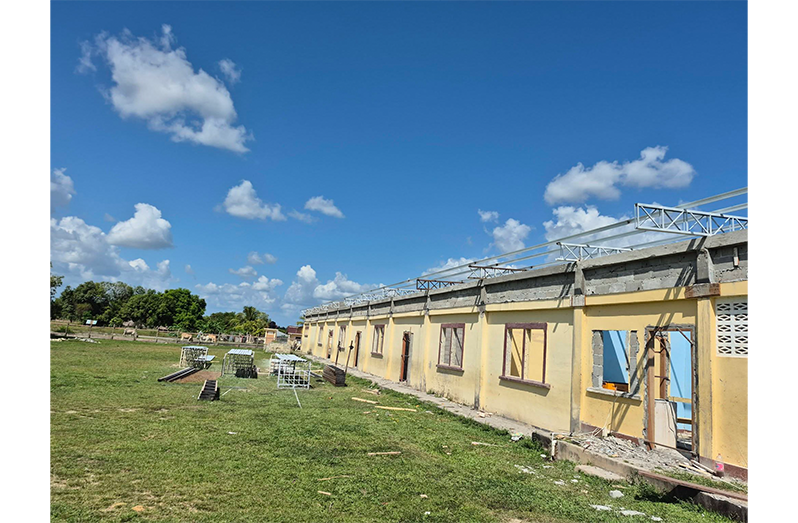
PUPILS in Karaudarnau Village, Region Nine, are set to return to an improved learning environment when the new school term begins in September, following ongoing upgrades to the community’s primary school.
According to the Village Council, the project is aimed at creating a safer, more comfortable and conducive environment for teaching and learning.
The works include enclosing the classrooms and installing a new steel roof. The roof has been raised to improve ventilation, helping to reduce heat inside the classrooms and provide greater comfort for both pupils and teachers.
The project is being facilitated by Regional Executive Officer (REO) Karl Singh, who supported the village’s request for the upgrades. Residents said the improvements are timely, with schools scheduled to reopen next month.
The school project forms part of a broader programme of community development in Karaudarnau.
Recently, 48 streetlights were installed throughout the village by Councillor Peter Isaacs and his team, improving safety and visibility for residents.
Villagers have also been working together to prepare for the community’s Annual August Games by erecting light poles through voluntary labour.
This year’s August Games will be held from August 16 to 22, with the opening ceremony scheduled for 14:00hrs (2:00 p.m.) on August 16. The week-long event will feature sporting competitions, cultural activities and family entertainment, with male and female teams competing across several disciplines.
Karaudarnau has benefitted from several major development projects in recent years, including the rehabilitation of internal roads, the installation of a solar photovoltaic (PV) mini-grid and upgrades to the village’s water-distribution system.
The community has also pursued initiatives to expand local agriculture, including peanut butter and farine processing, while researchers recently documented a wild-rabbit species in the area, extending its known range into Guyana.
Karaudarnau, an Indigenous Wapichan village in the Upper Takutu-Upper Essequibo (Region Nine), has a population of more than 1,000 residents. The village is supported by a nursery and primary school, health post, ICT hub, guest house and other community facilities, while residents continue to preserve their Wapichan language and culture.




