







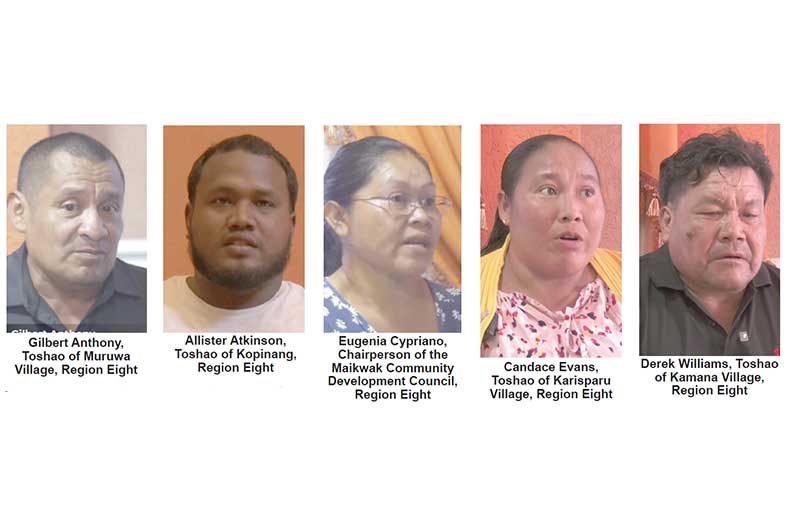
VILLAGE leaders from several Indigenous communities in Region Eight have credited government investments and projects funded through the Low-Carbon Development Strategy (LCDS) with significantly improving infrastructure, livelihoods and economic opportunities in their villages.
Speaking ahead of the National Toshaos Conference, the leaders outlined a range of completed and ongoing initiatives, while identifying additional priorities they hope will receive government support.
Toshao of Muruwa Village, Gilbert Anthony, said the once-underdeveloped community has seen notable improvements in recent years.
According to Anthony, Muruwa now has two schools, a health post, teachers’ quarters, a village office, a sewing centre and a garage, facilities that were previously unavailable.
He also highlighted the provision of an outboard engine through a government-supported fishing project, which has enabled residents to catch and sell fish, creating an income-generating opportunity for the community.
Meanwhile, Toshao of Kopinang, Allister Atkinson, said his village has benefited from several major projects, including a village kitchen, ICT hub, guesthouse and sewing centre.
He noted that the village kitchen, which is currently under construction, will serve both residents and visitors, while the guesthouse is expected to support the community’s growing tourism sector.
Tourism, he explained, is one of Kopinang’s key development priorities, with plans to officially launch tourism activities in the village next year.
Through LCDS funding, the village has also constructed a craft centre to showcase traditional Indigenous crafts and locally-made souvenirs for visitors.
Chairperson of the Maikwak Community Development Council, Eugenia Cypriano, said her community has experienced substantial development through government support and LCDS financing.
Among the projects completed are a new school kitchen, an expanded playfield, an ICT hub, a guesthouse, a fuel depot, and two pavilions.
Cypriano, who is also pursuing studies at the Cyril Potter College of Education, said the ICT hub has become an important resource for students and residents by improving access to training and educational opportunities.
She added that while progress has been significant, improving roads and expanding the community’s water supply remain priorities. She is also seeking assistance to provide water storage tanks for households that are still without access to standpipes.
Cypriano noted that the new fuel depot will eliminate the need for residents and travellers to journey to neighbouring villages to purchase fuel, making transportation more convenient while creating new economic opportunities.
Toshao of Karisparu, Candace Evans, also praised the pace of development in her community, citing government-funded projects including a fuel depot, a completed shop, a sewing centre, a nearly completed benab, improvements to the village airstrip and the completion of the Cypress Bridge.
Looking ahead, Evans said she is hopeful for continued collaboration with the government to further advance development in the village.
Meanwhile, Toshao of Kamana, Derek Williams, said LCDS carbon credit funds have been invested in projects that directly benefit residents.
He explained that the village purchased all-terrain vehicles (ATVs) to improve transportation across the Pakaraima Mountains, making travel easier for villagers.
The community also established a mini-market using carbon credit funds. Williams said the business serves not only Kamana residents but also customers from neighbouring villages, creating both economic activity and improved access to essential goods.
The testimonies from the Region Eight leaders come as the Government continues to significantly expand investments in Amerindian and hinterland communities.
Through the 2026 National Budget, G$7.5 billion has been allocated to support the development of Indigenous communities, complemented by substantial funding under the Amerindian Development Fund.
These investments are aimed at improving infrastructure, healthcare, land titling, education and economic opportunities, while supporting more than 800 community-led projects financed through Guyana’s carbon credit agreements under the LCDS.
Most recently, 11 Amerindian villages received capital grants from the Ministry of Amerindian Affairs to implement projects designed to improve livelihoods, strengthen community infrastructure and promote sustainable development.
The beneficiary villages are Quarrie, Wowetta, Aishalton, Yurong Paru, Katoonarib, Tiger Pond, Sand Creek, Surama, Yakarinta, Kanashen, and Annai.
Government investments have also resulted in the installation of more than 37,000 solar home systems across remote and off-grid communities, including a G$300 million 24-hour solar grid in Batavia Village.
Additionally, more than G$14.5 billion has been transferred directly to Amerindian villages to finance community-led initiatives such as eco-tourism, agro-processing and other sustainable economic ventures.
Indigenous entrepreneurs are also able to access zero-interest loans of up to G$3 million to expand their businesses.
To further strengthen village capacity, communities continue to receive assets including all-terrain vehicles (ATVs), transportation vehicles and other equipment to support economic and administrative activities.
On the issue of land rights, the administration has demarcated 15 villages and issued 17 certificates of title since taking office, securing land ownership for more than 16,000 Amerindians. A further G$400 million has been allocated this year to continue the Amerindian Land Titling Programme.
Healthcare access is also being expanded through the rollout of telemedicine services, alongside the construction of new regional hospitals in Regions One, Seven, Eight and Nine, bringing specialised healthcare closer to hinterland residents.
The National Toshaos Council (NTC) Conference will be held from July 20 – 24, 2026 at the Arthur Chung Conference Centre under the theme: Empowering Leadership while Building Sustainable Village Economies through Inclusive Partnership”.
This important gathering will bring together Toshaos and Indigenous leaders from communities across Guyana to engage in meaningful discussions on issues affecting Indigenous peoples and communities.
The conference will also provide an opportunity for direct dialogue with government ministers, agencies and President Irfaan Ali on matters that are critical to Indigenous development, governance, and wellbeing.



