
FOR many young people of the millennial generation, agriculture is seldom viewed as an attractive career path.
Instead, professional success is often associated with urban employment, corporate careers or migration in search of better opportunities.
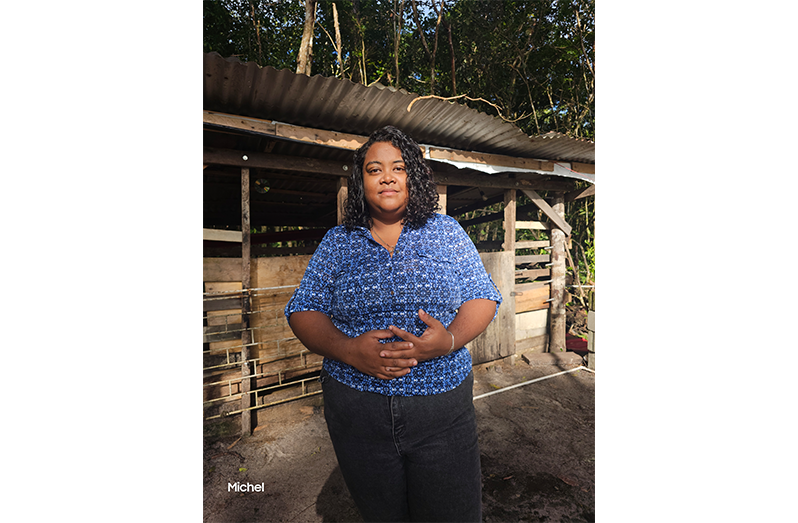
Yet, for Nikita Williams, 26, life unfolded in a remarkably different direction. What began as an unexpected move from Guyana’s coast to a remote village evolved into a powerful story of resilience, personal transformation and agricultural entrepreneurship.
Today, Williams represents a growing generation of young women demonstrating that farming can provide not only economic opportunity but also dignity, empowerment and a meaningful contribution to Guyana’s food security agenda.

Born and raised in the coastal village of Strathspey, East Coast Demerara, Williams had little indication in childhood that agriculture would one day define her future.
Although she studied Agricultural Science for three years at Annandale Secondary School, farming remained a classroom subject rather than a career aspiration.
Like many young people facing personal and social challenges during adolescence, she had her educational journey interrupted before she completed secondary school.
Marriage to her husband, Paul Williams, ushered in a new phase of life, but neither anticipated that their future would ultimately be shaped by livestock farming deep within Guyana’s hinterland.
That defining moment arrived in 2022, when the couple relocated to Tigerbone Banakari, along the Linden-Soesdyke Highway, her husband’s ancestral home.
The transition from the bustling coastal environment to the tranquillity of an Indigenous hinterland community required significant adjustment.
Yet, what initially appeared to be a dramatic lifestyle change soon revealed itself as an opportunity for personal reinvention.
Surrounded by nature and a close-knit community, Williams gradually began to view her new environment not as a limitation but as a place where new possibilities could emerge.
As she settled into village life, Williams quickly recognised that Tigerbone Banakari was itself undergoing an important period of transformation.
She recalls arriving at a time when development was still in its infancy, with limited infrastructure and few economic opportunities.
However, she believes that sustained government investment has fundamentally changed the community’s trajectory.
“There wasn’t as much development in 2022 as we see today,” she reflected. “But because of the PPP/C Government’s intervention through the Presidential Grants Programme and the Low Carbon Development Strategy (LCDS), our community is growing by leaps and bounds, and we are willing to grow even more.”
This transformation created an environment where residents, particularly women and young people, could begin to explore new livelihood opportunities.
Motivated to become more actively involved in her community, Williams joined the Banakari Tigerbone Women in Action Group, a vibrant organisation committed to empowering women through skills development, entrepreneurship and agriculture.
The group promotes food security while encouraging women to establish sustainable income-generating activities within their households.
For Williams, participation in the organisation proved to be the catalyst that would permanently alter the course of her life.
Looking back, she admits that she never imagined agriculture would become such an important part of her identity.
“As a young woman, the opportunity to empower myself through agriculture was something I never envisaged,” she explained.
Interestingly, her agricultural journey began with an investment so small that few would have recognised its long-term potential.
One day, her husband returned home carrying a Muscovy duck hen he had purchased from his workplace.
Soon afterwards, the couple acquired a drake, completing what seemed to be an insignificant beginning.
However, through careful management and patience, that modest investment gradually evolved into a thriving breeding enterprise.
Today, the Williams family maintains a flock of more than 60 healthy Muscovy ducks, which now serve as the parent stock for an expanding commercial duck-meat production enterprise.
Reflecting on those humble beginnings, Williams remarked, “The investment was very small then, but today, it has grown into something much bigger. It taught me that if you care for your animals properly and stay committed, small beginnings can become successful businesses.”
The success of duck production sparked a genuine passion for agriculture and encouraged Williams to consider expanding into other livestock production areas.
Consequently, when the opportunity arose through the Banakari Tigerbone Women in Action Group to participate in a government-supported swine development initiative, she readily embraced the challenge, despite having absolutely no previous experience in pig farming.
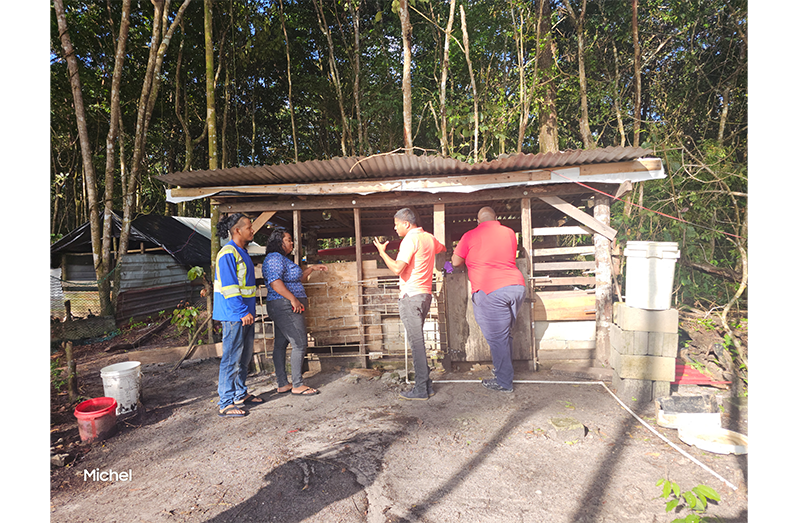
Supported by the Guyana Livestock Development Authority (GLDA), she received introductory technical training, along with two improved breeding sows, feed, and nipple drinkers, in February this year, as well as ongoing extension support to establish her farm.
Although excited by the opportunity, Williams openly admits that the early stages of swine production were intimidating.
Entering an entirely unfamiliar field required both confidence and guidance. Fortunately, she credits the unwavering support provided by GLDA’s technical officers with helping her navigate the learning process.
She expressed particular appreciation for Mr Cameron, Head of GLDA’s Swine Production Unit; Dr Nauth, Regional Veterinarian; and Mr Bhawandin, Livestock Officer, all of whom provided practical advice and reassurance throughout the establishment of her enterprise.
“Even today, I can call any one of them at any time, and they are always willing to provide support. That gives you confidence as a new farmer because you know you’re never alone,” she said.
The results of that support have become increasingly evident. After only seven months, her breeding animals entered the gestational stage, bringing the exciting prospect of her first litter of piglets.
For Williams, this milestone represents far more than an increase in livestock numbers; it signifies the successful transition from a novice farmer to a confident agricultural entrepreneur.
Looking ahead, she intends to expand her operation by producing both breeding animals and market-ready fatteners to supply Guyana’s growing pork industry, thereby creating an additional and sustainable source of household income.
While the economic benefits are important, Williams believes agriculture has transformed her life in far deeper ways.
Beyond providing an opportunity to earn an income from home while maintaining her responsibilities as a wife, farming has strengthened her confidence, independence and sense of purpose. “I am proud to be both a housewife and an agricultural entrepreneur,” she said.
In addition to managing her livestock enterprise, she also maintains part-time employment and serves as Secretary of the Community Development Council (CDC), actively contributing to local governance and community development.
Her experience demonstrates how agriculture can become a powerful platform for women’s economic empowerment and leadership.
Equally inspiring is Williams’ determination to complete the education she once believed she had lost forever. Recognising that education remains fundamental to personal and professional growth, she enrolled in the Government of Guyana’s Guyana Online Academy of Learning (GOAL) scholarship programme, through which she is currently pursuing her secondary school certification.
As someone who once considered herself a school dropout, she now views education as another opportunity created through national development policies. “As a school dropout, I never thought I would get another chance,” she reflected.
“Today, I have that opportunity, and I intend to make the most of it.”
Her long-term ambition is to continue advancing academically while simultaneously expanding her agricultural business.
Her confidence to pursue both education and farming continues to be reinforced by the ongoing support she receives from GLDA’s extension services.
Beyond the initial training and livestock distribution, GLDA officers regularly provide veterinary care, husbandry advice, disease-prevention guidance and technical assistance whenever challenges arise.
Williams speaks warmly of this relationship, emphasising that the accessibility of extension officers has been critical to her success. “Whenever I reach out for assistance, the GLDA extension staff respond.
“They always come to provide the services needed to improve my animals, and I truly appreciate that level of commitment,” she explained.
Such extension support remains an indispensable component of Guyana’s broader livestock-development strategy, particularly for first-generation farmers entering the sector.
Williams’ own transformation mirrors the remarkable evolution taking place throughout Tigerbone Banakari Village.
She vividly remembers arriving in a community where dense vegetation vastly outnumbered houses and infrastructure was extremely limited.
Today, however, the village has experienced significant improvements through investments in roads, community facilities and public services.
Residents now benefit from all-weather roads, expanding access to electricity, a modern Resource Centre, an Information and Communications Technology (ICT) Hub, community recreational facilities, village-owned tractors and trailers, vehicles and other amenities designed to improve both livelihoods and quality of life.
For Williams, these developments represent far more than physical infrastructure; they symbolise opportunity, optimism and the confidence that young people can build meaningful futures within their own communities.
Visitors to the Williams household are immediately struck by the diversity of animals that populate the property.
In addition to her growing swine enterprise and Muscovy duck flock, the farm is home to chickens, parrots, dogs, cats, monkeys and several other domestic animals, creating a unique environment where agriculture coexists harmoniously with Guyana’s rich natural biodiversity.
The farm reflects not only her passion for animals but also her broader vision of developing a diversified and sustainable agricultural enterprise capable of supporting her family for years to come.t
Ultimately, Nikita Williams’ story is about much more than livestock production. It is a compelling testament to the transformative power of resilience, community support, education and strategic public investment.
From a young woman whose education ended prematurely to an emerging agricultural entrepreneur, community leader and GOAL scholarship recipient, her journey demonstrates that success is not determined by where one begins but by the willingness to embrace opportunity when it arises.
As Guyana continues to modernise its agricultural sector and promote inclusive rural development, Williams stands as a powerful example of how government support, effective extension services and personal determination can converge to change lives.
Her experience reminds us that agriculture is no longer merely a necessity; it is increasingly a pathway to entrepreneurship, empowerment and national development.