






- agency says 90 per cent of cocaine seizures traced to Venezuela as anti-drug education campaign expands nationwide
INVESTIGATORS have traced a death threat made against Customs Anti-Narcotic Unit (CANU) Head James Singh to a suspected criminal group operating out of Venezuela, as authorities continue efforts to identify those behind the intimidation attempt targeting Guyana’s anti-narcotics operations.
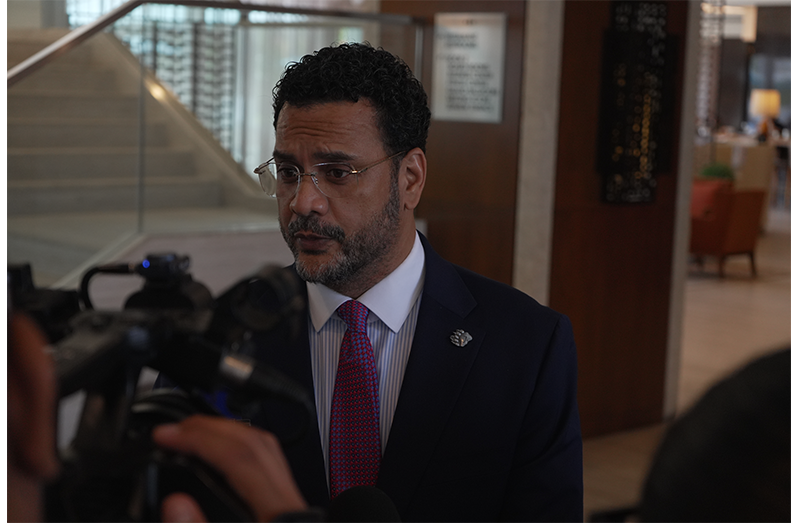
Singh disclosed the development while speaking with members of the media on the sidelines of the Ninth Annual General Meeting of the Asset Recovery Inter-Agency Network of the Caribbean (ARIN-CARIB), where regional efforts to combat organised crime and recover illicit assets were highlighted.
The threat, which emerged months ago in a viral video featuring a masked gunman threatening Singh’s life, remains under active investigation. Singh said while progress has been made in tracing the source of the video, challenges remain due to limited cooperation and communication with Venezuelan authorities.
“I am still here, so that is a good sign,” Singh said, noting that investigators are continuing to work with regional and international counterparts to advance the probe.
“Based on the information that we got, it’s a Spanish group, we suspect, out of Venezuela,” he said.
However, Singh explained that the absence of the level of information-sharing arrangements Guyana maintains with other countries has slowed efforts to determine the identities of those responsible and bring them before the courts.
“Unfortunately, we do not have the sort of communication we would with Venezuela as we have with other countries. But we are sharing some information with our counterparts here and in the region, and we are doing our best to at least get to the bottom of it,” he said.
COCAINE TRAFFICKING ROUTE
Meanwhile, the CANU head revealed that a significant percentage of cocaine seized by the agency has been linked to Venezuela as the final transit point before entering Guyana.
Singh said while the original source of the narcotics may not always be known, investigations have repeatedly identified Venezuela as the last point of movement before the drugs reach Guyana.
“I do not want to keep labelling Venezuela, but at the end of the day, most of the narcotics we found are persons from Venezuela. The evidence shows it would have come through Venezuela,” he said.
“Where it originated from, we have no idea. But the last place before it entered Guyana was from Venezuela, and several persons arrested were Venezuelan nationals.”
According to Singh, approximately 90 per cent of cocaine seized by CANU has been linked to Venezuela.
“I would say 90 per cent of the drugs that we have seized, cocaine, has been originated from Venezuela,” he stated.
STRENGTHENING BORDER SECURITY
Singh said CANU continues to work closely with the Guyana Police Force (GPF), Guyana Defence Force (GDF), and other intelligence agencies to strengthen border surveillance, intelligence gathering and interdiction efforts.
However, he acknowledged that limited information-sharing from Venezuelan counterparts has created difficulties in tracking individuals and networks involved in transnational drug trafficking.
“There are persons in Venezuela who we would have reached out to for information. Unfortunately, that information has not been forthcoming,” Singh said.
“In the meantime, we are working with the local counterparts, police, Guyana Defence Force and other agencies to strengthen our current systems.”
Despite these challenges, Singh said recent seizures demonstrate that law enforcement agencies are successfully detecting and intercepting illegal shipments before they reach communities.
He pointed to the recent discovery of marijuana at a local wharf as evidence that security measures at ports of entry are proving effective.
“The fact that we were able to detect it is an indication that law enforcement is doing what they are supposed to do at the necessary ports of entry,” Singh said.
PREVENTION CAMPAIGN TARGETING YOUTHS
Alongside enforcement operations, CANU is expanding its drug prevention and awareness programmes, particularly among young people.
Singh said the agency has partnered with the Ministry of Education, Ministry of Health, schools, private sector organisations and other stakeholders to develop a national sensitisation programme aimed at highlighting the dangers of drug and substance abuse.
The initiative focuses on early intervention and education, rather than waiting until communities are impacted by drug-related problems.
“We have stakeholders from the private sector, also Ministry of Education, Ministry of Health, several schools, and others. So, it is more awareness, and we’re working to develop a programme to sensitise the youth about the dangers of drugs and other harmful substances, alcohol,” Singh said.
The outreach programme has already been conducted in several regions, including Region Nine, other hinterland communities, Berbice and Georgetown.
Singh said some schools have also approached CANU directly for assistance in educating students about the risks associated with substance abuse.
“There are some instances where schools have reached out specifically to us because they are concerned, and we are working with them to sensitise them on that,” he said.
As Guyana continues to strengthen its response to organised crime and narcotics trafficking, CANU is maintaining a dual approach of aggressive enforcement and public education to reduce both the supply of illegal drugs and demand among vulnerable groups.




