






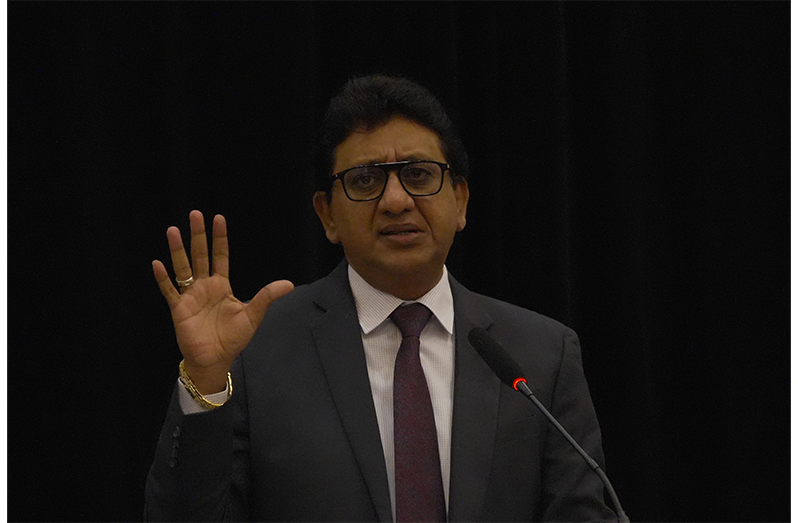
– new institution expected to remove admission limits and expand opportunities for Caribbean students.
GUYANA’S long-awaited law school is moving closer to becoming a reality, with the design proposals for the institution now before the National Procurement and Tender Administration Board (NPTAB) for review, according to Attorney General and Minister of Legal Affairs Anil Nandlall, SC.
Speaking on the sidelines of the Ninth Annual General Meeting of the Asset Recovery Inter-Agency Network of the Caribbean (ARIN-CARIB), Nandlall said the government has advanced the project to the procurement stage, marking another step towards establishing a fourth law school in the Caribbean. As he noted, “The law school. We went down to tender for a design of the edifice that will accommodate the law school, that will constitute the law school. And the bids were received and they are at the National Procurement and Tender Administration Board (NPTAB) currently,” the Attorney General added, “I think they were opened last week, so we should get a result from NPTAB shortly.”
The Attorney General said the creation of the institution comes at a time when legal education across the Caribbean requires significant modernisation, given the changes that have taken place since the existing system was established more than five decades ago. Speaking on the need for modernisation, Nandlall noted, “The law school, legal education in the Caribbean, in the way that it is currently constructed, commenced in 1970,” Nandlall further explained, “Anything that was conceived and designed five decades ago would hardly be likely to serve effectively in today’s environment. So, by a passage of shared time, we need to overhaul and relook the provision of legal education in the Caribbean.”
Currently, students across the region seeking to complete their legal education are primarily served by just three law schools existing within the region, including the Norman Manley Law School and the Hugh Wooding Law School, with another institution, the Eugene Dupuch Law School, established in The Bahamas. However, Nandlall noted that growing interest in legal studies has placed increased pressure on existing facilities, creating the need for additional capacity. “We have had an increased interest in legal studies across the region. The two law schools that traditionally existed, Norman Manley and Hugh Wooding, have long buckled on the load of demands,” he further added, “A third one has opened in Bahamas. For whatever reason, I do not think that that third law school ever reached the potential that it was conceived to achieve.”
Guyana’s planned institution, he said, presents an opportunity to position the country as a regional provider of education, similar to the country’s growing leadership role in other sectors. Highlighting this aim, Nandlall added, “Guyana presents a great opportunity, and it aligns with our vision of providing educational services to the region. We are doing it in the medical field, we are doing it in oil and gas, we are doing it in the hospitality sector, and now we are doing it in the legal sector.” Moreover, the Attorney General said the government intends to pursue the project with urgency and will continue discussions with the Council of Legal Education as plans advance, noting “We are going to pursue it aggressively. We are hosting, actually, the Council of Legal Education meeting in September here in Guyana. So, we will have another discussion again,” he said.
Nandlall stressed that the institution will not be limited to Guyanese students but will serve as a regional law school, with the potential to significantly increase access to legal training. Highlighting the potential for the institution, he added, that the local institution will bolster the local law landscape by allowing more Guyanese to better access education. “It is going to be a regional law school, so it is not Guyanese. Of course, Guyanese will have access to it, and there will not be any limit to our numbers,” he further added, “Now, currently, there are limits to our numbers. We can’t admit more than 25 at UWI’s Hugh Wooding Law School. There will not be limitations here, but we will encourage the entire Caribbean to come here.”
Before receiving approval to move ahead with the project, Guyana conducted a feasibility study to determine the demand and sustainability of the institution. “We had to do a feasibility study to show that this is a viable institution. That it will not flop, that there is sufficiency of demand to service a fourth law school,” Nandlall further added, “We did all of that, and we did it to the satisfaction of the relevant authorities.” With the design phase now progressing, the proposed law school is expected to become another addition to Guyana’s growing portfolio of regional education services, while creating expanded opportunities for aspiring legal professionals in Guyana as well as throughout the Caribbean.




