–step up use of drones to modernise public health supply chain
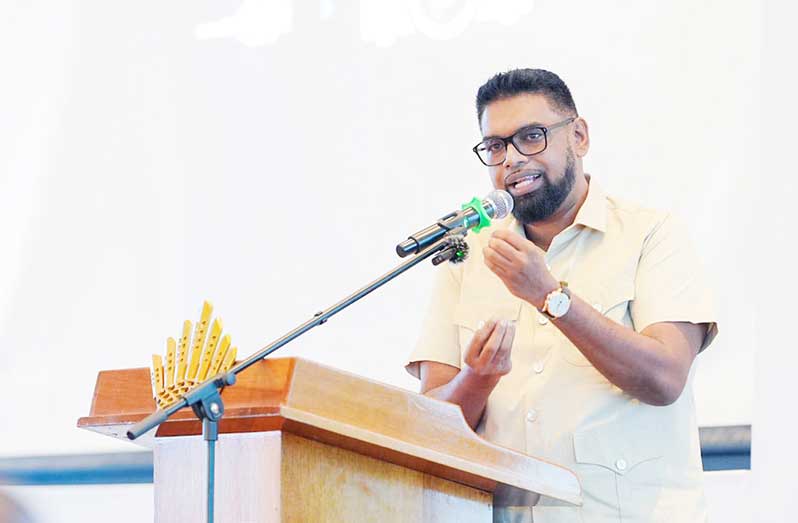
GUYANA to soon introduce an artificial intelligence (AI)-powered inventory platform, and continue and expand the use of drones to deliver emergency medicines to remote communities as part of a major push to modernise Guyana’s public health system, President Dr Irfaan Ali has said.
While addressing a gathering in Region Two, the President noted that while the government is making investments in the physical infrastructure to support modern, decentralised supply chain for medication, a new digital architecture will ensure every box and bottle of medicine in the public system is tracked and managed in real time.
“A modern health system also requires information and accountability. That is why this new infrastructure is being paired with a monumental effort to digitise our entire health system,” he said.
The Head of State disclosed that the government is partnering with global experts to introduce an AI-driven platform capable of forecasting demand, flagging problems and guiding procurement decisions based on actual consumption rather than guesswork.
“We are partnering with the global export to establish an AI-powered system that will provide us the real time data to guide our decision making. This digitisation will be transformative,” he added.
President Ali said the new system will allow health authorities to anticipate shortages, prevent expiry and respond rapidly to spikes in illnesses such as dengue.
“It will allow us to prevent waste, pretend challenges, and plan ahead of every situation. Take, for example, today, if the Minister of Health wants to know whether a community is having a challenge with dengue, he’s required to call and get information… now with this system based on consumption, he can tell you whether it is a spike in a particular problem, and we are able to plan ahead of that problem and address that problem,” he said.
President Ali added that predictive analytics will be used to identify seasonal or event-driven surges in demand and to adjust orders accordingly.
“Data-driven intelligence will allow us to generate precise location specific forecasts automatically, flag slow moving items before the approaches are expired, and adjust ordering quantities dynamically to match actual demand rather than historical averages,” he said.
The President further related that the predictive analytics could identify seasonal or event-driven spikes in usage, enabling the Ministry of Health to stock up strategically while avoiding surplus.
“In essence, digitisation doesn’t just improve forecasting, it transforms exploration management from a reactive cost centre into a proactive intelligent system that continuously learns, adapts, and drives measurable reduction in waste.”
Framing the initiative as a clean break from the era of chronic drug shortages and ad hoc management, the President said the combination of decentralised storage and digital monitoring is designed to end both stock‑outs and wastage.
He pointed out that the system will incorporate pre‑ and post‑audits, comfortability matrices and a dedicated patient‑feedback portal that feeds directly to the Minister of Health.
DRONES TO REACH “WHERE ROADS END”
The President also highlighted the integration of drone technology to move high‑value and time‑sensitive medical supplies from the new hub to distant communities that cannot safely store certain drugs and vaccines.
“Drones are delivering critical medical supplies to our most far‑flung and hard‑to‑reach communities, where roads end at river slope. These unmanned aircraft fly fast and direct, ensuring that life‑saving medicines, vaccines and emergency supplies reach those who need them most, not in days but in hours,” the Head of State said.
He added: “We are laying the groundwork today for a healthier and stronger Guyana.”
Guyana launched its telemedicine programme in 2022 to connect health posts and clinics in remote and hinterland communities with doctors and specialists at regional hospitals and the Georgetown Public Hospital Corporation (GPHC).
The service uses telecommunications technology to provide remote consultations and has since expanded to 81 sites across the country’s administrative regions, improving access to healthcare in previously isolated areas.
“This is the foundation upon which we are building a healthcare system that is not just functional but formidable,” he said, adding: “We are laying the groundwork today for a healthier and stronger Guyana, and one where no citizen is left waiting, no prescription is left unfilled, and no promise is left unfulfilled.”