By: H.E. Sasenarine Singh, Ambassador to the Kingdom of Belgium and Netherlands and Permanent Representative to the European Union
FOR the better part of a decade, the world has viewed Guyana and observed an extraordinary national transformation. Since oil began flowing in 2019, our country has consistently recorded the world’s fastest GDP growth rate. We see inspirational headlines about infrastructure expansion, new skylines, and a future as the “Dubai of the Caribbean”, which are welcomed.
Yet beneath the story of petro-dollars and development lies a quieter, equally important narrative. It is told through millions of small transactions in New York, Toronto, and Miami. I am referring to the steady stream of remittances sent home by the Guyanese Diaspora. According to recent data, remittance inflows have risen steadily from $264.6 million in 2016 to an estimated $444.4 million in 2025 (see graph below).
@Source – the Bank of Guyana
In a nation now blessed with significant oil wealth, why do families continue to rely on money sent from overseas? The answer reveals not a failure, but rather the nature of the growing pains of a rapidly modernising economy navigating global realities.
A Resilient Lifeline
Remittances are traditionally associated with struggling economies. Guyana, like Ethiopia, and Uzbekistan, however, defies that stereotype. These countries, like Guyana, are experiencing historic growth, yet remittances continue to climb alongside their GDP.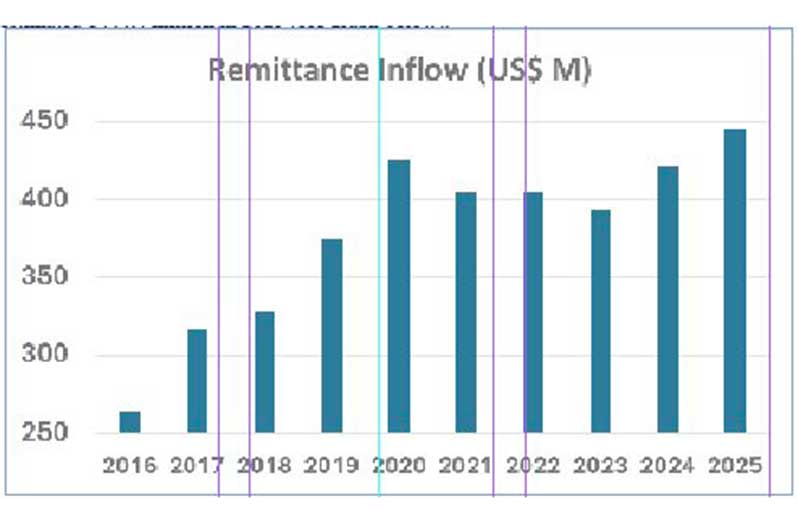
The primary factor is imported inflation; a challenge faced by nearly all open economies undergoing rapid development. Guyana does not yet produce the majority of what it consumes (imported fertilisers, etc.), and it trades freely with the global market (exposing our currency). As oil production accelerated, a significant influx of petro-dollars entered our financial system, which was supposed to strengthen our currency and boost national revenue. But for some strange reason, our currency is not strengthening, and this is an area that require a detailed analytical study by the University of Guyana.
While oil wealth is steadily building highways, hospitals, and housing, the pace of growth in daily household expenses has outpaced growth in local wages. The evidence illustrates that Guyanese households continue to be exposed to global price shocks beyond the immediate control of the regulators. But it begs the question, why are we not imposing more non-tariff barriers to ease the influx of some of these unnecessary imports which continue to destroy what is left of the local manufacturing sector?
In this context, the Diaspora has stepped in as a reliable support system. This reinforces this testament to the enduring bonds of the Guyanese family. Funerals, weddings, medical treatments, and home expansions are being honoured in part by the Diaspora because of this love for family.
In 2020, at the height of the pandemic, remittances spiked to $425.7 million. While much of the world froze, the Guyanese Diaspora sent cash home precisely when the local economy needed it most. That family-to-family support has never wavered since the pandemic.
From Survival to Investment
Emigration has long been a feature of our national story. Every flight leaving Cheddi Jagan International Airport carries a Guyanese citizen pursuing their dreams overseas, planting a seed for a future financial connection back home. This is not a crisis. It is an enduring national characteristic that has been with us for generations, one that can be leveraged for shared prosperity and future investments.
That is why the idea announced by President Dr Irfaan Ali on May 26, 2026, as Guyana celebrated its 60th Independence Anniversary, is so welcoming: a Diaspora Bond. There are additional funds available within the Diaspora that can be mobilised for national development, allowing Guyanese abroad to earn a decent return while being part of the process of building their homeland.
An encouraging shift lies within the data. While total remittances have risen, the percentage of household income they represent has declined significantly, from roughly 51% in 2010 to about 10% today. This is genuine progress on the local front. The facts is that Guyanese households are becoming less dependent on remittances for survival, even as the absolute flow increases.
Furthermore, the purpose of these dollars is evolving. Increasingly, diaspora funds are building assets: renovating homes into rental properties, and providing seed capital for small businesses. The Diaspora is quietly transitioning from a safety net into a partner in national investment.
A Final Reflection
So why is remittance inflow increasing? Because development is not instantaneous. Because the transition from a pre-oil to a post-oil economy involves complex adjustments. And because the love of family transcends borders.
While President Irfaan Ali has made remarkable strides in a very short time, the steady flow of foreign currency from our Diaspora serves as a bridge; a family refusing to let go of the homeland. The Government of Guyana has recognised this dynamic and responded thoughtfully. The reopening of the Diaspora Affairs Unit was a welcome and strategic step.
The $444.4 million that was poured into Guyana by the diaspora in 2025 is not just a statistic. It is a testament to the resilience of the Guyanese people, at home and abroad, and a reminder that our greatest natural resource is not oil; but our people.