—after traveller alleges humiliating airport screening
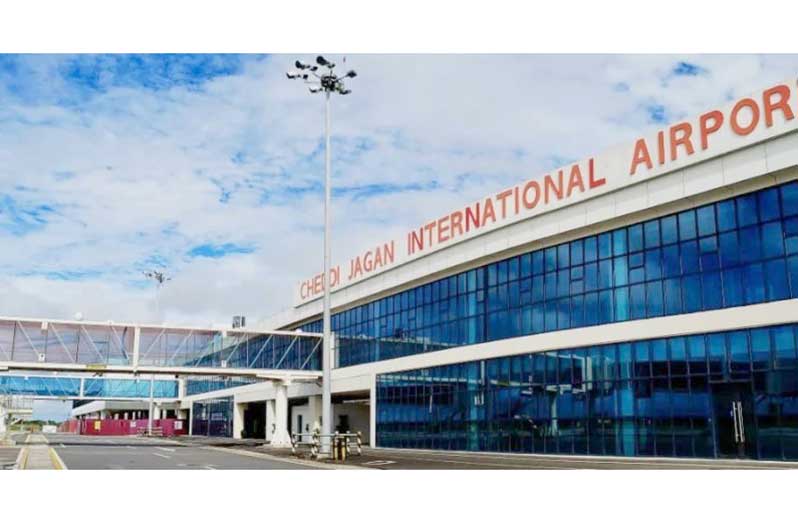
THE Cheddi Jagan International Airport Corporation (CJIAC) has reaffirmed its commitment to maintaining the highest standards of aviation security while ensuring all passengers are treated with dignity and professionalism, following allegations by businessman Zaid Khan that he was humiliated during a security screening process at the airport.
Khan, a below-knee amputee, took to Facebook to recount what he described as one of the most degrading experiences of his life while departing Guyana.
“Today, I left Guyana with a heavy heart,” Khan wrote in a post on June 17. He alleged that during a security screening he was instructed to remove his prosthetic leg and clothing despite his visible disability.
“Standing there, I felt stripped not only of my prosthetic but of my dignity,” he said.
While noting that he fully supports airport security measures, Khan argued that disabled travellers should not be subjected to procedures that leave them feeling embarrassed or degraded, particularly when alternative screening methods exist.
He called for a full review of the incident, preservation of all available security footage and records, identification of the personnel involved, a review of disability screening procedures and enhanced disability-awareness and sensitivity training.
Khan also said he would be pursuing legal action and advocacy efforts, urging international investors and business partners to reconsider travelling to Guyana.
“This is not just about me. It is about every veteran, every amputee, every disabled child, every disabled parent, and every traveller who should never have to fear humiliation because of a disability,” he wrote.
In response, CJIAC said that under the National Civil Aviation Security Programme, additional screening is mandatory whenever an alert is generated or an anomaly is detected at the initial screening checkpoint.
The corporation explained that standard operating procedures require passengers to be offered two options when additional screening becomes necessary.
Passengers may choose to undergo screening privately in a dedicated screening room or remain in the main screening area and complete secondary screening using specialised screening equipment.
“At no time is the removal of a prosthetic device mandatory,” CJIAC stated.
The airport also encouraged passengers to report any concerns directly to management, noting that all reported incidents would be investigated to determine whether established procedures were followed.
Chairman of the CJIA Board and attorney-at-law, Sanjeev Datadin, publicly responded to Khan’s allegations, expressing regret over the experience while noting that security protocols must still be observed.
“As Chairman of the CJIA Board I’m sorry to learn of your experience. I hope you are well and have reached your destination safely,” Datadin wrote.
“We try to make every passenger experience positive whether differently-abled or not. However, we have security protocols which we cannot depart from or avoid but we must be able to implement same in a way that causes less discord. We will try to do better.”
Datadin said the matter is being examined thoroughly and promised to engage Khan once all the facts are confirmed.
The incident has generated significant debate on social media, with many users expressing sympathy for Khan while also defending the need for robust airport security measures.
One commenter said no traveller should feel humiliated because of a disability, but questioned whether the issue stemmed more from the manner in which the screening was conducted rather than the screening itself.
“My question is, would you have felt differently if the search had been conducted professionally and privately in a separate room instead of in public?” the commenter wrote. “To me, the issue seems less about security doing their job and more about how the situation was handled. There has to be a balance between security and treating people with dignity and respect.”
Another user argued that security officers must remain vigilant given Guyana’s challenges with drug trafficking and the smuggling of gold and other contraband.
“I agree with what he’s saying to an extent, but with the way things are going with the exporting of drugs and raw gold in large quantities, even innocent-looking or disabled passengers have to be processed because they might be used to carry out these things undetected because of their conditions,” the commenter wrote.
A third commenter noted that prosthetic devices have been used internationally to conceal illegal items and suggested that airport officers were likely following security protocols.
“Unfortunately, drugs and other contraband can be hidden in a prosthetic leg. While I understand your feelings, Guyana, like so many Caribbean and Latin American countries, is forced to carry airport security in that manner,” the user wrote.
The commenter added that responsibility should be placed on those who exploit security vulnerabilities rather than on airport staff carrying out their duties.
CJIAC has indicated that any formal complaint regarding the incident will be fully investigated and appropriate action taken if established procedures were not followed.