- Says nation to remain global growth leader despite global slowdown, rising geopolitical uncertainty.
EVEN as the global economy faces mounting uncertainty from geopolitical tensions, rising energy prices and slowing growth, Guyana is expected to remain one of the world’s standout economic performers, with the World Bank projecting that the country’s economy will continue to record exceptional growth on the back of expanding oil production.
The assessment was made in the World Bank’s June 2026 Global Economic Prospects report, which painted a cautious picture of the global economy while singling out Guyana as a bright spot in the Latin America and Caribbean region.
According to the report, countries across the Caribbean are expected to face increasing pressure from higher fuel costs and inflation as a result of disruptions in global energy markets. However, Guyana’s rapidly expanding petroleum sector is expected to continue driving strong economic performance.
“In Guyana, growth is expected to remain exceptionally strong as oil production continues to expand,” the World Bank said.
The report comes at a time when Guyana’s oil industry continues to set records. From a standing start in December 2019, the country has increased production to more than 900,000 barrels per day in just over six years, making it one of the fastest offshore oil production ramp-ups in modern history.
Production from the prolific Stabroek Block now exceeds 900,000 barrels per day through the Liza Phase One, Liza Phase Two, Payara and Yellowtail developments, with several additional projects expected to come on stream over the next few years.

ExxonMobil Guyana, the operator of the Stabroek Block, holds a 45 per cent interest in the acreage. Its partners are Hess Corporation, now owned by Chevron, with 30 per cent and China’s CNOOC, which owns the remaining 25 per cent.
The continued expansion of production has transformed Guyana into one of the world’s fastest-growing economies and a major emerging oil producer, generating billions of US dollars in revenues and attracting significant foreign investment.
While the World Bank warned that the global economy is being buffeted by the effects of conflict in the Middle East, which has triggered sharp increases in energy prices and renewed inflationary pressures, Guyana’s status as an energy exporter places it in a stronger position than many countries that rely heavily on imported fuel.
The institution projected that global economic growth would slow from 2.9 per cent in 2025 to 2.5 per cent in 2026, marking the weakest pace of expansion since the COVID-19 pandemic. Emerging market and developing economies are also expected to see slower growth this year as higher energy costs, tighter financial conditions and weaker trade weigh on economic activity.
Across Latin America and the Caribbean, growth is projected at 2.2 per cent in 2026 before improving modestly in the following years. The World Bank noted that most Caribbean economies remain vulnerable to elevated fuel prices because they are net energy importers. Nevertheless, economic activity in the sub-region is expected to strengthen on the back of tourism recovery and resilient domestic demand.
Guyana, however, continues to chart a different course.
The report classified Guyana among the world’s energy-exporting emerging market and developing economies, underscoring the country’s growing role in global energy markets.
The latest forecast adds to a growing body of international assessments that continue to identify Guyana as one of the fastest-growing economies globally, driven by increasing crude oil production and sustained investments in infrastructure, energy, housing, healthcare and other transformative sectors.
Back in April, the World Bank’s Latin America and the Caribbean Economic Update – April 2026 had reported that Guyana remains the standout performer in the region, with projected growth of 16.3 per cent in 2026, continuing a multi-year trend of extraordinary expansion. This double-digit growth is forecasted to continue in 2027 to 23.5 per cent.
Guyana recorded more than G$159 billion in oil revenues during the first quarter of 2026, according to figures published in the Official Gazette, with receipts covering the period December 30, 2025, to March 31, 2026.
The Ministry of Finance reported that the bulk of the inflows came from profit oil earnings across ExxonMobil-operated developments, including the Liza Destiny, Liza Unity, Prosperity and One Guyana floating production, storage and offloading (FPSO) vessels.
Individual cargo payments ranged between G$12.3 billion and G$15.1 billion, reflecting sustained production levels offshore.
A significant portion of the earnings came from a G$23.1 billion royalty payment tied to fourth-quarter 2025 production, under Guyana’s fixed two per cent royalty mechanism within the production sharing agreement.
Under the country’s petroleum framework, profit oil represents the government’s share of crude after cost recovery, with revenues deposited into the Natural Resources Fund (NRF) and reported on a cash basis.
Earlier this year, World Bank Country Director for the Caribbean, Lilia Burunciuc, had emphasised that Guyana has moved from being one of the lowest-income economies in the hemisphere to one of the fastest‑growing in the world, while seeking to ensure that the benefits of growth are broad‑based and sustainable.
Burunciuc recalled first visiting Guyana almost five years ago, just as the country was preparing to receive its first oil revenues. She noted that at the time, Guyana’s income per capita was among the lowest in the region.
“Almost five years ago, Guyana was the first country I came to in the entire region, and it was the moment when Guyana discovered oil and was preparing to start receiving the revenues, but it was still a country which had one of the lowest income per capita in that hemisphere,” she said.
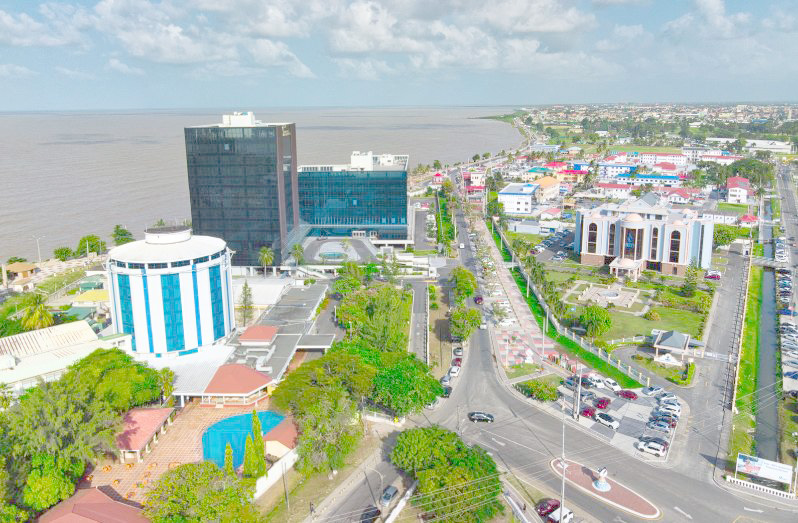
The World Bank official said the transformation since then has been striking, citing rapid growth, improved living standards, and a visible shift in the physical landscape.
Recent years have seen major investments in transport and hospitality infrastructure, including new bridges, upgraded roads and hotel developments, helping to support both domestic connectivity and international business.
“I could feel the change in the air. The change was coming. And five years later, when I see the country, the country has changed,” she said adding: “The country is very different from what it was five years ago. I can only imagine what this country will be in another five years or 10 years. The development is remarkable. I must commend the government for investing in what really matters when you have an economy that gets significant revenues.”